

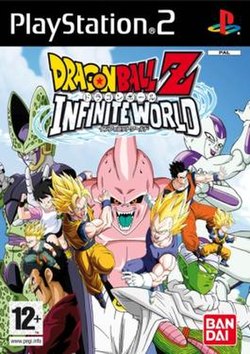

Dragon Ball Z: Infinite World arrives late in the PlayStation 2 life cycle looking like someone who showed up to a costume party in last year’s cosplay and decided to double down. Developed by Dimps and released in late 2008, Infinite World is essentially a love letter to the Budokai lineage with a scattershot of new ideas stuffed in its pockets like Zeni in a capsule. The game promises an "infinite" dig through the Dragon Ball universe via a story mode called Dragon Mission, a roster that bumps up to 42 playable characters, and enough transformations to make a hairdresser weep. Critics and players greeted it with a polite shrug: it sold respectably in Japan but otherwise left many asking why they were playing something that felt oddly familiar and occasionally frustrating. This review will examine whether Infinite World is nostalgia in a shiny case or nostalgia that forgot to charge the batteries.
If you’ve played Budokai, you have already peeked at Infinite World’s homework. The core mechanics are essentially Budokai rebadged: button combos, ki blasts, transformations and a health/ki bar dance that will be according to plan. Dimps did pick up a few things from Burst Limit, like a simplified combat flow, but it mostly reads as incremental stitching rather than a genuine overhaul. That will comfort people who wanted Budokai 3 with a minor facelift and infuriate anyone who hoped for a fresh fighting system. Dragon Mission is the game’s main pitch: a map-based story mode where you move an avatar around and trigger objective missions. These objectives range from the expected - standard fights and timed endurance bouts - to the mildly bewildering: on-foot searches, races, timed button-sequence tests, and even first-person shooter segments. The intention is admirable; Infinite World tries to be more than a sequence of arena fights. The reality is that the mini-games sometimes feel like they belong to a different console and were invited to the party by mistake. The shooting and racing bits are clumsy and tonally at odds with the rhythm of the combat. You can play them, and some will enjoy the variety, but many will find themselves skipping ahead to the next face-off. The roster is one of the game's loudest checkboxes. Forty-two characters, not counting transformations, means you get pretty much every face you vaguely remember from the anime - from base Goku to obscure forms and series crossovers like GT characters and Syn Shenron. Transformations are numerous: multiple Frieza forms, all the major Super Saiyan tiers, Perfect/Imperfect/Super Perfect Cell, Broly’s legendary modes and so on. The variety is fun on paper. In practice, balance is patchy and many characters feel like coat hangers for a move list rather than fully-realized fighters. Skill capsules return from Budokai as a customization system. Buying multiple copies of the same capsule amplifies effects, which is a little less fiddly than the Budokai implementation but still a grind if you want min-maxed builds. Fighter's Road unlocks later and gives you a gauntlet of battles on a handful of Dragon Mission maps. It’s fine, in the way that an endurance run where you don’t have to think too hard can be fine. Rewards are Zeni and rarely thrilling unlocks, which is exactly the sort of carrot that works if your idea of fun is completionism. Casual players will probably stare at Fighter’s Road and decide that completing it would require more patience than the story mode deserves. Where Infinite World genuinely earns some credit is in fan service. The battles recreate famous moments from the anime, and fans will appreciate triggers that let them reenact key fights. But those fans are also the most likely to notice the game's shortcomings: the combat can be frustratingly floaty, AI decisions are occasionally dumb, and some mechanics feel like they were simplified to the point of being undercooked. Critics called the gameplay frustrating in a way that suggested the game was built to look like classic DBZ rather than play like it.
Graphically, Infinite World is a PlayStation 2 game that knows it is a PlayStation 2 game and behaves accordingly. The cel-shaded character models and stage designs aim for the anime look and often hit the target: energy attacks pop, transformations feel dramatic, and key setpieces are recognizably DBZ. But the art doesn’t hide the fact that much of the engine appears to be reused. Textures are soft, some animations loop like they’re on a budget, and stages suffer from pop-in and simplistic geometry. This isn’t a problem if you were expecting PS2-era visuals; it becomes one when the gameplay is supposed to carry weight and the presentation doesn’t lift it higher. The UI is straightforward if a little bland, and character portraits and menus lean heavily on previous Budokai assets. It’s the visual equivalent of reheated leftovers: familiar, edible, and ultimately not worth calling your friends about. On the audio side, the soundtrack is a weird contrarian success. Composed primarily by Kenji Yamamoto (credited oddly on some Western packaging to Hironobu Kageyama), the music is one of the better parts of the package. Some reviewers praised the tunes while others misattributed or called them repetitive; they’re at least competent and occasionally excellent, which makes the rest of the game look worse by comparison.
Dragon Ball Z: Infinite World is best described as a patchwork tribute: stuffed with characters, transformations and enough fan service to make series completists nod approvingly, but hamstrung by muddled pacing, a combat system that rarely surprises, and mini-games that sometimes feel like obligations rather than fun. If you’re a die-hard DBZ fan with nostalgia for the Budokai formula and a collection goal in mind, you’ll find moments of joy and probably enough to justify a low-cost purchase or a rental. If you want a fighting game with tight mechanics, balanced roster depth and polish that respects your time, Infinite World will probably frustrate you until you remember the soundtrack and sigh. On aggregate the game aligns with its critical reception: mixed to mediocre scores, respectable first-week sales in Japan, but an overall commercial life that didn’t change anyone’s mind about late-era PS2 DBZ titles. Recommendation: borrow it for the roster checklist, listen to the soundtrack separately, and don’t expect it to be the definitive DBZ fighting experience. It wants to be a nostalgic buffet and ends up being a lot of small plates that don’t always go together.
 Harvest Moon: One World on Switch
 Tennis World Tour on Switch
 Nobody Saves the World on Xbox Series X/S
 Ultraman Fighting Evolution on PlayStation
 ACA Neo Geo: Art of Fighting 2 on Xbox One
 ACA Neo Geo: The King of Fighters '98 on Xbox One
 Touhou Hyoibana: Antinomy of Common Flowers on Switch
 Dragon Ball Xenoverse 2 on Xbox Series X/S
 Sonic Rush on DS
 The Rumble Fish 2 on PS5
 Dragon Ball Xenoverse 2 on Switch
 Freedom Wars Remastered on PS5












 Another SquareThought Site