

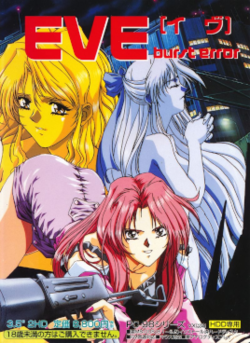

EVE: New Generation arrives carrying the baggage that made its predecessor famous: a taste for political skulduggery, a penchant for complicated plotting, and the kind of branching narrative that politely refuses to be linear. It is a sequel born into a franchise that started in 1995 with EVE Burst Error - a cult favourite that sold hundreds of thousands of copies in Japan, put visual novels on consoles, and taught writers that two protagonists arguing with each other can be a legitimate design choice rather than just a relationship status on social media. Kotaro Uchikoshi, credited on New Generation, is a name that hints at clever knotty scenarios; if you liked the original's game of narrative ping-pong between an intelligence agent and a private eye, New Generation is politely offering you the same ball, but with different handwriting.
If you are looking for twitch reflexes, quick-time events, or anything that benefits from a faster heartbeat, this is the wrong bus stop. EVE's DNA is visual novel and adventure: long scenes of dialogue, careful reading, and decisions that ripple across timelines and perspectives. The franchise's signature mechanic - two protagonists, offering interlocking viewpoints and the ability to switch between them - is the part that kept the first game interesting. Instead of finishing one character's route and putting the other on a shelf, the system lets you flip mid-investigation, letting information gleaned by one player directly affect the other's options. That cooperative-as-a-single-player trick becomes the game's central puzzle. New Generation inherits this architecture. Expect branching narrative paths, choices that matter, and the occasional moment where you must have both protagonists cooperate to move past a plot brick wall. The result is that the story rarely feels like a straight line; it's more a junction box with tasteful neon signs pointing toward betrayals, revelations, and cabinet-level conspiracies. The pacing rewards patience and attention. There are fewer instant payoffs and more delayed satisfaction: a clue picked up in chapter two may not bloom until chapter six, by which point you either feel brilliant or deeply guilty for having missed the obvious. The downside is one that plagues many adventure titles: when the writing clicks, the game hums. When it doesn't, you will find yourself reading ornate exposition while wondering why the protagonist never, at any point, Googled the obvious thing. New Generation's strength is scenario craft - Uchikoshi is known for twisty setups - but twists are only as good as the emotional stakes that precede them. Players who loved EVE Burst Error for its interplay between an agent protecting a diplomat's daughter and a struggling private eye will recognise the formula here. Players new to the series should know that patience and a taste for narrative complexity are prerequisites, not optional DLC.
Graphically, New Generation wears its era like a sensible cardigan. The PS2 aesthetic is present: character portraits that communicate more through clever expression work than high-definition texture, backgrounds that suggest locations rather than photorealistically render them, and cinematic cuts that rely on framing, not polygon count. Compared to modern remakes - the series later received an upgraded R edition with refreshed visuals - the PS2-era presentation can feel quaint, which is to say it carries the charm of a painting rather than the sheen of a billboard. The art direction does what it needs to do: it conveys mood, gives the characters faces you can care about, and makes the twist reveals readable rather than visually confusing. Music also plays its part; the series' early entries featured memorable chiptune-ish compositions from Ryu Umemoto and others, and while New Generation's score has matured, it still knows how to punctuate a late-night revelation without melodrama. If you are the sort who judges a game's worth by ray-traced light shafts bouncing off a hero's jacket, you will be disappointed. If you judge by whether a close-up of an eye can sell a lie, the PS2 graphics do their job with admirable thrift.
EVE: New Generation on PS2 is a dry martini of a game: precise, slightly bitter, and not aimed at people who want their entertainment with a neon straw. It extends the franchise's best ideas - dual perspectives, interlocking cases, and the slow, satisfying unspooling of conspiracies - and pairs them with the kind of screenplay work that makes you underline lines you want to remember. It is not flawless. The pace can be slow, some beats land with the grace of a falling filing cabinet, and the PS2 visuals age in a way that is charming for some and 'retrochestra' for others. Those with patience and a taste for narrative puzzles will find themselves rewarded. Those looking for action or immediate emotional payoffs should acquire different tastes, or at least a shorter attention span. The game sits comfortably in the series' lineage: not as revolutionary as the 1995 original was in its time, but solidly competent, narratively ambitious, and written by a developer who understands how to make two characters argue you into caring. Give it time, and it gives you a plot. That is not the worst bargain a game can offer.
 Ultra Street Fighter IV on PS3
 Vampire: The Masquerade – Shadows of New York on Switch
 Tintin: Destination Adventure on PlayStation
 One Piece Grand Adventure on PS2
 Taiko no Tatsujin: Don to Katsu no Jikū Daibōken on Switch
 Punch Line on PS4












 Another SquareThought Site