

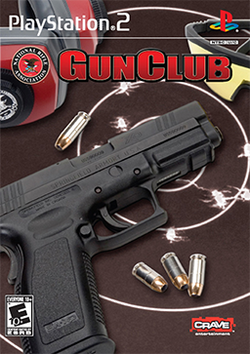

If you boot up NRA Gun Club expecting the sort of high-octane, narrative-laden shooter that makes your palms sweat, you're in for a very specific kind of disappointment. This is a target range simulator in the plainest sense: paper targets, watermelons, and sporting clays. It wears an NRA logo like a badge and boasts "over 100 licensed and recreated firearms," which sounds impressive until the game demonstrates that ornamentation ≠ meaningful gameplay. Released on PS2 in October 2006 by Jarhead Games and published in North America by Crave (with 505 only in Italy), Gun Club positions itself as a sporting marksmanship exercise - nonviolent, score-driven, and ostensibly about technique. The problem is that the challenge is often hamstrung by the game's own design choices. This review zeros in on the skill sets the game asks of you, the ways it actually tests them, and where the experience collapses under poor feedback and sterile presentation.
Skill-wise, NRA Gun Club points you at classic marksmanship fundamentals: steady aim, trigger control, lead calculation for moving targets, and repetition for muscle memory. The game's activities-paper bullseyes, exploding watermelons, and flying clays-each advertise different mechanical demands. Paper targets should reward tiny adjustments and precision; watermelons are about satisfying hits with visible, gratifying feedback; sporting clays demand you think in three dimensions, tracking movement and leading your shots to where targets will be, not where they are. In practice, the game occasionally obliges. There are moments when lining up the sight, squeezing the trigger, and watching a high-score number pop up feels like a proper little victory. If you're the sort of player who enjoys incremental improvement, measuring your grouping tighter over repeated strings, Gun Club can be framed as a practice tool. It asks for patience; it rewards the disciplined player who practices sight alignment, cadence, and timing. Multiplayer modes promise the competitive edge where reaction time and nerve under pressure matter - if you can drag friends into a PS2 party and keep a straight face about the aesthetics. Where the challenge falters is in the clarity and depth of the feedback loop. A target-shooting game lives or dies by two things: how it makes you feel when you hit or miss, and whether the tools at your disposal behave distinctly. Gun Club throws a wrench into both areas. Despite the headline "over 100 licensed firearms," the guns don't meaningfully change the way you play. In a genre that lives on subtle differences (recoil patterns, sights, rate of fire, effective range), the lack of differentiation turns what should be a long-term, skill-deepening progression into a cosmetic stamp-collecting exercise. You can swap a Glock for a custom rifle and still feel like you're pointing the exact same cursor at the screen. For someone chasing mastery, that's dispiriting. Another gameplay challenge arises from the audio-visual scaffolding the game gives you. Precise shooting requires pinpoint feedback: clear sound cues for a solid hit, subtle camera/shake to convey recoil, and crisp visuals that tell you why your bullet landed where it did. Gun Club offers generic audio that seems recycled across the hundred-odd guns; without distinct gun sounds or convincing recoil, it becomes harder to learn from mistakes. If the game can't tell you "that recoil came from your hold, not the weapon," or "you pulled the trigger early," then the only path to improvement is drudgery - run the same course until RNG and luck give you better groups. The learning curve is therefore uneven. Beginners might appreciate the simplicity: there are no enemies, no complex maps, and no moral ambiguity to worry about beyond choosing watermelon or paper. But intermediate players hoping to level their technique encounter a flattening effect. The supposed complexity of real-world firearms is reduced to a checklist item, not a functional mechanic. Competitive skill expressions like advanced lead calculation, recoil compensation, or adapting to weapon quirks are present in theory but muffled by the game's refusal to spotlight them. The net result is a title that asks for shooter skills but doesn't always reward their refinement in satisfying, game-y ways.
Visually, NRA Gun Club looks like a budget PS2 outing trying to pass for respectable. The backgrounds and target environments are serviceable enough to tell you where you are, but they lack the polish and clarity you'd want when the entire point is visual precision. Critics at the time hammered the graphics, and rightly so: textures are bland, target presentation is often generic, and animations won't win any awards for conveying realism. When a game's raison d'être is hitting little circles on a board, the artistry of those circles matters. Low fidelity here makes it tougher to parse shot placement, judge subtle angles, and feel rewarded for marginally improved aim. Audio compounds the visual shortcomings. Sounds are described as generic and reused across the arsenal, which is a catastrophic miss for a firearm-focused title. When different guns all register with the same acoustic personality, you lose an entire channel of learning. Part of adapting to any weapon is listening to it: cadence, bark, and the tiny mechanical idiosyncrasies. Gun Club strips that away and leaves you depending almost entirely on on-screen numbers to gauge success. For a game that markets an impressive roster of licensed firearms, treating them as indistinguishable props undercuts the credibility of the entire experience. There are occasional bright spots; the splat of an obliterated watermelon is oddly satisfying for about twenty seconds, and some clay trajectories feel properly modeled so that timing and lead still matter. But those moments are too rare and too thinly articulated to carry the visual and audio weight the game needs. If you're trying to develop transferable skills that might make sense even in other shooters - breath control, trigger discipline, leading targets - the lack of crisp sensory feedback makes training feel blunt and inefficient.
NRA Gun Club is an odd, earnest little contraption: it wants to be a respectful, nonviolent celebration of marksmanship and responsible firearm use, but its execution sabotages its own thesis. The challenge it offers is real in that it requires steady hands, timing, and a modicum of conscientious practice. The disappointment is that the game rarely gives you the tools or feedback to turn those attempts into meaningful improvement. Over 100 licensed firearms is an eyebrow-raising marketing line, but when they behave like indistinguishable skins, the progression becomes meaningless. For an 18-year-old looking to sharpen raw aim in a chill, non-hostile environment, the concept is appealing on paper. In practice, you'll find more satisfaction from a decent aim trainer on PC or even playing more polished shooters that actually model weapon handling. Critics at the time (GameSpot's 1.6/10 and IGN's 1.5/10) weren't exaggerating: poor graphics, generic audio, and shallow weapon differentiation make Gun Club one of the more forgettable PS2 entries. There's a niche here for someone who wants an NRA-branded, E10+-rated practice range on a console with a friend, but most players seeking a real challenge or skill progression will leave the range disappointed and pocket a few splatter screenshots of destroyed fruit as consolation. If you want to practice marksmanship mechanics, look for titles that give clear feedback, distinct weapon behaviors, and a learning curve that rewards technique rather than tedium. If you insist on trying NRA Gun Club for historical curiosity or morbid interest in a licensed oddity, go in with low expectations and a sense of humor; the game's ambition is small, and its execution is smaller. The basic skills it appeals to - patience, precision, timing, and consistency - are worth mastering. This game, sadly, is not the best teacher.
 Time Crisis on PlayStation
 Top Gun: Hard Lock on PS3
 PixelJunk Shooter 2 on PS3
 Primal Carnage: Extinction on PS4
 Tower of Guns on PS3
 Commandos: Strike Force on PS2












 Another SquareThought Site