

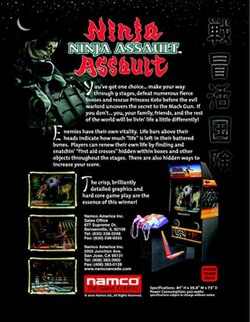

Ninja Assault started life as a Sega NAOMI arcade cabinet tricked out with feudal-Japan-meets-demonic-horde art and a trigger-happy audience. By the time it arrived on PlayStation 2 in late 2002 it had to survive two long questions: could an on-rails arcade blast-'em-up keep its mojo when moved into living rooms, and could a PS2 disc faithfully reproduce an experience designed for coin-op hardware? The short answer is: mostly. The long answer is a little messier, with trade-offs in fidelity, input model, and design philosophy that will matter if you're the kind of player who reads frame-timing logs for fun. This review approaches Ninja Assault as an artifact of arcade-to-console engineering. I care about how the port preserves or alters the arcade's rendering pipeline, enemy wave scripting, input and reload mechanics, audio mix fidelity, and how those technical pieces combine into a playable rhythm. If you want a nostalgia-fueled light-gun session that feels like a trip to the arcade, the PS2 version mostly delivers the choreography; if you're expecting modern precision or deep systems, it shows its lineage in both good and awkward ways.
Ninja Assault is an on-rails light-gun shooter in the classical sense: camera paths are baked, movement is automatic, and the player's interaction layer is strictly limited to shooting and reloading. That restriction is the point: by removing navigation, the designers force focus onto enemy placement, aim ergonomics, and reaction windows. The PS2 port keeps those constraints intact, meaning room layout, enemy spawn timing, and set-piece pacing remain the primary levers for challenge. Mechanically, the game uses some simple but effective patterns. Enemies appear in guarded volumes that are tightly choreographed to the camera's trajectory-think of spawn boxes attached to spline checkpoints. This allows a predictable density curve: moments of high target saturation for chaos, then a drop to allow reload windows and boss telegraphs. Because there is no hiding pedal or cover mechanic (explicitly called out in the arcade lineage and preserved on PS2), the only defensive option is aim and timing. That elevates two technical systems: hit detection and reload ergonomics. Hit detection is handled with a classic sprite/billboard + collision test model: most enemies are 3D models or billboards that present a hitbox mapped to the visible sprite. For an on-rails shooter the important variables are hitbox fidelity and input latency. On the hardware-accurate arcade NAOMI, the light-gun input and display pipeline likely guaranteed sub-50ms input-to-register times. On PS2, depending on whether you use a peripheral or a standard controller, that latency changes. The PS2 build seems to prioritize reaction windows large enough to tolerate typical TV lag of the day and controller response. Practically, this results in a forgiving hit window; you don't need pixel-perfect aim to feel competent, which is consistent with the game's arcade DNA aimed at quick sessions rather than esports-level precision. Reloading in Ninja Assault is a deliberately physical gesture: "shoot away from the screen to reload." It's an arcade tradition and an interesting input pattern because it's not a button press; it's a temporary signal cessation interpreted as a reload action. On PS2 this is emulated by a dedicated input or by detecting an off-screen shooting event. From a systems perspective that means the game is listening for a non-aim vector or a timing gap rather than a discrete reload event. The advantage is immersion-your body does the reload choreography-but the downside is potential ambiguity on consumer displays and controllers. If the PS2 controller mapping is used instead of a light gun, some of the tactile immediacy is lost, and the cleverness of reloading becomes a semantic button press rather than a physical rhythm. Enemy design riffs on archetypes familiar to shooters like Virtua Cop and The House of the Dead: standard fodder with telegraphed movement, shielded units that need headshots or multiple hits, and larger demon bosses that introduce bullet-hell-like projectile patterns. The game compensates for limited player agency by layering variety into enemy behaviors and environmental hazards. Because the camera path is fixed, the level designers can create "trap" moments where a miss costs you health or resets momentum-this is where the PS2's difficulty tuning shows. The port's difficulty curve is tuned toward casual co-op play: scores and lives are balanced so the experience is tense but not punishing. Co-op is implemented as a local two-player mode, which is functionally important because it changes the game's load profile: two sets of hit calculations, two aim vectors, and split-screen or fused, depending on arcade vs PS2 UI. The PS2 keeps the local cooperative feel intact and benefits from the social element of tag-team reloading and target prioritization. Score and enemy aggression scale to accommodate two players, which is technically a simple multiplier but requires careful wave scripting to avoid overcrowding the same spawn boxes. There are some design concessions that feel like porting compromises rather than deliberate choices. The lack of additional modes or extended content on the PS2 means the game leans heavily on the core run-and-reload loop; after repeated runs, the finite set of camera paths reveals itself. Replay value comes from score-chasing and the mechanical satisfaction of clearing waves rather than from branching levels or unlockable systems. The PS2 bonus of an unlockable code to enter a Namco contest (a cute artifact of early 2000s marketing) is a period touch, but functionally it doesn't mitigate the run-length ceiling. If you approach Ninja Assault with an engineering mindset, it's a neat illustration of how much personality can be conveyed by a simple pipeline: deterministic camera splines + well-spaced spawn geometry + forgiving input windows = a playable, punchy arcade port. If you approach it as a modern shooter, the constraints can feel obvious and limiting.
Graphically, Ninja Assault is a time-capsule of early-2000s arcade aesthetics. The original hardware was Sega NAOMI, which provides a clear baseline for the visual style: fairly low-poly character models, heavy use of pre-baked textures, sprite billboards for certain effects, and wide use of depth-graded fog to mask draw-distance and pop-in. The PS2 port reproduces that look faithfully-textures are slightly softened compared to the arcade attract footage, but that's an expected trade-off when adapting to consumer TV pipelines and the differing memory budget of a console. One of the most immediately striking technical choices is the use of camera-centric set dressing. Because the viewpoint is fixed along a spline, artists can afford higher texture detail on focal elements while allowing peripheral geometry to be low-res. This is resource-efficient: the engine allocates triangles and texture memory preferentially to areas that will be onscreen at close range during a scripted camera pass. The result is convincing foreground detail-ornate shrine doors, demon armor plates-while mid-ground foliage and background skyline rely on cheaper assets and alpha layers. Particle effects and muzzle flashes are used economically. Explosions are mostly texture swaps and additive blended quads, which hold up fine because the game's framerate is prioritized over GPU-heavy effects. Frame pacing on the PS2 build aims for a stable, consistent cadence; you rarely notice stutter, which is crucial because on-rails shooters rely on smooth camera motion to cue players. The port's consistency suggests the developers optimized the rendering loop to avoid expensive dynamic lighting and instead used pre-baked lighting and vertex coloring to simulate scene illumination. Animation work is competent for the genre. Enemy movement animations are short, looping cycles designed to read well in short bursts. Boss animations get a few more frames and exaggerated poses to help telegraph attacks-this is an important gameplay-graphics synergy where the art directly informs player response windows. While animation fidelity isn't high by modern standards, it serves the critical function of communication: attack telegraphs, stagger states, and death flares are all legible at typical play distances. Audio-visual sync is another technical area where the PS2 port performs its duties. Sound effects are punchy and mixed to prioritize shot impacts and reload cues, which helps offset any controller or display lag. Composer Hiroto Sasaki's soundtrack supplies a mix of percussive rhythms and synth textures that accent the game's tempo. The mix leans toward clarity rather than atmosphere-again, a deliberate arcade design choice designed to prioritize player feedback loops. The visual identity-demons in feudal armor, torii gates, and sacrificial altars-bolsters the game's thematic clarity. You know immediately what you're shooting at and why. The PS2 trade-offs mean you won't get photorealism or dense simulation, but you do get an effective, well-optimized presentation that keeps the frame rate and feedback tight, which is the right compromise for this type of game.
Ninja Assault on PS2 is an honest port: it preserves the arcade DNA-on-rails paths, reload-by-shooting gesture, and cooperative blast sessions-while adjusting for the realities of home hardware and living-room displays. From a technical standpoint the developers did the sensible things: optimized rendering to favor foreground detail, tuned input windows to tolerate consumer latency, and kept frame pacing stable so that scripted camera choreography remained readable. Those choices deliver the primary promise of the genre: immediate, satisfying target destruction. Where the game shows its age is in content depth and modern expectations. The on-rails architecture is both the game's virtue and its limitation: it makes for excellent 10-20 minute bursts of gameplay but lacks the mechanical variety or longevity many players expect from console titles. Mixed critical reception (Metacritic around 60/100; Famitsu 28/40) reflects that split: well-engineered execution of a narrow vision, but not much to expand that vision. If you're a technical purist or an arcade refugee who wants a faithful NAOMI-to-PS2 translation, Ninja Assault is a tidy, playable package. If you want a deep shooter with unlock trees, branching levels, or modern control nuance, you'll find it shallow. I give it a 6/10 as a measure of engineering competence and arcade charm-it's optimized for what it is, but what it is isn't trying to be anything more than a focused, fast-paced light-gun throwback. Bring a friend, lower the lights, and enjoy the satisfying rhythm of waves, reloads, and demon explosions; just don't expect it to reinvent the wheel.
 Naruto Shippuden: Ultimate Ninja Storm 2 on PS4
 Ninja Gaiden 4 on Xbox Series X/S
 Time Gal and Ninja Hayate on PlayStation
 Projection: First Light on PS4
 PixelJunk Shooter 2 on PS3
 Time Crisis on PlayStation
 ObsCure on PS2












 Another SquareThought Site