

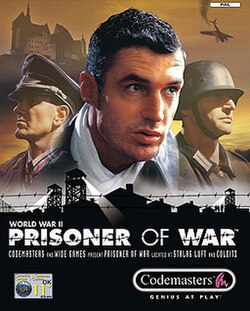

Prisoner of War is a stealth-focused, third-person escape simulator wrapped in World War II pajamas. You play Captain Lewis Stone, a downed USAAF pilot shoved into a sequence of POW camps and asked to be sneaky rather than trigger-happy. On the PlayStation 2 this title stands out not because it re-invented the wheel, but because it stripped the wheel of spikes: there are no combat mechanics and the game forces you to treat guards as social puzzles rather than HP bars. That design choice is the game's strongest and most polarizing technical signature. It alters pacing, AI expectations, and level design in ways that are interesting to examine if you care about how systems interact under constraint (and also if you like the idea of bribing people with candy and cigarettes).
At its core Prisoner of War is a stealth game that removes the entire combat branch from the player moveset. Instead of adding shoot-to-solve options, the designers made social engineering, inventory manipulation, and timing the primary tools. Technically this decision cascades across every mechanical layer. The guard AI follows a rule set that is both uncommon and unforgiving: guards will first call the player out to cease suspicious actions; if the player keeps going, they escalate to lethal force. If the player is too close when the guard detects suspicious behavior, that proximity check flips an automatic surrender flag and you lose. Those two detection branches - warning-versus-immediate-surrender - create a stealth model where line-of-sight cones, distance thresholds, and state transitions matter far more than raw reflexes. The inventory and item systems are deliberately simple but meaningfully integrated. Captain Stone carries mission-critical items like keys and crowbars for unlocking doors, and a currency system exists for buying information or gear from fellow inmates. Game states persist not only through a standard objective tracker but also via a journal that stores maps and active tasks. The barracks contains a designated hiding place for ill-gotten goods, which is an elegant, low-overhead implementation of a stash mechanic: rather than an arbitrary inventory cap, developers chose to force spatial concealment, reinforcing the thematic feel of sneaking in a prisoner camp. NPC interaction is treated as a gameplay subsystem. Fellow prisoners are always willing to help, but the help is gated either behind currency or conversational choices. Dialogue options function as a branching mini-economy: talk, bribe, or trade. This encourages lateral thinking; success often depends on assembling the right combination of information, objects, and timing. Escape attempts are rarely solo achievements - they are emergent outcomes of item circulation, information propagation, and staged distractions orchestrated via the escape committee. Mission design favors extended scenarios built around planning and execution. Examples from the narrative include stealing German rocket documents, photographing V2 production, using a captured radio to call Allied bombers, and assembling the infamous Colditz glider. These are multi-step objectives that chain stealth mechanics with environmental puzzles: tunnel navigation, sewer escapes, hiding in vehicles, and disabling hardware under duress. The lack of combat means failure states are about detection and capture rather than health depletion, which raises the game's difficulty curve. It's less about twitch skill and more about understanding detection radii, memorizing guard routines, and exploiting the social economy of the camp.
Visuals on the PS2 are utilitarian rather than flashy. The art direction leans into drab, militaristic palettes that serve the sneaking mood: browns, greys, and the occasional smudge of boot polish used to darken Stone's face. From a technical standpoint the PS2 build balances draw distance and geometry complexity to maintain steady performance in enclosed environments like barracks, tunnels, and castle interiors. Character models are serviceable for the era: not high-poly works of art, but rigging is competent enough for the required animations - walking, crouching, hiding, and the contextual surrender animation. Level geometry is where the game shows careful design thinking. Camps are laid out to support multiple approaches: there are patrol routes, service paths, and places to stash or exchange items. Lighting is used functionally rather than spectacularly; night-time sneaking relies on reduced visibility to expand traversal windows, and boot polish as a mechanic links the rendering of darkness with player opportunity. On the other hand, environmental variety is inconsistent. Some areas feel recycled and architectural fidelity wavers, which is noticeable when mission goals demand precise navigation. The UI contributes positively with a readable journal and objective list, though it's minimal - fitting for a game focused on immersion over HUD clutter. Audio design works as a stealth affordance. Guard calls, footsteps, and ambient camp sounds give reliable feedback for player decisions. Because the game lacks direct combat, sound cues carry extra weight: they are often the only early warning before a detection state escalates. That makes audio mixing and positional cues a key technical pillar for the stealth experience.
Prisoner of War is an intriguing study in how removing an expected mechanic - player violence - forces innovation elsewhere in game systems. Its strengths are in the integration of AI detection states, item-based problem solving, and social interaction mechanics that make escape feel like a crafted operation instead of a corridor shooter. On the PlayStation 2 the game benefits from a focused presentation and a PS2-friendly approach to geometry and audio that keeps the stealth experience coherent. Weaknesses come from a steep difficulty born of strict detection rules, occasional level repetition, and a visual package that shows its age. The title found a lukewarm critical reception overall, but reviews were split in ways that track platform and taste: Eurogamer rated the PS2 version highly, while aggregate scores sat in the mid-60s for PC and Xbox. For players interested in system-driven stealth, historical settings, and puzzle-like escape scenarios, Prisoner of War is worth a playthrough. It earns a solid 7 out of 10 for daring to be different and for the neat technical ways it enforces non-violent problem solving, even if it isn't the most polished or forgiving sneaking simulator in the canon.
 Helldivers 2: The Ultimate Skill Test — How to Survive When Friendly Fire Is A Feature
 Transformers: War for Cybertron on PS3
 Don 2: The Game on PS2
 Oddworld: Stranger's Wrath on Switch
 Primal Carnage: Extinction on PS4
 Crimson Sea 2 on PS2











 Another SquareThought Site