

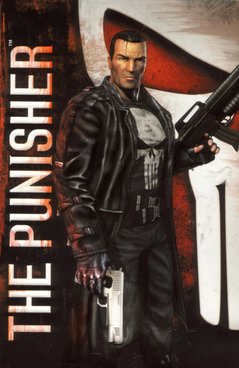

The Punisher for PS2 is Volition's mid-2000s answer to comic book catharsis: a single-player, third-person shooter that marries methodical interrogation set pieces with brazen, over-the-top violence. The game adapts both the 2004 film and storylines from the comics, and it even borrows Thomas Jane to voice Frank Castle. On the technical side the title is a classic PS2-era compromise: bold systems and design choices that often outshine the hardware-bound presentation. If you want a review that digs into the nuts and bolts rather than just counting limbs, buckle up. This is a look at how the mechanics, systems and presentation either make or nearly break a grim, gory walk through crime-ridden New York.
Mechanically The Punisher is an exercise in contrasts: deep ideas wrapped in relatively simple execution. The core shooter loop supports up to three carried weapons: two one-handed guns that can be dual-wielded and a single heavier two-handed piece. Dual-wielding is functional rather than flashy; aiming rewards positioning over twitch precision. A quirky but important constraint is the way heavy weapons are handled. You can temporarily dual-wield a heavy if another copy is on the ground, but you cannot carry two heavies. The reload/drop mechanic is noteworthy: once a heavy's ammo is depleted the secondary gets dropped instead of reloaded, which forces the player into tactical scavenging rather than button-mashing recharges. That design nudges the player to think about ammo economy even within the game's more permissive, violent fantasy. Volition built a system that deliberately blends shooter action with an interrogation/torture subsystem that changes the pacing. Interrogation hot spots are placed in levels as discrete nodes; approach them and you enter a different interaction mode with an on-screen intimidation meter. The meter displays both enemy health and a breaking point threshold. Keeping intimidation at or above that breaking point for a few seconds yields points and information or services, while letting the enemy die or going too far deducts points. Points are effectively a progression currency used to unlock upgrades at Frank's apartment and to open alternate level modes. From a systems design perspective this is smart: it ties the game's thematic brutality to mechanical reward, and forces a risk/reward calculation during encounters. Close-quarters mechanics extend beyond interrogation. Frank can grab enemies, use them as human shields, perform one-button quick kills, or toss them through doors and geometry. These interactions are more scripted than emergent physics spectacles, but they matter: environmental kills like dropping a target into a car compactor or impaling someone on scaffolding are set up by level geometry and trigger satisfying animations. Slaughter Mode is another mechanical flourish. It builds as you kill, then temporarily swaps Frank's guns for combat knives, boosts movement speed and changes engagement dynamics to close-quarters brutality. That mode functions like a short, high-intensity buff window and causes you to prioritize melee and throwing-knife usage while it lasts. Enemy AI is competent but not revolutionary. Grunts take cover, flank occasionally and respond to gunfire, but interrogation and environmental interactions are the real stars. Level design is predominantly linear, which aligns with the game's narrative vignettes and flashback structure during the Ryker's Island interrogation framing device. The linearity makes sense given the density of bespoke interrogation hot spots and narrative moments, but it contributes to the criticism of repetition many reviewers noted. Shooting innocents results in an immediate failure state, a clean design choice that enforces the antihero's moral code despite his otherwise lax approach to collateral damage. From a technical standpoint the game balances scripted set pieces and reusable systems effectively. The interrogation meter, Slaughter Mode timers, and weapon-drop-on-empty behavior are all deterministic systems that give players predictable feedback. Where the implementation struggles is variety: enemy types and encounter templates repeat, and the fairly strict checkpointing can make learning enemy placements feel grindy. Still, when the designers combine interrogation, environmental kills and dual-wield gunplay the result is a distinct mechanical signature few licensed games matched at the time.
Graphically the PS2 version shows both the ambition and the limitations of mid-2000s console hardware. Character models are recognizably detailed for the era, and Thomas Jane's likeness adds a layer of authenticity in cutscenes and voice work. Textures and lighting are serviceable but clearly constrained: distant draw is limited, texture pop occasionally occurs, and polygon budgets are visible in crowded scenes. Where the game leaned into stylistic tricks it paid dividends. The notorious interrogation/kill cinematics were solarized and desaturated to skirt higher rating restrictions, and that black-and-white gating actually gives those moments a comic-book, pulp-horror aesthetic. In regions like the UK and Australia further alterations were applied to meet local certification rules, adding zooms and camera distance changes that, while controversial, also varied the presentation between versions. Effects work is focused on delivering visceral feedback rather than photorealism. Blood, gore and ragged animations are emphasized through particle splashes and specific animation cues like dropping enemies through windows or crushing them in a compactor. Physics are limited but purpose-built: throwing enemies through doors or into setpieces triggers bespoke ragdoll and animation blends that sell the brutality without relying on an expensive physics engine. Audio is the weaker half of the presentation; many critics singled out thin sound effects. Gunfire can lack punch and ambient mixing sometimes buries footsteps or hit reactions, which is unfortunate because the voice acting and score do a reasonable job of supporting mood. Overall the graphics and audio amount to a glossy-but-hardware-aware package that backs the gameplay's intent, even if it doesn't always match the polish of higher-budget contemporaries.
The Punisher on PS2 is an uneven but fascinating example of licensed design doing interesting technical work under constraints. Its interrogation system, weapon economy quirks and Slaughter Mode are the kinds of mechanical choices that reward players who enjoy systems-first design. Where it trips up is repetition in encounter design, a limited audio palette, and presentation quirks born of PS2 limitations and regional censorship. For players interested in how mechanics can embody a character's vigilante ethos, this game is worth revisiting. For those seeking a tight, endlessly varied shooter loop, it will feel a bit linear and blunt. Commercially the gamble paid off for Volition, with solid sales and a clear niche audience that appreciated its brutally consistent vision. If you want a PS2-era single-player experience that prioritizes thematic mechanics over sandbox polish, The Punisher still delivers a technically interesting, frequently messy, and occasionally brilliant ride.
 Bad North on PS4
 Marvel vs. Capcom Fighting Collection: Arcade Classics on PS4
 Tintin: Destination Adventure on PlayStation
 Disney's Chicken Little: Ace in Action on PS2
 Pirates: The Legend of Black Kat on PS2
 One Piece Grand Adventure on PS2
 Saints Row: The Third on PS3
 Saints Row IV on PS3
 Saints Row 2 on PS3
 Saints Row: The Third on Switch
 Red Faction: Guerrilla on PS3












 Another SquareThought Site