

 Aug 2012
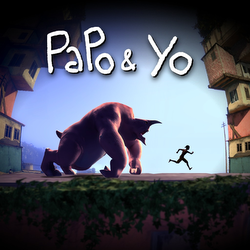

Papo & Yo arrives like a bedtime story that wandered off its shelf and wandered into a fever dream. On the surface it's a short, single-player adventure puzzle game - the kind you can finish in an evening if you order pizza and cut out the bathroom breaks. Under the surface it's designer Vander Caballero's emotional scrapbook about growing up with an abusive, alcoholic parent, dressed up in a toybox favela and narrated by bizarre, wonderful mechanics. If you're approaching this primarily to be mentally wrecked by fiendish puzzles and platforming gauntlets, temper your expectations: the game prizes imagination and metaphor more than twitch reflexes. That said, Papo & Yo still asks a surprising amount of skill from players - but the skills are mostly of the brain-and-heart variety. Expect to rely on spatial reasoning, timing, risk management, and a specific brand of creative lateral thinking as you shepherd Quico (the kid) and Monster (the large, unpredictable buddy-with-a-problem) through a handful of memorable chapters.
Papo & Yo's core loop reads like an indie puzzle-platformer love letter filtered through a child's imagination. The player controls Quico, a young Brazilian boy who escapes into a dreamlike favela. The world is malleable: tug on a glowing thread and a stair appears out of nowhere; lift a cardboard box and an entire shack detaches and becomes a moveable platform; shanties sprout legs and scuttle into place like drunks at closing time. The studio clearly wanted puzzles to feel like 'what if LEGO had mood swings' - which means the main challenge is less about 1:1 execution and more about recognizing mechanics and composing them into solutions. Spatial reasoning is the bread-and-butter skill here. Many puzzles are essentially environmental logic problems: where do you stack that shack, which object becomes a bridge, and how do you reconfigure a collection of rickety huts into a vertical path? The game invites you to think in three dimensions and to treat architecture as a fluid resource. You will frequently have to disassemble and reassemble the environment, moving entire buildings like oversized puzzle pieces so roofs line up with ledges and windows become launch pads. If you enjoy Tetris with a conscience, this is your jam. Timing and momentum matter too, though Papo & Yo never requires the split-second precision of a hardcore platformer. Jump arcs are forgiving; movement is deliberate rather than twitchy. Still, there are sequences where you crank up a structure and then have a narrow window to ride Monster's trampoline belly or spring off a slamming platform. In those sections, decent platforming fundamentals - judging distance, anticipating landing spots, and controlling mid-air adjustments - will keep you from face-planting into a watery death or an avoidable respawn. The single most interesting mechanical twist is Monster himself. He is both puzzle tool and walking hazard. When docile, Monster is enormously useful: his weight holds down pressure plates, his belly functions as a super-trampoline, and his lumbering gait can push objects or open paths. The game's puzzles often revolve around Coop Mode with an AI companion who eats your snacks and occasionally ruins your life. The catch is Monster's addiction to frogs: if he eats one, he transforms into a blazing enraged beast that smashes the environment and chases Quico. This introduces an essential skill set beyond mere platforming: risk assessment and crowd control. Resource management in the form of calming fruit becomes a tactical consideration. Fruits are finite -- you don't collect them like experience points; you use them like bandaids. Deciding when to use a fruit to soothe an angry Monster is a small but meaningful choice. Do you calm him immediately to avoid collateral damage, or bait him into a trap where his rage will activate otherwise unreachable mechanisms? Those decisions test a player's ability to plan ahead and prioritize long-term puzzle goals over short-term safety. Observation and pattern recognition are critical. Papo & Yo rarely shouts its solutions at you. Instead it hands you a handful of toys and an ecosystem of cause-and-effect. You need to watch how Monster interacts with the world, notice what triggers a house to sprout legs, and see how glowing threads hint at manipulable geometry. The game rewards players who scan the scene, experiment with combinations, and mentally rehearse sequences before committing to an action. It is possible to brute-force some puzzles, but the intended elegance is in seeing the pattern and assembling the steps neatly. Lateral thinking often wins where brute force fails. In contrast to many puzzle games that present discrete, isolated riddles, Papo & Yo's challenges are composite. You might first use a rigged shack as a counterweight, then utilize Monster to hold down a pressure pad, then yank a thread to create a step - all in the space of one puzzle. That means you must sequence actions coherently: understand prerequisites, predict consequences, and sometimes create temporary scaffolding that you'll remove later. Patience and the willingness to backtrack and reconfigure are more valuable than jaw-clenching determination. Difficulty balance in Papo & Yo is unusual. Critics generally pointed out that the puzzles "aren't the most challenging you'll find," and the game is short (many players report a 3-5 hour run). You'll rarely get stuck for long unless you stubbornly refuse to experiment. Where the game can trip players up is when it expects you to combine multiple mechanics without explicit hand-holding. Those moments feel clever rather than mean, but they can be bewildering if you're used to obvious signage and glowing arrows. So the game tests patience as much as analytical ability. Combat, strictly speaking, doesn't exist; Monster is both tool and obstacle. The psychological labor the game asks of players - shepherding a friend who occasionally becomes a threat - is its most interesting challenge. You must read Monster's state, predict his path when enraged, lure him into traps or away from Quico, and sometimes use his anger as fuel to solve environmental puzzles. That blend of empathy and cold planning is a rare test of emotional decision-making in a puzzle title. Finally, the game's short length and deliberately gentle challenge profile mean that the biggest skill required might be emotional stamina. You're not being grilled on platforming prowess; you're being nudged through an allegory. If you care about narrative resonance, you'll approach puzzles with a slower, more contemplative mindset. If you want to speedrun, you'll mostly be rewarded with a neat run but not the satisfaction of overcoming brutal difficulty spikes. In short: bring curiosity, spatial logic, timing sense, and a pair of ears to listen to the story the environment is whispering.
Papo & Yo uses Unreal Engine 3 to create a colorful, slightly uncanny favela that looks like a child's diorama after a sugar rush. The visual design is one of the game's strongest communicators of mechanic: glowing threads, movable shacks, and a gigantic, oddly vulnerable Monster are rendered with enough charm and clarity that the player can instantly understand how to interact with them. The art direction leans into contrast - a gritty, rundown slum becomes simultaneously whimsical and haunted - which supports both the puzzle readability and the emotional tone. The game's performance on PS3 is adequate but not flawless; a few reviewers noted technical rough patches. Textures and animation are stylized rather than hyper-detailed, which helps keep the visual language clean for puzzle purposes. Animations for the environment reconfiguring themselves are a joy to watch and reinforce the "this world is alive and rearrangeable" concept. Monster's expressions are especially effective: he can look playful, puzzled, and terrifying in quick succession, and those cues feed directly into gameplay decisions. If you demand cutting-edge realism, you'll be disappointed; if you appreciate a strong, readable design that makes puzzle elements obvious and emotionally resonant, Papo & Yo delivers.
Papo & Yo is not a brutal puzzle gauntlet, nor does it pretend to be. It's a compact, imaginative experience that tests a player's spatial reasoning, timing, and decision-making within a story-heavy package. The trickiest part of the game isn't a 20-frame window to land a triple-somersault - it's the subtle meta-skills: seeing the environment as malleable, sequencing multi-step solutions, managing Monster's moods, and deciding when to use scarce calming fruit. Those skills reward a more reflective kind of player. If you're after hair-tearing difficulty, you may find it tame. If you're willing to trade merciless challenge for metaphorical payoff and inventive puzzle toys, you'll find Papo & Yo charming and thoughtful. It shines when it asks you to combine mechanics like a puzzle chef, and it stumbles only when its technical rough edges or brief runtime get in the way. For an evening's worth of clever environmental puzzles, emotional storytelling, and a giant who behaves like both an ally and a grenade, this PS3 indie is worth a look. Bring your brain, your patience, and a soft spot for weird, lumbering friends.
 One Piece Grand Adventure on PS2
 Professor Layton and the Last Specter on DS
 Puzzle by Nikoli 4: on PS4










 Another SquareThought Site