

 Aug 2025
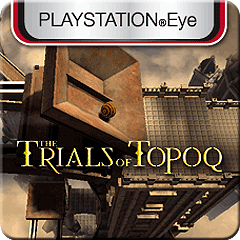

The Trials of Topoq is a PS3 downloadable puzzle experiment from London Studio that insists you bring your whole body to the living room like a very confused, physically interactive jenga piece. Built around the PlayStation Eye camera peripheral, Topoq turns the player into both controller and canvas: your silhouette, hands and gestures are captured by the camera and remapped as tiles on a vertical course, which you then deform with motion to roll an orb through five progressively difficult towers. Technically it's one of those mid-2000s console oddities that exists because the hardware can do it, and someone at Sony thought it would be neat to see an actual person mapped to a game level. The result is clever, occasionally charming and, depending on your lighting and patience, either a delightfully kinetic puzzle experience or a lesson in the limitations of consumer-grade motion capture circa 2007. This review focuses on the technical aspects: how the camera and tracking are integrated, the control fidelity, latency, environmental dependencies, the data-mapping pipeline that turns motion into geometry, and how those decisions affect level design and player agency. If you remember playing with webcams and toy motion games and wondering why your hand sometimes turns into a blob, you're in the right frame of mind. Topoq's ambition is bigger than its execution, but the parts where the tech works are genuinely interesting in an age before polished depth cameras became common.
At its core Topoq is elegantly simple: guide a ball (an orb) across a tessellated surface to hit mystical energy cages while avoiding static hazards like gargoyles. The vertical courses are organized into five 'cities'-City I through City V-ranging from very easy to very hard. What distinguishes Topoq is how it translates player input: the PlayStation Eye captures the player's image in real time and maps it onto a mosaic of tiles that form the course surface. Every motion you make causes tiles in the corresponding region to 'rise', creating slopes and gradients that the orb responds to via classical physics simulation. From a systems perspective the pipeline involves several steps: camera capture, silhouette extraction (or at least motion-region detection), mapping onto a grid of tiles, conversion of tile heights into surface normals/geometry, and finally applying forces to a rigid-body orb that obeys the simulated gravity and collision constraints. Because the game runs on a console and the camera input is relatively low-res, London Studio opted for a tile-based approach rather than attempt per-pixel mesh deformation. This is a pragmatic engineering choice: a tile grid reduces noise amplification, stabilizes the feed, and makes collision detection computationally cheap enough to maintain a steady frame rate on mid-life PS3 hardware. Menu navigation is another place Topoq leans on the camera. Instead of a DualShock, you reach out and physically interact with UI elements; the camera's region-detection turns hand waves and presence into menu selections. This creates a unified interaction metaphor-your body is the controller everywhere-but also ties the experience tightly to camera calibration. The PlayStation Eye must be set to the standard focal setting (noted in the manual as the Red field of view), and placement relative to the player is critical. Misalign the camera, and the mapping skews; set it too far or too close, and gesture recognition degrades. There are four trial styles-Trial of Value, Trial of Caution, Trial of Speed, and Trial of Control-each subtly reshuffling objectives and constraints to expose the strengths and weaknesses of the motion interface. Speed trials expose the worst technical assumptions: any latency, jitter, or misread posture becomes punishment because the orb responds immediately to surface geometry. Control trials, by contrast, reward players who learn the camera's idiosyncrasies and cultivate a slow, deliberate body language to coax the orb precisely. The physics are tuned toward predictability. The orb feels weighty but not sluggish; it rolls in a way that communicates the slope created by your gestures. That said, the mapping from tile elevation to the orb's acceleration is a calibrated function designed to hide the discrete nature of the grid. If the gradient changes too abruptly between adjacent tiles, the orb can stutter; to counteract this, the engine smooths the heightfield with a local averaging filter before feeding it to the physics solver. This smoothing helps gameplay but occasionally reduces the fidelity of fine manipulations-small, rapid hand motions don't translate into proportional micro-slopes. Detection reliability is the major gameplay limiter. The PlayStation Eye uses color and motion cues for region detection, so uniform lighting and uncluttered backgrounds are not optional niceties; they're requirements. The game even enforces camera calibration at boot, refusing to run without a properly set focal length. Players in bright, evenly lit rooms with the camera at waist height will experience the most precise control. Those in dim rooms, with pets wandering through the capture area or wearing clothing that blends into the background, will see intermittent false positives and dropouts. In those cases the game's elegance evaporates into a frustrating dance of repositioning and holding still while the orb stubbornly ignores your best intentions. Level design embraces the tech by favoring broad gestures and macro-strategies. Puzzles are constructed around channeling and momentum rather than pixel-perfect routing. When the tracking cooperates, there's a satisfying skill ceiling: learning how to shape continuous curves with your hands, how to nudge the orb's inertial vector into a gate, or how to induce controlled falls between platforms. The failure cases are instructive for anyone studying early camera-driven interfaces: ambiguity in player silhouette, lag, and quantization of the tile-grid are the reasons why Topoq feels like half a modern Kinect game and half an experimental art piece.
Visually Topoq is intentionally minimalist, and that's a wise technical direction. The courses are made of tessellated tiles that form a mosaic; your live camera texture is composited onto that mosaic so the level literally carries your image. From a rendering pipeline standpoint this is straightforward: capture texture from the camera, run a chroma key/silhouette operation, upload as a dynamic texture, and sample it across a tile mesh. LOD demands are low because the geometry is simple; what matters is shader work that convincingly blends the player's feed into lighting and shadow context so the raised tiles look three-dimensional. The tile-rise mechanic is implemented as a heightfield over a regular grid. Each tile stores a target height and a current height; the engine interpolates between them to avoid popping. The normals for lighting are computed from neighboring heights, giving a believable per-tile shading. Because the camera texture is low-resolution, the aesthetic intentionally leans toward stylization-your face rendered as a shifting mosaic reads as a deliberate artistic choice rather than a technical limitation. Particle effects and environmental lighting are minimal, keeping GPU load low and ensuring the system can devote CPU cycles to physics and image processing. Performance is when the technical design pays off. By keeping per-frame image processing bounded (silhouette extraction done at a modest resolution, tile grid aggressively capped), the PS3 can maintain steady frame timings for both the physics simulation and the rendering thread. That said, the fidelity ceiling shows: textures are soft, the camera feed can show compression and noise, and the tile grid's discretization means there's a trade-off between responsiveness and artifacting. Increasing the grid resolution would improve tracking precision but would also increase the sensitivity to camera noise, so London Studio chose a balanced middle ground more conducive to robust gameplay than to photorealistic mapping. Lighting in the rendered world is basic but functional-directional shading and simple ambient occlusion approximations are used to give depth to the tiles. This choice reduces shader complexity and avoids flicker when the heightfield changes rapidly. The orb uses reflective shading to communicate surface curvature and movement; it's a small but effective detail that helps the player's brain link cause and effect: you raise tiles, the orb tilts, you can see the highlights shift accordingly. The end result is not a showcase of graphical horsepower, but it doesn't need to be: the visual design's constraints are aligned with the technical realities of camera-driven input on the PS3.
The Trials of Topoq is a fascinating technical specimen: a puzzle game that takes the PlayStation Eye seriously and builds mechanics around the realities of a webcam-style sensor. If you're evaluating it purely as a motion capture demonstration, it succeeds more often than it fails. The tile-based deformation approach is both clever and efficient, the physics are dialed to feel meaningful, and the visual integration of the player feed into the game world is conceptually satisfying. Where Topoq falters is less about bad ideas and more about environmental and sensor limitations. The PlayStation Eye's low-resolution capture, sensitivity to lighting, and the inherent latency of a console-camera loop all conspire to make precise maneuvers occasionally frustrating. The game's design mitigates these issues by focusing on macro-gestures and momentum puzzles, but players expecting the snappy, accurate tracking of later depth sensors will be disappointed. For a player with a well-set-up PlayStation Eye, willing to learn the quirks of the tracking and who enjoys a deliberate, tactile puzzle experience, Topoq offers a unique and rewarding ride. For casual players or those without a suitable play area, the novelty can quickly become irritating. Technically curious players will appreciate the engineering trade-offs London Studio made: pragmatic choices that favor reliability on constrained hardware. In the history of motion-controlled games it sits somewhere between experimental playground and useful prototype-a title that proves a camera-driven physics puzzle is possible on PS3, even if it also reminds you how far the tech still had to go. Score: 6.5/10 - an inventive, technically interesting puzzle game held back by the practical limits of the camera technology it depends on. If you have the PlayStation Eye, good lighting and an empty living room, Topoq is worth a try; if you expect flawless tracking and twitch-precise controls, this is not the trial for you.
 The Outlast Trials on Xbox Series X/S
 Trials of Mana on Xbox Series X/S
 Puzzle by Nikoli 4: on PS4
 Professor Layton and the Last Specter on DS
 Puzzle Kingdoms on DS
 Puzzle de Harvest Moon on DS
 PlayStation Home on PS3
 Operation Creature Feature on PS3










 Another SquareThought Site