

 Nov 2008
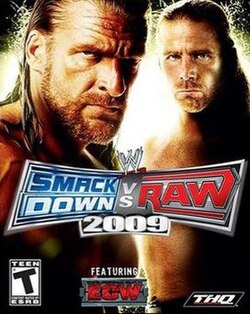

There was a time when a wrestling game could be judged by how loud the crowd chanted your tag team's name and whether a low-budget polygonal turnbuckle could somehow still look menacing. By 2008 the ring had become almost as complicated as the soap operas the WWE sells between the ropes, and WWE SmackDown vs. Raw 2009 arrives as the series' attempt to keep pace. Built by Yuke's and bearing the THQ logo like a wrestler's sponsor patch, the PS3 version is the console flagship: it carries the high-resolution trappings of the generation while trying to graft new systems on top of a familiar engine. The result is a curious mixture of progress and inertia - an experience that will make the ardent fan feel at home and the impatient player wonder if the developers have been spending too much time backstage.
If you buy SmackDown vs. Raw 2009 for anything, buy it for the tag-team retooling and the new Road to WrestleMania. Tag matches are no longer an afterthought; teams share momentum bars, attributes and even double-team finishers. The game adds the hot tag and the forced blind tag to the lexicon, which makes a well-timed change feel like the turning point of a match rather than a chore. Partners on the apron interfere more believably now - holding opponents on the ropes and yanking down the ropes to thwart a charging foe - and the overall flow of a team contest rewards cooperation rather than two solo performances accidentally occurring in the same ring. For a series that has historically leaned on singles brawling, this is a welcome push toward the chaos and choreography of real tag wrestling. Road to WrestleMania is the headline single-player mode. It replaces the older Season mode and does so with an episodic, character-focused approach: you can play through bespoke storylines for Triple H, John Cena, The Undertaker, Chris Jericho, CM Punk and a co-op tag story for Batista and Rey Mysterio. The cutscenes are written with the wrestler's persona in mind, and the mode's structure mirrors the season-ready television arcs the audience eats on Monday and Friday nights. If you cherish the melodrama of wrestling plots, this mode is your handheld soap opera on steroids. Career Mode casts a wider net. Unlike Road to WrestleMania's curated experiences, Career lets any roster member - including created superstars - chase titles and build their skills. Wins reward attribute points tailored to your playstyle, which encourages experimentation and gives longevity beyond the character-driven stories. Speaking of creation, the game introduces Create-A-Finisher on major consoles: players can chain up to ten animations from a pool of over 500 to craft unique finishers, tweaking speed where desired. It's limited to face-to-face starter positions, but still gives bespoke flair to a created champion. Another interesting tool is the Highlight Reel. Exclusive to PS3 and Xbox 360, it records the last 30 seconds of play so you can stitch together an entrance reel or catalog your best moments with camera angles and effects. It is an earnest attempt to let players be their own showrunners within the engine, and when it works it feels like wrestling highlights on a late-night VHS compilation. In-ring mechanics see some pruning and some additions. Fighting styles, a big feature from the previous year, are mostly removed; many of their benefits survive as selectable abilities - each wrestler has six of twenty perks that shift how matches feel. Signature moves return as choices you can store when at full momentum instead of burning a finisher. There is also a semi-auto targeting system which generally picks sensible opponents to attack while giving you the ability to override it in play. New match types arrive in force: the Inferno match makes its video-game debut with a temperature meter that must hit a threshold before you can literally set an opponent alight, and backstage brawls make a comeback as a weapon-filled chaotic alternative to parking-lot scrums. Not every choice lands cleanly. Create-A-Finisher and Highlight Reel are excellent ideas hampered by limitations and a feeling of being half-baked according to some critics: the editor's bounds and the occasional monotony of the animation pool can make the spectacle feel predetermined. AI improvements are noticeable but not revolutionary - opponents act smarter in tag situations, yet movement animations and clipping problems sometimes betray the illusion. Online features are robust for the era, with voice chat on PS3 and 360 and multiplayer season options, though created characters with tattoos are banned from online play - a curious safeguard that undercuts some of the community's customization fun. The Nintendo DS and Wii versions stray from the PS3's path in places, but on PS3 the game is a decidedly console-oriented package. Loading times have been reduced (THQ claimed a 50% improvement), entrances feel quicker, and the locker-room drama of a co-op Road to WrestleMania is a rare treat.
Graphically the PS3 edition sits comfortably in the middle of its contemporaries. Yuke's delivers sharper character models and more detailed arenas than last generation's hardware allowed, and the faces of marquee talent look presentable under the lights. Movements, however, still oscillate between believable and mechanical. The big moments - finishers, double-team sequences and pyrotechnic-laden entrances - are staged well and benefit from camera work that sells the drama. There are aesthetic complaints to lodge: clipping issues persist when limbs intersect ropes or turnbuckles, and some transition animations can look awkward next to otherwise smooth motion. Sound design is uneven; commentary teams have been tuned toward more play-by-play delivery, but the lines can repeat or fall flat, and a handful of impact sounds lack punch. The licensed soundtrack and the option to import your own music for entrances on PS3 are welcome - customizing an entrance with your own theme remains one of the year's more delightful personalization features.
WWE SmackDown vs. Raw 2009 for the PlayStation 3 is a competent, occasionally inspired wrestling game that suffers only when it forgets that spectacle needs substance. The tag-team overhaul and Road to WrestleMania are meaningful steps forward, and Create-A-Finisher and Highlight Reel show ambition in letting players stage their own soap-opera climaxes. Where the title stumbles is in some tired animations, clipping and a few design limits that leave new systems feeling partially realized. Critics were broadly polite - consensus scores cluster around the high sevens - and for fans of the product who want a deep roster, a buffet of match types and a chance to craft memorable moments, this version will satisfy. If you approach it as a wrestling sim that wants you to put on a show rather than a revolution in fighting systems, you will find plenty to love. For those expecting seismic changes to the series' core mechanics, prepare for a game that pushes the franchise forward in meaningful but measured increments. It is, in short, a solid hour-and-a-half main event: not flawless, but definitely worth the price of admission if you came for the sweat, the storyline turns and the occasional pyrotechnic flare.
 WWE SmackDown vs. Raw 2011 on PS3
 WWE '12 on PS3
 Deca Sports DS on DS
 Accolade Sports Collection on Xbox Series X/S
 Alan Hansen's Sports Challenge on PS2
 EA Sports MMA on PS3
 WWE '13 on PS3
 UFC 2009 Undisputed on PS3
 WWE SmackDown vs. Raw 2010 on PS3
 UFC Undisputed 2010 on PS3
 Earth Defense Force: World Brothers on PS4










 Another SquareThought Site