

 Jan 2020
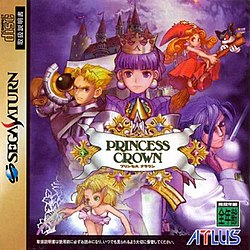

Princess Crown is the sort of game that reads like a gaming archeology report: originally born on the Sega Saturn in 1997, reluctantly resurrected on PSP in 2005, and then re-emerged on PS4 in 2020 - though only in Japan, because carefully curated scarcity still counts as cultural heritage. The PS4 release is a port of the PSP build, offered as bonus or paid DLC alongside Atlus' 13 Sentinels: Aegis Rim in Japan, and so it arrives here less like a modern rerelease and more like a cherished scrapbook page scanned and uploaded in grayscale. If you approach Princess Crown expecting modern widescreen comforts, you will be reminded that the past had integrity. The game is unapologetically 2D: side-scrolling, sprite-driven, and proud of it. Its lead - Gradriel, a teenage queen who sneaks out to help her people - is refreshingly decisive for a royalty-related plot, and the narrative expands by handing you three additional protagonists once her main quest is done. The gameplay is a beat-'em-up with RPG bones: combos, shields, subweapons you can throw, and a Power meter that punishes button-happy players the way a disappointed parent punishes unmade beds. It's the sort of mechanical compromise that makes sense for a game designed under time pressure, platform constraints and a production story involving bankruptcy and studio absorption. The result is quirky, occasionally flawed, and oddly beautiful in a way that critics and later developers found hard to forget.
Princess Crown's design is intentionally simple and intentionally fussy in equal measure. Movement happens along linear roads between towns and dungeons, which is the game's way of saying "you will go places in a line, and sometimes you'll fight things on that line." Combat is split into normal random encounters and scripted boss battles. Random encounters typically pit you against one enemy (which sounds polite until several show up at once), while bosses are there to remind you that narrative stakes exist and that they are user's responsibility. At the heart of the action is a beat-'em-up system that cleverly layers RPG elements over a simple attack button. Press it thoughtfully and you can chain combos; press it like a caffeinated squirrel and the game's Power gauge will drain until your character is a very stylish sitting target. Every action - attacking, dodging, jumping - costs Power. When the gauge is empty you become vulnerable, so the game prefers planning over button mashing. Power refills if you stand still or walk. This design choice transforms some fights into a clever resource-management puzzle and others into a lesson in patience. Each character has a main weapon, throwable subweapons and a shield for blocking. The shield is not decorative: timing a block matters. Equipment includes armor and accessories that raise stats or grant passive effects like healing. Consumables and attack items (elemental jewels, anyone?) live in an inventory you can access mid-battle, which is the sort of sanity-saving feature that keeps encounters from turning into tragicomedy. Wins earn experience points that increase level, health and attack power, which is old-school and perfectly reasonable. On the non-combat side, the game is quietly domestic. You can buy seeds in towns and plant them to yield ingredients, which you can then cook into meals that restore more health than eating raw vegetables directly off the floor. Cooking provides a little bustle of strategy outside fights: tiny farming loops reward forward planning, resource conservation and the satisfaction of turning a seed into a stew. It's wholesome and slightly smug. The story structure is also mechanically embedded. You play Gradriel first: a thirteen-year-old queen who wants to help people in person and inevitably gets embroiled with a sentient grimoire attempting to resurrect the demon Lalva. Completing Gradriel's route unlocks character-specific scenarios for Edward (a knight), Portgus (a pirate), and Proserpina (a witch-in-training). Play all of them and you get the final, true ending that ties myths and dragons into the narrative: Gaia, four guardian dragons, Heindel the dragon who manipulates events, time travel patches, and moral decisions that escalate to an oddly solemn final act. In practice, the multiple scenarios make the game feel bigger than its linear map, because each protagonist fills in narrative gaps and shows events from different angles. That said, Princess Crown does have some rough edges. Critics have pointed out repetitive backtracking and occasional difficulty spikes where enemy behavior can feel arbitrary. Balance isn't always friendly: some mechanics lack polish and can punish unfamiliar players. The Power meter in particular can feel restrictive in prolonged fights, where the game seems to prefer you to stand and contemplate stamina rather than spam combos like a person in a clearance sale. The PSP port (and therefore the PS4 port, which uses the PSP build) also leaves the screen resolution and aspect ratio untouched: no native 16:9 widescreen support. It's an honest port in the way a museum replica is honest: accurate, but not modernized.
Princess Crown's visual design is the thing people write love letters to. Its sprite work is smooth, expressive and animated with a patience modern 3D pipelines don't always have time for. The director George Kamitani cited John Tenniel's illustrations for Alice in Wonderland as an influence, and the result is a world that feels stitched from fairy-tale line art and Saturday-morning fantasy: characters have personality in a handful of pixels, and backgrounds look deliberately painted, as if someone had time to care. Technically, the Saturn-era team implemented a "Character Morphing System" to get fluid animations out of limited hardware, which is a polite way of saying they rigged sprites to behave in elegant ways that surprised people used to jerky 2D movement. Reviewers since have praised the smoothness of the animation and the artistry of the backgrounds. The aesthetic quietly invites you to forgive some gameplay quirks because the world looks nice while doing it. On the PS4 port side, the visuals are faithful to the PSP release. That means the original Saturn proportions and the PSP resolution are preserved - and so are their limitations. Several outlets criticized the PSP port for not doing basic modern niceties like widescreen support. The PS4 version, being a straight port of the PSP build, inherits that choice. If you like your retro visuals in a classic frame, this is fine; if you wanted a remaster that stretches, repaints and high-fives the modern era, this isn't it. The art still holds up, but it presents itself with the modesty of someone who has been told they look great and chooses not to respond.
Princess Crown on PS4 is not a modern remake. It is a preservationist's dream and a pragmatist's compromise wrapped in charming pixel art. If you want a reimagined 2D RPG bursting with modern UI and widescreen polish, look elsewhere. If you want a game that showcases why George Kamitani later founded Vanillaware and inspired Odin Sphere and Dragon's Crown, this is the historical document you read with interest. Play it for the visuals and the occasionally brilliant combat moments, which reward timing and resource management more than thumb stamina. Expect repetition, expect the occasional balance issue, and expect to be charmed by design choices that were born from hardware limits and production chaos - the latter includes a bankruptcy, last-minute genre shifts from life sim to action RPG, and a team rescued by Atlus. That chaos produced something idiosyncratic: a bit rough, often beautiful, and stubbornly sincere. Localization and access remain thorny. The PS4 release is Japan-only and based on the PSP port, and for years localization was blocked by missing source code and questions of age and viability. Fans and journalists have kept Princess Crown in conversations about lost classics and the endurance of 2D design. On balance, the PS4 port is worth playing if you can get it, but primarily as a cultural artifact - and as a reminder that great art sometimes arrives with a Power gauge and a stern look. Score: 8.5/10 - A visually exquisite oddity whose gameplay is clever enough to be memorable and flawed enough to be interesting. Recommended for players who like their RPGs hand-crafted, their sprites animated, and their nostalgia served with a side of sensible resource management.
 Fat Princess Adventures on PS4
 Princess Natasha on DS
 Combat Elite: WWII Paratroopers on PS2
 Onimusha: Dawn of Dreams on PS2
 Door Kickers: Action Squad on PS4
 Dragon Ball Z: Kakarot on PS5










 Another SquareThought Site