

 Aug 2025
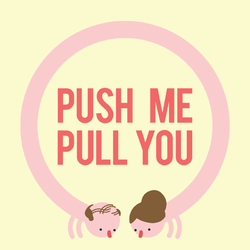

Push Me Pull You dresses like a minimalist party game and performs like a surreal arthouse wrestling drama. Developed by four friends from Melbourne operating under the indie label House House, it thrusts players into the ring as teams of tubular, sausage-like bodies with a head at each end, and asks them - very politely, and then not at all politely - to control a ball in a circle. The premise is intentionally ridiculous: think capture-the-flag meets Greco-Roman wrestling meets visual metaphors for awkward human relationships. Despite its sparse rule set, the game brims with personality. Critics called it everything from 'Koonsian' to 'David Cronenberg's Wrestleball', and like any good indie, it revels in the tension between innocent fun and gross-out spectacle. There's even a hidden option that replaces human heads with dog heads, because if the game's thesis is 'friendship in the age of bodily confusion', then at least some of those friends should be good boys.
If Push Me Pull You were a soap opera, its cast would be two duos: Team A and Team B, both long, squishy, and very committed to taking control of territory. The game stages every match as a circular arena where two teams - either controlled by two or four players locally - literally bind themselves around a ball to claim it. That simple loop is also the game's narrative skeleton; every push, pull, and chaotic tangle reads like a plot beat in a tiny, sweaty melodrama. The characters are not named, but that's part of the charm. The bodies are blank canvases for motivation: one head wants glory, the other just wants to eat snacks; one is calm and strategic, the other panics and flails. Play transforms those blanks into personalities. In a two-player match each player controls both heads of a single sausage-body, which creates an immediate internal monologue of two minds trying to coordinate. In four-player matches each head often belongs to a different person, which produces perfect sitcom chaos - alliances that last the length of a single tug, betrayals executed with a bump and a fart sound, and miracles of cooperation that feel like plot twists. Narrative progression in Push Me Pull You happens on the micro scale. The opening act of any match is the Establishment: players test reach, figure out controls, and probe the opponent's defenses. This period is the game's 'exposition' - heads bobbing, limbs flailing, small compassionate noises that almost sound like theme music. The middle act is the Complication: grips are tested, coils interlock, and the ball changes hands repeatedly. You will watch a harmless push escalate into an entangled free-for-all that would make any physical comedy director proud. Then comes the Climax: a decisive possession where one team coils so perfectly around the ball they create a fortress of flesh. It's both beautiful and grotesque, like watching a performance art piece and a rugby scrum simultaneously. Because the game's rules are minimal, character arcs rely on emergent storytelling. A timid player might go from hesitant to aggressive as they learn to coordinate both ends of the body; a strategic head-turner might begin to anticipate the opponent's pattern and, in the final minute, execute a theatrical reversal that rewrites the team's identity. Four-player matches have soap-opera subplots: two players fuse into a symbiotic offense, only for one to drop the ball and trigger a melodramatic blame scene lasting three rounds. The game's hidden dog-head option is a delightful narrative device - flip it on and the entire tone shifts. Suddenly the drama becomes less existential and more familial. That mode gives otherwise inscrutable defeats the comforting subtext of 'my friend meant well, but he smells like the park'. Push Me Pull You has a rhythm that functions like screenwriting beats: establish control, escalate tension, resolve via a burst of coordinated motion. The game's pace is fast; matches rarely overstay their welcome and often end with everyone either laughing or flinging a controller across the couch in slow-motion horror. It is, at its core, a social game. The developers have called the game 'about friendship and wrestling', and you feel that in every match. Friendships are tested by forced co-dependency - you literally move by manipulating both heads or trusting another player not to send your end spinning into oblivion - and the wrestling is as physical as a controller can make it feel. Critics' comparisons (Jeff Koons, David Cronenberg, the Human Centipede) capture the weird double-life Push Me Pull You occupies: hypnotic and a little alarming. But beneath the shock value is tight, elegant design. There are no convoluted power-ups or punishments; the joy is in how bodies interact. The minimalism invites backstory. Teams develop reputations in your living room: the 'strategists' who build slow domes of control, the 'frenzies' who twitch and surge, and the 'sabotagers' who make personal chaos their art form. Matches become serialized episodes in these living-room dramas. The gameplay loop supports repeat viewings, and with local multiplayer this becomes group theater rather than isolated gameplay. The game's lack of a traditional narrative actually becomes its storytelling strength. By gifting players with a mutable cast and a small set of mechanics, House House created a sandbox for tiny character arcs to bloom. You are not watching a prewritten story; you are directing a new one every match, and because the rules are so clear, character beats read instantly. That makes Push Me Pull You a fantastic party game for people who enjoy improvised comedy, emergent drama, or just watching their friends try to coordinate a body that will not cooperate. A note on longevity: because the meat of the experience is social, single-player modes are thin by design. The game shines with other people, and while a four-player local session can produce a mini-epic of emotional beats across an evening, it may feel shallow if you're looking for a deep solo campaign. But if you're into short-form, intensely social storytelling and don't mind that the plot often resolves with a squeaky noise and a conceded goal, it delivers consistently.
Visually the game looks like the love child of abstract minimalism and late-night adult swim idents. The arenas are clean and circular, the color palette pastel and slightly off, and the bodies - while conceptually gross - are rendered in a charmingly simple style that keeps everything readable. This is a game where the design deliberately skews toward the uncanny valley without ever fully diving into realistic gore. The effect is intentionally 'Koonsian' - cute, glossy, and a little alarming - and that aesthetic choice plays into the narrative you improvise with friends. The animations are expressive in a low-fi way: flailing limbs, head-tilts, and the way the bodies coil around a ball all convey intention despite the minimalist visuals. Sound design leans into the campy: squelches and grunts punctuate every contest, making each dramatic reversal feel operatic. Composer Dan Golding contributes a soundtrack that underlines the absurdity; it tips its hat to sport-game bombast while staying playful and eccentric. Together, the visuals and audio carve out a consistent tone - part athletic contest, part absurd theatre - which reinforces the game's emergent story arcs. Critics noted the Adult Swim-esque vibe, and that's accurate: Push Me Pull You feels like a midnight animated short given multiplayer controls. It looks deliberately simple because that simplicity is the stage on which the characters - your friends' unpredictable choices - do their best work.
Push Me Pull You is a small, cunning party game that tells surprisingly rich little stories through mechanics rather than dialogue. House House gave players a tiny world where co-dependency, trust, and slapstick wrestling become the narrative engine. Your living room will generate recurring characters - the steady strategist, the chaotic anarchist, the lovable betrayer - and over a few matches these personalities will form arcs that feel emotionally true even though they're constructed out of squeaks and controller inputs. This is not a solo epic or a narrative-heavy title. It is best experienced in the company of friends, where emergent drama and comedy can bloom. If you like local multiplayer, social improvisation, or games that let you role-play a very committed tube of flesh, this will reward you with repeated, oddly touching bouts of chaos. The Metacritic consensus (75/100) and critical commentary calling it both grotesque and charming are apt. In short: bring snacks, bring friends, and maybe enable dog heads for the emotional safety net. It's hilarious, occasionally horrifying, and consistently fun - and I'll give it a solid 7.5 out of 10 for its brilliant execution of a bizarre, heartfelt idea.
 Monster Rancher on Switch
 Prototype 2 on PS4
 The TakeOver on Switch
 Super Mario Party Jamboree – Nintendo Switch 2 Edition + Jamboree TV on Switch 2
 Rabbids: Party of Legends on Switch
 Trivial Pursuit on PS3
 Press Your Luck on PS3










 Another SquareThought Site