

 Aug 2025
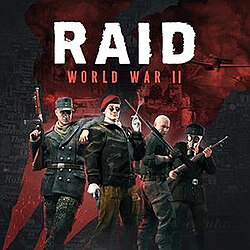

RAID: World War II arrives like a heist movie that forgot half its props - promising the Payday-style cooperative criminal energy but dressed up in World War II uniforms and moral ambiguity. Developed by Lion Game Lion on the Diesel Engine 2.0 and financed on an $8 million budget, RAID is a multiplayer-first shooter that also offers single-player with AI companions. The concept is straightforward: four ruthless ex-prisoners (Sterling, Rivet, Kurgan and Wolfgang) are unshackled to steal Nazi gold and take down the Reich using whatever rules they care to ignore. That pitch sounds like a ready-made playground for tight mechanics and satisfying co-op synergy, but the reality on PS4 is more mixed: the underlying tech and design choices often fight the game's intent rather than support it. This review looks at RAID through an engineer's microscope - focusing on the engine, rendering, gameplay systems, AI, and how those parts come together (or don't) on Sony's console.
RAID's mechanical DNA is clearly related to Payday 2: four-player co-op heists translated into a wartime setting. Missions are structured around objectives rather than an open sandbox; you push from point A to point B, clear rooms, trigger switches and extract loot. The tactical-shooter tag is appropriate on paper: loadouts, classes (each character has a thematic niche), and a cover-aware approach reward planning over run-and-gun. The single-player option with AI companions is a significant inclusion given the game's multiplayer focus - it lets you play the content without friends and avoids making the whole package dead weight for solo players. From a systems perspective, the mission and objective scripting is modular, which is a strength. Objectives chain together and trigger level events (reinforcements, doors unlocking, scripted enemy flanks) rather than relying solely on static spawn points. That makes missions feel dynamic when the scripting behaves. The tradeoff is that heavy reliance on scripted moments can produce brittle pacing: when triggers fail to fire or when AI routines don't react as intended, sequences can either stall or collapse into chaos. Given RAID's modest budget, the team leaned on scripted encounters to make fewer, louder moments look and feel cinematic rather than building a fully emergent combat ecosystem. Weapon handling and shooting are functional but not class-leading. Diesel Engine 2.0 gives solid basic ballistics and hit detection, but the tactile feedback loop - animation responsiveness, recoil animation blending and sound design coupling - lacks the polish that makes gunplay feel truly rewarding. Animations occasionally decouple from input, producing small timing mismatches where a reload or weapon swap looks slightly delayed compared to the player's command inputs. That may not break encounters, but it diminishes the purposeful rhythm that tactical shooters usually cultivate. Character progression and loadout economy are modest. RAID leans into loot culture - stealing Nazi gold is both narrative device and progression resource - but the customization trees and sandbox options don't offer the depth seen in comparable titles. For players who enjoy min-maxing builds, the system feels shallow; for players seeking pick-up-and-play co-op it is adequate. AI companions are the linchpin for single-player viability. On paper, the AI follows patrol paths, provides covering fire, revives and completes basic objective tasks. In execution there are stumbles: pathfinding occasionally gets stuck on geometry or door thresholds, and tactical choices (like choosing a cover point or prioritizing grenades) can appear simplistic. This is not unusual for a team-driven AI budget, but it makes single-player feel more like a co-op with predictable bots rather than a polished solo stealth/tactical experience. Cooperative multiplayer partly masks these issues, since human players fill the tactical reasoning role the AI sometimes lacks. On the multiplayer networking side, RAID's matchmaking and session stability were frequently cited in reception as middling, which aligns with the game's design emphasis on quick-drop-in co-op rather than competitive modes. The implementation focuses on short-session co-op, which is easier on server load and aligns with the Diesel Engine's heritage, but also contributes to a sense of lightweight online infrastructure: you can get into games quickly, but long-term meta systems, ranked play, or extensive social features aren't present to keep communities invested long-term.
RAID runs on Diesel Engine 2.0, an engine with pedigree from Overkill/Grin and prior experience in cooperative shooters. Diesel's strengths show in material work and lighting: metallic surfaces, dirt maps and baked ambient occlusion produce satisfying period sets when viewed at a still frame. Artist Dinko Pavicic's contribution is visible in character silhouettes and prop design; the world reads as 'authentic pulp WWII' and the production design leans into theatrical, exaggerated set pieces that support the heist aesthetic. On PS4 the visual package is uneven. Textures and LODs are serviceable at gameplay distance, but under the hood there are clear memory-management compromises. Textural fidelity drops at longer draw distances and some character facial textures are low-res compared to body kits - symptomatic of console memory budgets being prioritized for gameplay readability over high-frequency detail. Shadowing is a mixed bag: baked shadows give good contact for props while dynamic shadows sometimes alias or shimmer during camera movement, indicating a hybrid shadowing approach where dynamic cascades are conservative to hit framerate targets. Animation systems are competent but reveal limits in blend trees and inverse kinematics. Standard locomotion and weapon animations are fine, but contextual transitions (e.g., moving from sprint to a low cover lean) occasionally stutter or snap due to imperfect blend timing. Bullet impacts and destruction are punchy when they work, but physics-driven debris is conservative - likely a deliberate CPU/GPU tradeoff to maintain consistent multithreaded performance on the PS4's Jaguar cores. Performance on console reflects those tradeoffs. RAID appears tuned for stability over spectacle: framerate tends to be steady but conservative, favoring 30 FPS-style consistency rather than pushing higher or risking dips during scripted explosions. Given the engine and budget constraints, that choice is understandable, but it also means the game feels less fluid than other shooters of the era that prioritized higher refresh responsiveness. Audio is an underrated technical element here - Ivan Selak's soundtrack adds cinematic heft and the SFX mix aims for clarity, which helps compensate for some of the visual shortcomings during firefights. Spatialization and hit-sound feedback are tuned to be informative, which is important in co-op firefights where enemy positions need to be read quickly.
RAID: World War II is an honest product of its pedigree and budget - a cooperative shooter built by a team with Payday DLC experience, using Diesel Engine 2.0 and an $8 million production pool. The result is often competent: modular mission scripting, readable combat encounters, and a game that works as a pick-up co-op if you go in expecting modest systems rather than industry-leading polish. The technical decisions are consistent and explainable - conservative memory budgeting on PS4, reliance on scripted moments to create dramatic encounters, and an AI design that ensures single-player is possible without building a high-cost emergent simulation. Where RAID falters is in the small technical and design frictions that add up. Animation blending inconsistencies, simplistic companion AI behavior, shallow progression loops and a visual package that leans on practical art rather than high-end shader work make the experience feel like a competent prototype rather than a fully-realized modern shooter. Critical reception reflected this - aggregate scores trended in the mid-to-low range - and on PS4 that translates to a product that will satisfy a niche: players who want a Payday-like co-op transplanted to WWII, and who are willing to overlook rough edges. If you're prioritizing tight gunfeels, top-tier animations, or deep progression meta, RAID is unlikely to become your new obsession. If you want a relatively stable, story-lite cooperative romp with cinematic set pieces, modest technical ambition and a soundtrack that punches above its weight, RAID is worth a rental or a discount grab. From a technical vantage point, Raid is an instructive case study in tradeoffs: with an experienced engine and a small budget you can deliver a functional multiplayer shooter - but delivering standout, enduring polish requires more investment in AI complexity, animation systems and rendering headroom than RAID had available. That honesty is both the game's economy and its charm.
 Harvest Moon: One World on Switch
 Nobody Saves the World on Xbox Series X/S
 Tennis World Tour on Switch
 PixelJunk Shooter 2 on PS3
 Warhammer 40,000: Boltgun 2 on Xbox Series X/S
 Tom Clancy's Rainbow Six: Vegas on PS3
 Commandos: Strike Force on PS2










 Another SquareThought Site