

 Aug 2016
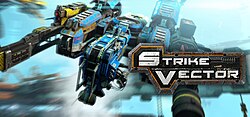

When I first put a DualShock in my hands and fired up Strike Vector EX on PlayStation 4, I felt like a combat pilot who'd accidentally wandered off a '90s arcade flyer and into someone's living room. This is not a flight sim in the traditional sense; it is an arena shooter masquerading as a jet fighter, and it makes that masquerade work with blunt, enjoyable efficiency. Birthed on the Unreal engine by a tiny French studio called Ragequit Corporation, Strike Vector began life on PC in 2014 and staggered onto consoles two years later as the compactly named EX. Its premise is simple enough to pitch in a pub: strap into a hi-tech Vector craft, switch between two radically different movement modes on the fly, and carve the multiplayer arena into pieces. The console port does what it must - it translates the frantic, twitchy rules of an arena dogfight to a living room controller - even if it occasionally feels like trying to play a jam session on a harmonica when you were handed a grand piano.
Strike Vector EX belongs in the school of shooters that treat momentum as a weapon. You do not lumber about like a tank; you are a predator of speed. The Vector is highly customisable, and that customisation is not cosmetic window dressing. Loadouts alter the feel and role of your craft: some configurations turn you into an intercepting missile, others favour measured strafing and precision fire. The defining mechanical switch, and the game's cleverest design flourish, is the instant toggle between Jet Mode and Stationary Mode. Jet Mode is the pure rocket-and-dodge option - raw velocity, long arcs, snap closures and escapes. Stationary Mode is as literal as it sounds: your vector holds position and lets you strafe with terrifying accuracy. It is a dichotomy that rewards players who can think in two different movement languages and switch dialect mid-fight. The camera alternates between third-person and a first-person cockpit view, which is more than a cosmetic choice. Third-person offers spectacle and situational awareness, crucial in a twitch-heavy arena; the cockpit view tightens focus, and it is genuinely useful when lining up shots in Stationary Mode. Multiplayer is the heart of Strike Vector EX. The modes are variations on classic objectives - team deathmatch, capture-focused scenarios and arena-style team play - and the maps are designed around three-dimensional flow rather than the dog-eared linearity of ordinary shooters. Verticality matters; ceiling space and pylons become highways. The solo Challenge mode provides a lab to test loadouts against AI, which is handy for those who prefer tuning before diving into ranked sparring. A console controller forces design compromises; Ragequit mostly navigates them skilfully. The instant-mode toggle is mapped to a single button, which is smart, because the split-second when you flip modes is often the difference between a glorious kill and a flaming wreck drifting into a crater. Aiming and manoeuvring translate well, though some of the subtler, high-FPS nuance of mouse precision from the PC original is inevitably blunted. Matchmaking can feel like a relic of an earlier era of online gaming: at times you find yourself in perfectly balanced skirmishes; at times the servers throw you into a slaughter or a cakewalk. The community that loved the PC build applauded the mechanical purity - critics scored it respectably on PC - and the PS4 port preserves that purity for those willing to learn its rhythm.
Strike Vector EX's aesthetic is a study in purposeful minimalism. This is not a game trying to drown you in photorealistic textures or post-processing excess. Instead the artists - Paul Chadeisson and Pierre-Etienne Travers among them - deliver crisp, clean designs that emphasise silhouette and motion. Vectors streak through arenas that favour industrial geometry and open skyboxes; the visuals prioritise readability in the chaos of combat. On PlayStation 4 the Unreal engine handles lighting and particle work with a polish that reads as competent rather than revolutionary. Effects like engine contrails, weapon discharges and explosion gouges are satisfying; they reward a player with a healthy visual vocabulary without turning every skirmish into a migraine. The sound design complements the visuals with tactical clarity. Weapons have distinct timbres, and the whoosh of mode-switching is as much an audio cue as it is a mechanical one. The soundtrack, credited to The Maravers, keeps the tempo brisk and sparely electronic - the kind of backing track an action film would use when it needs to remind you that danger is now imminent. For a small studio game, the presentation is lean and purposeful: it never distracts from the gameplay, which is itself the main event.
Strike Vector EX is, in essence, a very particular kind of pleasure. It does not aspire to cinematic grandeur or to the simulation depth of a Hawk or Falcon title from the analog era. What it offers instead is arcade clarity wrapped in modern online multiplayer: rapid engagement, a compelling movement dichotomy, and maps that reward spatial thinking. The PS4 port carries over the tightness of the original with only minor concessions; if you came to the game expecting overwhelming graphical fidelity or sprawling single-player narratives, you will leave underwhelmed. If, however, you enjoy a title that asks you to master momentum and to think two steps ahead in three dimensions, then Strike Vector EX will reward your attention. There is a bittersweet note to this appraisal. Ragequit Corporation eventually closed and the game was removed from sale on Steam in 2020, which makes the console port feel like a preserved cartridge from a bygone boutique era of development. The community that formed around the PC original appreciated the game's mechanical honesty, and those qualities survive here. My score - a balanced 7.5 out of 10 - reflects a game that is clever and energetic but also narrowly focused. It is a high-quality niche product: a shooter with the heart of an arcade machine and the soul of a small, passionate studio. For players who crave speed, customisation and aerial ballet without the ballast of modern triple-A epics, Strike Vector EX is a worthy sortie.
 Strike Suit Zero on PS4
 Sudden Strike 4 on PS4
 Tom Clancy's Rainbow Six: Vegas 2 on PS3
 Primal Carnage: Extinction on PS4
 Warhammer 40,000: Boltgun 2 on Xbox Series X/S










 Another SquareThought Site