

 Apr 2022
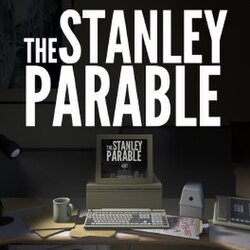

The Stanley Parable: Ultra Deluxe on PS4 is the game that remembers to ask you whether you remember the game. It is an expanded, polished, and occasionally self-loathing edition of a title that spent the 2010s teaching players how little control they actually have, then laughing politely about it. If you liked the 2013 remake - the one that suggested walking into offices was suddenly a profound act of rebellion - Ultra Deluxe gives you more jokes, more pathways, and more things to carry around in your inventory purely for comedic effect. It also moves from the Source engine into Unity so it can finally get a passport and appear on consoles without being arrested for trespassing on platform exclusivity.
Playing Ultra Deluxe is less like playing a game and more like attending a very specific audio play where the main actor keeps reacting to your stage directions with the weary patience of someone who has been forced to narrate corporate training videos for decades. You are Stanley, employee 427, a silent protagonist with an alarming talent for pressing buttons when no one is looking. Your real co-star is the Narrator (Kevan Brighting returns, and yes, his accent still sounds like a polite reprimand), who tells you what Stanley did, what you should do, and how disappointed he will be when you do something else. Controls on PS4 are straightforward - walk, look, press, and occasionally pick up a bucket because the game insisted. There is no combat, no crafting trees, and no skill-based ladder to fall down. The gameplay loop is pure exploration plus choices minus the illusion of agency, which is the point. When you follow the Narrator, you get one set of monologues and endings. When you staunchly refuse and vault through the other door like a person who has read a philosophy paper once, you get alternative narration that adapts, panics, or sulks accordingly. Ultra Deluxe weaves many new branches into the old tree: new areas like the Memory Zone (where praise and bitter Steam reviews fight like passive-aggressive roommates), an item-based route flexibility courtesy of a bucket that becomes a running gag and occasionally an emotional pivot, and entirely new meta-threads about sequels, criticism, and whether games are allowed to be embarrassed about themselves. The designers famously kept the experience short by design - the original's brevity meant you could see most endings without taking out a mortgage. Ultra Deluxe respects that compactness while adding material that rewards repeat visits. If you select that you have played before, you can skip to the new content quicker; otherwise the game gently forces several resets until the new bits unlock, which is the game's way of saying "we see you, you patient type, here's the new joke." There are still many endings, including some that are genuinely surprising and others that exist purely to watch the Narrator have an existential meltdown. The PS4's save and resume behavior is competent; the console controller maps cleanly to the game's minimalist demands, and the flowchart paranoia is replaced by tasteful visual cues so you won't miss choices unless you are intentionally trying to miss them, which is probably what the game wants you to do.
Ultra Deluxe trades the utilitarian Source look for a cleaner, slightly more modern aesthetic courtesy of Unity. Offices are still fluorescent-lit shrines to beige, and that's deliberate: the environments are designed around the Narrator's biases, not photorealism. The PS4 port looks tidy and readable; textures are crisp where they need to be and intentionally bland when it's thematically useful. New environments - the Memory Zone and the various parody levels that riff on Firewatch and Rocket League rather than the older Minecraft and Portal bits - are playful in tone and occasionally lavish in unexpected ways. Performance is mostly solid on PS4. There were reports of framerate issues on certain ports, and Ultra Deluxe does have moments when it strains under its own theatrical ambitions, but on a standard PS4 the hiccups are infrequent and generally forgiveable. The audio design is where the game truly shines: Brighting's narration is the star, and the soundtrack and sound cues accentuate punchlines and pauses with surgical precision. If you care about visuals, this is not a tech demo; if you care about atmosphere and a narrator who sounds like a librarian judging your life choices, then the presentation is perfect.
Ultra Deluxe feels like the same wonderful, teasingly philosophical game you remember, but with a few more witty detours, fresh meta-commentary, and a bucket. It successfully expands the original without bloating it, adding new routes that poke at game criticism, the sequel culture, and the absurdity of reviewing experiences for a living. The Narrator remains a brilliant, brittle center - part god, part passive-aggressive tour guide - and Kevan Brighting's performance anchors every surreal twist. The PS4 version is the most convenient way for console players to experience the full, expanded Stanley package, and it delivers the game's jokes and existential insults with minimal fuss. If you want a game that will make you laugh, make you question your role in digital narratives, and occasionally make you carry a bucket for reasons that eventually make sense, this is the one. Minor gripes: some new routes feel less interactive than others, a couple of ports have shown frame-rate wobble in edge cases, and the whole enterprise can feel smug about being clever. Those are small prices to pay for a game that looks you in the face and says, in the calmest voice imaginable, "You could do what I tell you, or you could be interesting." I recommend choosing interesting. Score: 9/10.
 Thymesia on Switch
 Mr. Saitou on Switch
 Tintin: Destination Adventure on PlayStation
 One Piece Grand Adventure on PS2
 Taiko no Tatsujin: Don to Katsu no Jikū Daibōken on Switch
 Disney's Winnie The Pooh's Rumbly Tumbly Adventure on PS2










 Another SquareThought Site