

 Oct 2020
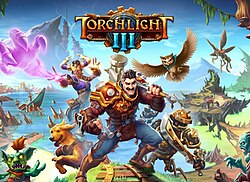

There was a time when action RPGs announced themselves with the crack of a two-handed sword and the polite groan of inventory Tetris. Torchlight III arrives from that same tradition, though it carries with it the baggage of a development journey that reads like a mid-90s PC magazine rumor column. Originally unveiled as Torchlight Frontiers with MMO leanings, Echtra Games and publisher Perfect World reined it back into a more conventional, linear Torchlight experience before launch. The result is a competent dungeon crawler that remembers how to loot, but seems to have misplaced some of the spark that made the earlier series entries memorable. I approached the PlayStation 4 build with the earnest skepticism of someone who grew up on Diablo clones and boxed strategy guides. Torchlight III presents itself from an isometric, top-down view familiar to any hack-and-slasher worth their salt. It runs on Unreal Engine 4, and while the engine provides a clean presentation, the game's identity crisis - once planned as a more open, MMO-like world and later refashioned into a compact, premium title - is visible in the seams. This is not a disaster. It is a tidy, reasonably enjoyable action RPG that will make some players grin and leave die-hard Torchlight veterans wanting more.
Torchlight III plays like a textbook dungeon crawler. You pick one of a handful of classes, equip weapons, cast spells, and use a stable of skills to carve a path through high-fantasy environments. Combat is immediate and straightforward: hack, slash, zap, loot, and repeat. The town hub acts as the familiar central marketplace where you buy, sell, and tweak equipment before venturing back into the dungeons. One of the more interesting development footnotes is how the game evolved from an MMO prototype to a closer spiritual successor to Torchlight I and II. As Torchlight Frontiers, the game experimented with large surface levels where players could party up in a shared world and tackled mechanics like item-based experience scaling - a curious idea designed to keep high-powered players from steamrolling low-level companions by temporarily weakening their gear in shared dungeons. Those systems were pared back in the shift to Torchlight III, which settles into a much more linear progression structure while still supporting both offline and online play. The loot loop is serviceable and occasionally rewarding. Items still matter, but fans who spent hours perfecting builds or rummaging through Torchlight II mods will find Torchlight III somewhat undernourished; Destructoid's complaint that the campaign is "forgettable" will resonate with anyone expecting the depth of the series' prior iterations. The Fort system - a base-building-esque feature mentioned in early previews and later reviews - feels underused; it promises customization but rarely evolves into a compelling gameplay pillar. Multiplayer exists, and co-op sessions can be pleasant, with accessible mechanics that allow drop-in play. Unfortunately, some outlets noted friction in the online process and limitations that make the experience less smooth than it should be. Dungeons, in particular, drew criticism for feeling cookie-cutter; PC Gamer found the procedural rooms competent but uninspired, where variety and memorable encounters should have been. Boss fights have an unfortunate habit of either being too trivial or leaning on cheap difficulty spikes rather than design nuance. The developers' decision to make Torchlight III a premium title rather than free-to-play reshaped expectations. It is a compact experience rather than an MMO sprawling with systems and microtransactions. For players who want an uncomplicated, pick-up-and-play dungeon romp on the PS4 - and who don't mind a shorter campaign and a less ambitious endgame ecology - the game delivers on the fundamentals. Those after deep systems, modding potential, or a spiritual evolution of Torchlight II's complexity may feel shortchanged.
Graphically the game is competent and frequently pleasant. Running on Unreal Engine 4, Torchlight III adopts a stylized palette that works well with the series' cartoonish, slightly exaggerated fantasy art direction. Push Square and other outlets conceded that the visuals are "fine" - not revolutionary, but clean and readable on a console where clarity often trumps photorealism. Textures, character models, and particle effects are serviceable for the PS4, and the overall aesthetic retains the series' charm. Technical hitches were noted in several reviews. While the build is generally stable, various outlets pointed out performance quirks and sporadic gameplay issues that pull you out of the experience. Level creation and procedural generation do their job, but often produce arenas and corridors that feel recycled. The result is an attractive box with familiar looking contents: satisfying at a glance, repetitive on close inspection. Where Torchlight II occasionally dazzled with emergent encounters and lively map design, Torchlight III opts for consistency and polish rather than ambition.
Torchlight III on PS4 is a respectable, middling entry in a beloved franchise. It is the product of a studio that walked away from an MMO experiment and chose to return to the simpler, more direct act of hacking monsters and collecting better hats. The positives are clear: accessible co-op, a functional loot loop, decent presentation, and the approachable design that makes it easy to jump in for short sessions. The negatives are perhaps more damning: an overall linear campaign that feels less rich than its predecessors, cookie-cutter dungeons, underutilized systems like the Fort, and some technical niggles. If you judge it on its own merits - a compact action-RPG that does the basics cleanly - Torchlight III is an agreeable way to burn a few dozen hours. Fans who cherished the depth, modability, and sprawling ambition of Torchlight II will likely feel under-served. Critics and aggregators were lukewarm (the PS4 Metacritic sits around the low 60s), which is a fair reflection: a game that performs many expected duties competently but seldom surprises. For those looking to relive the uncomplicated joy of mowing down hordes, trading loot, and seeing numbers pop, Torchlight III is worth a rental or a sale-priced purchase. For the torchbearers of the early series who wanted a bold successor, this installment is more of a polite shrug than a battle cry. In the end, it is a tidy little dungeon crawler with a respectable heart and the faintly disappointing soul of something that almost was.
 Kingdom Come: Deliverance II on Xbox Series X/S
 Terraria on Switch
 PlayStation Home on PS3
 Gaelic Football '25 on Xbox Series X/S
 Ōkami on PS2
 Together! The Battle Cats on Switch










 Another SquareThought Site