

 Aug 2022
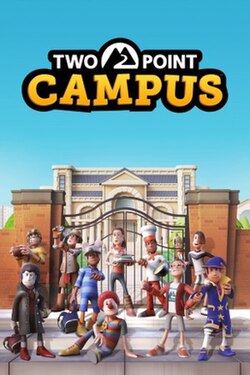

Two Point Campus is a cheeky, cartoony business-sim that asks you to run the kind of university where the lecture halls sometimes smell faintly of dragon smoke and the students take "Knight School" very literally. Built on the same playful DNA as Two Point Hospital, this sequel swaps bandages for backpacks and operating theatres for lecture halls, and then hands you the keys to a campus full of procedurally generated personalities. On PS4 the game is a comfortable, approachable management title: not the most technically flashy campus sim you'll ever play, but one that prioritises character and story - the relationships, traits and arc-like progression of its students - above spreadsheet brutality. The devs set out to make you care about these tiny digital lives; they even hoped you might wipe an eye during graduation. Whether you cry or just smirk, the narrative ambition here is noteworthy.
If Two Point Campus were a sitcom, the students would be the cast and your sandbox would be both stage and director's chair. The core gameplay loop - build classrooms, recruit lecturers, keep the toilets working, balance the books - is familiar to genre fans. What sets this title apart is how it frames those loops as character development. Students arrive as blank slates who fall into distinct archetypes. These archetypes are procedurally generated, but they act like personalities in a long-running show: the relentless partygoer who shows up late, the obsessive bookworm who hoovers up every lecture, the socially awkward genius, the overenthusiastic extracurricular zealot. The game doesn't hand you character bios on a silver platter; instead, it lets habits, needs and relationships write the biographies themselves. The studio added a "trait" system to let characters evolve. Traits are the plot devices here: a prank-loving student might pick up a "mischief" trait that infects their social circle; a stressed one could acquire "burnout" if you skimp on wellbeing. Because each in‑game year is roughly 20 minutes long, you get to watch cohorts mature in bite-sized episodes. Watching your first freshman wave into lecture halls nervous and bewildered, then, across several months of real-life play, blossom into a graduate in a cap and gown is the intended emotional arc. Game director Gary Carr explicitly wanted that feeling: "if we can make you have a little tear in your eye as you're waving them off into the great wide world, that's awesome." It's a bold, oddly tender goal for a management sim and it's mostly achieved through small, human moments rather than scripted cutscenes. Relationships between students are a surprisingly rich subplot. Friend groups form, fall apart, and on occasion spawn budding romances or bitter rivalries. Because the characters remain on campus for long stretches - unlike the transient patients of Two Point Hospital - you get invested. There's real narrative weight to the decision whether to funnel funds into a high-energy club that boosts morale but encourages nightly antics, or into a serious lecture series that improves graduation rates. Those macro-management choices double as moral choices for the lives unfolding under your watch. Do you coddle, push, or nudge students toward independence? The consequences land in the form of success, failure, or the most heartbreaking outcome in a sim: dropout. Staff are their own cast members. Lecturers, teaching assistants and janitors aren't just functional hires; they are supporting characters with influence over plotlines. A brilliant, eccentric professor can become the mentor everyone quotes in exam season; a lazy janitor might start a campus-wide cleanliness scandal that forces you to confront the narrative cost of cheap labour. The game even borrows a little from city-building mechanics so that the campus itself can act like a character: your architectural choices determine the campus's personality. A gothic, torchlit layout gives a very different narrative vibe than a bright, pastel collegiate quad filled with quirky statues. Two Point Campus leans into genre-fantasy courses - "Knight School" and other exotic classes - as episodic arcs. These are miniature storylines: the Medieval studies kids who train with wooden swords, the Space Academy recruits who want to orbit the scoreboard, and DLC expansions that dramatically expand the cast list and change narrative tone. Space Academy, School Spirits and Medical School DLCs allow fresh archetypes and story beats, like ghostly mischief in School Spirits or the stern, high-stakes training of Medical School, adding replayability as if each expansion were a new season of a beloved series. There are weaknesses to the narrative focus. Because personalities are procedurally generated, standout characters rarely achieve the depth of hand-crafted NPCs in narrative-driven games. You might encounter a fascinating student one week who seems ripe for deeper storytelling, only for them to fade into the alumni list after graduation with no real follow-up. The city-building emphasis also means some players will spend more time micromanaging aesthetic layouts than babysitting character arcs, and the emotional beats can be undercut by the conveyor-belt feeling of cohort turnovers. Still, when the system clicks - when a student's traits, your policy choices and a timely lecturer converge - the payoff is memorable and surprisingly human.
On PS4 the visuals lean into charm more than realism. Two Point Campus runs on Unity and the art direction is deliberately cartoonish: exaggerated proportions, bright colours and expressive little animations that make characters readable at a glance. The interface is clean and controller-friendly, which matters when you're juggling schedules, classrooms and tantrums with a gamepad. Frame rates are stable for the most part, and the game's cheerful aesthetic hides its complexity well, which is good because you'll spend hours zoomed out watching tiny people tumble through life. There are occasional rough edges on last‑gen hardware - pop-in at extreme zoom levels and the odd texture hiccup - but nothing that breaks immersion. The campus decor system is where the visuals sing: you can curate your campus like a mood board, and those cosmetic decisions act as visual shorthand for the kind of story you want to tell. Want a spooky, candlelit School of Necromancy? Go for it. Prefer clean, Nordic design that whispers "prestige"? That works too. The result is a game that looks jaunty on PS4 and communicates character through environmental cues rather than photorealism.
Two Point Campus isn't a deep narrative RPG helmeted in university regalia - it's a management sim that bent over backwards to make its minions feel like people. The procedural personalities and trait system turn dry lists of metrics into tiny, investable narratives. Students arrive, stumble, form cliques, burn out or triumph, and then cross the stage in a cap and gown; it's a cycle that hits surprisingly close to the theatre of real life. The game occasionally stumbles when procedural systems can't sustain individually memorable arcs and when PS4 hardware shows limits, but its heart is in the right place. If you like building sprawling campuses, nudging tiny lives toward success, and laughing at absurd courses like "Knight School," Two Point Campus on PS4 is an affectionate, funny and often moving campus sim. It's a wholesome, sometimes chaotic, and frequently hilarious campus drama that earns an 8/10 for ambition, charm and the occasional tear at graduation.
 Penny Arcade Adventures: On the Rain-Slick Precipice of Darkness Episode Two on PS3
 Two Point Hospital on Switch
 Pro Evolution Soccer 2015 on PS4
 Derby Stallion 04 on PS2
 MotoGP 19 on Switch
 Power Pro Kun Pocket 13 on DS
 Two Point Museum on Xbox Series X/S
 Two Point Museum on PS5
 Two Point Campus on PS5
 Two Point Museum on Switch 2










 Another SquareThought Site