

 Jan 2019
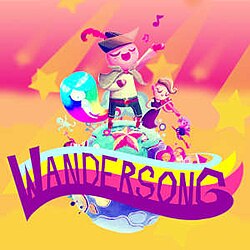

If you picture a hero charging into battle with a sword and a scowl, Wandersong is here to politely ask them to put the sword down and sing a jaunty tune instead. Developed by Greg Lobanov and ported to PS4 in January 2019, Wandersong turns music into a literal toolbox: your voice rearranges the world, unlocks doors, and trolls the laws of platforming physics. On PS4 the right thumbstick becomes your instrument, cycling an eight-direction "song wheel" (each slice a different note across an octave). The result is an oddball, paper-cutout adventure that trades in the usual twitch reflexes for timing, pattern recognition, and the kind of experimental curiosity you probably should have learned from a childhood piano lesson you half-paid attention to. This review zooms in on what really matters if you're booting this up for skill-building: how challenging the puzzles and rhythms are, what mental and motor skills the game asks of you, and whether your DualShock is up to the job.
Wandersong's gameplay is charmingly weird in the best possible way, and most of the challenge stems from learning the rules of its central toy: the song wheel. Imagine an eight-slice pie where each slice is a distinct note. On PS4 you flick the right stick to pick a direction and sing. Sometimes you just need to wiggle a bridge into place, other times you need to match the tonal direction an NPC is singing in. The game leans hard on pattern-matching and interpretive timing rather than brutal platforming. That makes the learning curve more about ear-and-eye coordination than about pixel-perfect jumps. If you're a methodical problem-solver, Wandersong asks you to listen carefully to environmental cues, watch directional hints, and experiment. Puzzles are rarely "just press the right note"-they usually present a small logic puzzle where the musical input triggers physics, moves platforms, or synchronizes NPCs. The eight-direction system is clever because it forces you to think spatially about sound: left-stick movement controls the Bard's body, while the right stick points the song. On PS4 that becomes a simultaneous hand-eye coordination job, so you'll be exercising independent thumb control and short-term memory: can you keep track of which direction corresponded to the sound that made the waterfall pause? Can you remember the sequence of directional cues an NPC sang two screens ago? Those little memory tests are the game's primary micro-challenges. There are rhythm segments in Wandersong where you match tunes against NPCs, which borrow from rhythm-game conventions. These can demand timing precision: hear a motif, then replicate it with the wheel. Unlike high-end rhythm games, Wandersong's rhythm sections are more forgiving; they're intended as narrative beats as much as difficulty spikes. That said, some reviewers found the platforming and rhythm bits a touch undercooked-platforming is serviceable but not the star-and you may run into a few moments where timing feels fiddly. Expect a handful of sections that require precise timing of notes to synchronize moving parts; these are the times the DualShock's responsiveness and your thumb dexterity get tested. The title's commitment to accessibility changes the nature of the challenge. Lobanov designed puzzles so solutions are hinted at by direction rather than sound or color alone, making them solvable by players who are deaf or colorblind. That means the mental skill required is often deductive rather than purely auditory: read the arrows, try the corresponding direction, and learn from the world's reaction. Because Wandersong introduces new uses of the song wheel in each puzzle area rather than ramping a traditional difficulty curve, the skill set shifts as you progress. Early areas are about exploration and basic cause-and-effect experiments; later regions remix mechanics and require you to combine learned behaviors. This structure keeps the game from becoming a monotonous exercise in repetition, but it also means the "challenge" is frequently cognitive rather than reflexive. Several puzzles were simplified during development because testers found them opaque, and that design choice shows. Wandersong rarely punishes you for failure; instead it encourages experimentation and rewards observation. If you're looking for something that will chew up your thumbs for hours, this isn't Dark Souls with a lute. If you want to flex creativity, lateral thinking, and rhythm-based pattern recall, it's an excellent fit. The gameplay challenge, then, is about patience and curiosity: being willing to sing to literally everything and watch what happens. And yes, occasionally you will perform a dance animation purely for the vibes, not the advantage. One last practical PS4-side note: the right thumbstick mapping works well for the song wheel, but if you prefer more granular pitch work you may miss finer musical controls. The mechanic is intentionally broad and toy-like; it's not trying to make you a virtuoso, only a bard who can improvise solutions out of melody and mischief.
Wandersong dresses its puzzles in a paper-cutout visual style that's both economical and expressive. The art is deliberately simplistic-two-dimensional, characters flip like paper when they turn-so the visual language stays readable during puzzle moments. The backgrounds and character designs are warm and often whimsical, which softens the cognitive load when you're chewing on a tricky sequence. Because the game was built with Lobanov as the sole artist and programmer, you get a clear, consistent aesthetic that never asks more from your eyes than you can manage mid-puzzle. Comparisons to Wind Waker and Paper Mario are fitting if you're thinking about tone rather than technical polish. On PS4 the visuals are crisp, perfectly competent, and they do the most important job for a puzzle-adventure: convey what you need to notice without distracting you. The paper look doubles as a subtle accessibility aid-shapes and directions are unambiguous, which matters when the solution depends on nodding toward an arrow and singing.
Wandersong on PS4 is a delightful, low-pressure challenge that tests a different set of skills than most action-adventure games. You're not asked to be a virtuoso jumper or a lightning-quick tapper; you're asked to listen with your eyes and think with your thumbs. The song wheel's directional logic trains spatial reasoning and short-term memory, the rhythm segments sharpen timing, and the puzzle design rewards experimentation and deduction. Accessibility choices-directional hints instead of color or pitch dependence-make the challenge equal parts inclusive and clever. If you want an unforgiving, mechanical trial, look elsewhere. If you want a game that will make you grin while quietly improving your pattern recognition, timing, and improvisational problem-solving, take up the lute. Score-wise it's not perfect: some platforming and rhythm moments can feel thin and the difficulty is intentionally soft, but for what it aims to do Wandersong delivers with charm, heart, and a surprisingly effective set of skill challenges. Sing loudly, practice your thumb independence, and prepare to save the world with a melody and a smile.
 One Piece Grand Adventure on PS2
 Puzzle by Nikoli 4: on PS4
 Twinbee Taisen Puzzle Dama on PlayStation










 Another SquareThought Site