

 Jan 2023
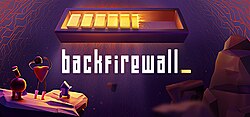

Backfirewall_ is the kind of game that sneaks into your phone, pulls up a folding chair, and starts a TED Talk on planned obsolescence while you stare at plumbing labeled 'GPU' and 'RAM'. On PS5 the experience is presented as a tidy puzzle-adventure: you play an update assistant helping-or sabotaging-an old operating system called OS9 to stop an upgrade to OS10. The premise is delightfully meta, and Naraven Games leans into that with a tight mechanical vocabulary. This review focuses on the implementation details: how the game's systems are designed, how level and UI affordances communicate puzzle constraints, and where the design choices pay off or collide with the game's ambitions. If you like your puzzle games with deterministic rules, clearly signposted mechanics, and a side of technopolitical commentary, Backfirewall_ is worth a deep look.
At its core Backfirewall_ is a rules-engine playground. Each level hands you a checklist of objective constraints-statements about counts, states, or positions of objects-that are intentionally stated as truths which you must then violate to open the exit. That inversion (solve a level by contradicting the given conditions) is more than a novelty; it forces the player to think in terms of state machines rather than single-action puzzles. The primary toolkit consists of a small, explicit set of 'commands' that manipulate the simulation: delete removes objects from the scene, reverse flips the gravity vector for a targeted object, color code toggles object behavior via palette-based rules, and duplicate spawns copies of items. These operations combine like Lego instructions for finite-state automata, and the game deliberately keeps the primitives lean so the combinatorics come from interaction, not from an ever-expanding verb list. Design-wise, the levels are structured around mobile phone subsystems-RAM, GPU, battery, etc.-and each subsystem acts as a microcosm with its own local rules and idioms. That separation is a smart move: it scopes the rule-set per level, enabling Naraven to introduce mechanics gradually without overwhelming the player. Early puzzles serve as tutorials in disguise; they force you to use a single command in isolation so the mental model for that operation becomes reliable. Later puzzles layer constraints (timing, blocked paths, interdependent objects) in ways that reward mental simulation. Because objects are elemental (boxes, levers, gates, elevators), the cognitive load stays focused on system states rather than on learning new object types. The color-code mechanic is a particularly elegant piece of system design. Instead of being merely cosmetic, color assigns behavioral profiles to objects-change the hue and you alter an object's interaction set. That makes visual language meaningful: color changes are both a control mechanism and a communicative signal. It reduces reliance on text and helps the player read the level at a glance, which is essential for puzzles that require juggling multiple dependent states. Duplicate, meanwhile, is the game's way to let you turn finite resources into variables; it interacts beautifully with delete to create little algebra problems: how many objects do you need, at what color state, occupying which coordinates, to falsify the constraint list? The hint system deserves technical praise and a small gripe. Hints are accessible via an in-universe interface-OS9 and a rubber duck-that periodically provide nudges or outright solutions. From a design perspective this is clever: the hint conduit is diegetic, so it doesn't break immersion while still providing graduated assistance. Reviews have noted the system's usefulness and that it's well-designed; the trade-off is that the game's own convenience tools can sometimes 'defeat the point' of a puzzle by offering complete solutions. For players who enjoy the journey, the incremental hint tiers and the player's option to ignore them mostly preserve challenge. For the compulsive achiever who can't resist a hint button, the presence of full solutions can collapse the puzzle's epistemic value. It's a deliberate design choice-accessibility and pacing over pure mystery-and it's implemented cleanly. Pacing and variety are where Backfirewall_ shines. The game rarely relies on a single toy for long; mechanics are recombined, reversed, and put under competing constraints. This keeps the serious core intact: it's not just 'use reverse to move this box' but 'use reverse to reposition a duplicated, color-coded box so that a gate's sensor reads a different state than the checklist describes.' Structure matters: objectives are explicit, feedback is immediate, and the level geometry is functional. Critics noted the puzzles are both 'entertaining without ever being repetitive' and 'short and simple' depending on perspective-both statements are defensible because the game favors compact, satisfiable puzzles over marathon brain-benders. If your ideal puzzle evening is a string of well-crafted vignettes rather than a single epochal enigma, Backfirewall_ aligns with that preference. One technical caveat: the game's rule-driven meatspace sometimes produces edge-case behaviors that players might exploit or find unintuitive. Delete-and-duplicate interactions, or stacking reversed-gravity objects, can generate states the designers didn't explicitly anticipate. In practice these are rarely game-breaking and can even be amusing, but they betray the limits of any hand-authored rules engine: the model is elegant until it isn't, and the exceptions remind you that this is a deterministic sandbox with finite testing rather than a provably closed system.
Backfirewall_ adopts an illustrative, colorful representation of an 'IT environment' rather than photorealism, and that choice supports its systems-first design. Visuals act as the game's primary documentation: color coding is functional, object silhouettes are clear, and environmental motifs (a RAM level that looks like memory blocks, a GPU level that favors shader-like lighting cues) help you map conceptual systems to spatial ones. Several outlets praised the game's imaginative take on the inside-of-a-phone aesthetic and the careful environmental detailing that makes the setting feel alive. Not everyone will be sold on the presentation. Some critics found the visuals' limited appeal and occasional non-sequiturs in design-areas that look pretty but whose internal logic is fuzzy. From a technical-readability standpoint, that criticism matters. In a puzzle game, visual decisions are also affordances: does a platform read as an elevator? Does a gate clearly indicate its trigger state? Backfirewall_ mostly nails this, but a few levels prioritize whimsy over crisp signposting, which can briefly raise the cognitive load when you're trying to simulate the consequences of a command. Overall, the art direction complements the mechanics more often than it sabotages them, and the worldbuilding is both witty and functional enough to justify the game's narrative stakes.
Backfirewall_ is a compact, system-savvy puzzle adventure with a topical narrative and a tight toolbox. Naraven's engineering of mechanics-delete, reverse, color-code, duplicate-creates a small but expressive instruction set that fosters emergent puzzle design while keeping player reasoning transparent. The hint system is one of the better implementations I've seen: diegetic, layered, and optional, though it sometimes hands you the answer if you're careless with its temptation. Visuals and level themes largely support readability and tone, even if a few stylistic choices skew divisive. For PS5 owners who enjoy rule-based puzzles, clear feedback loops, and a story that bites at our disposable-tech habits, Backfirewall_ earns a strong recommendation and an 8.5/10. It's clever, concise, and technical in all the right ways-like debugging a phone with a sense of humor and a soldering iron made of sarcasm.
 Tintin: Destination Adventure on PlayStation
 Puzzle by Nikoli 4: on PS4
 Twinbee Taisen Puzzle Dama on PlayStation
 Professor Layton and the Last Specter on DS










 Another SquareThought Site