

 Sep 2025
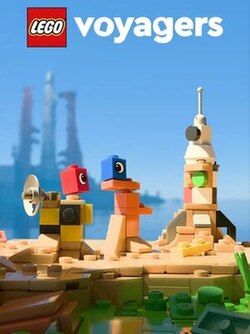

There is a particular gravity to reviewing a game that dresses itself in primary colours and insists, quietly and without fuss, that cooperation is the headline act. Lego Voyagers arrives on PlayStation 5 from Light Brick Studio with the polite confidence of a title that knows exactly what it wants to be: a two-player puzzle-platformer about two 1x1 Lego bricks-Red and Blue-rolling, attaching and occasionally serenading their partner on a mission to rescue an abandoned spaceship. The studio, spun out of The Lego Group, leans on three declared pillars for this outing-puzzle-platforming, friendship, and co-op-and the result is a compact, composed experience that feels like an elegant little machine built out of snap-together pieces. The game's pedigree is visible from the opening seconds. It was produced in Unity, scored by Henrik Lindstrand, and shepherded by creative director Karsten Lund, whose stated ambition was to make a game approachable to all ages while allowing puzzle complexity to creep upwards as the voyage continues. Annapurna Interactive handles publishing duties, and the release on September 15, 2025, included thoughtful touches such as a Friend Pass so the purchaser can invite a partner who plays for free. Critics have been kind: the PlayStation 5 edition sits around a 79 on Metacritic and garnered solid commendations across outlets. The reception makes sense; Voyagers is not a thunderbolt of innovation, but it is deliberate, precise and unexpectedly warm.
Voyagers is built around a simple core: two players, each controlling a Lego brick, must combine movement, attachment and rotation to negotiate environments and construct solutions to puzzles. Movement is a humble affair-rolling and jumping-yet complexity emerges when the bricks latch onto other Lego pieces scattered through levels. These pieces become scaffolding, gears and bridges; occasionally Red and Blue will interlock with each other and with ambient parts, forcing both players to manoeuvre as one. The sense of shared agency is the game's proudest achievement. You are often solving not for a solitary avatar but for a composite object that binds the intentions of both players. The title supports both local couch co-op and online play, which in a modern era of social retreat feels like the right call. Controls are intentionally tactile; reviewers have noted a learning curve as the game's tactile physics and attachment mechanics ask you to think like a child building a model, not like an accustomed platformer veteran. There are moments of fiddliness-the rotation-on-top mechanic and the precision needed to mount certain pieces can feel fussy-but these design choices enforce communication. When your partner sings to draw your attention, the game accomplishes what a million blinking HUD icons cannot: it gets you to look at each other. Puzzles progress in difficulty at a measured pace. Early setpieces are forgiving, instructing players in the ways bricks attach and combine; later stages ask for choreography, timing and occasionally sacrifice, as structures must be moved intact across shifting terrain. The combinatory element-where multiple pieces form a single, unwieldy construct-creates the most satisfying puzzles. Both players must synchronize inputs, plan movement paths and accept that the route is sometimes indirect. It is a lesson in cooperative play that feels earned rather than tacked on. There is a pronounced design ethic that the in-game structures could be recreated with physical Lego bricks, and that ethos carries through to level design. The world is composed of recognisable Lego construction motifs, and Light Brick Studio has clearly worked to make each interactive element read cleanly. That clarity helps when the camera pulls back and the mute tones of the soundtrack encourage a contemplative tempo. The game is not long, nor is it meant to be. What it aims for is a compact, cohesive co-op puzzle experience, and in that goal it largely succeeds.
Visually, Voyagers is modest, restrained and unapologetically Lego. The palettes lean toward muted colours rather than the screaming neons one might expect, lending the stages a subdued, almost diorama-like quality. On PlayStation 5 the game runs with a crispness befitting its scale; the surfaces have the soft plastic sheen of actual bricks, edges click with the satisfying clarity of a well-aimed snap, and level geometry reads cleanly so you rarely misinterpret a route. Light Brick Studio's background in tactile Lego aesthetics shows. Camera work is ambient rather than cinematic, often holding a tableau that lets you appreciate the construction of a puzzle rather than racing for the next cutscene. Henrik Lindstrand's score pairs with these visuals to create an atmosphere of gentle curiosity; the music rarely asserts itself, preferring to buoy the player rather than demand attention. There are no graphical fireworks here-no ray-traced bravura or texture porn-but that is precisely the point. The presentation prioritises readability and tone over spectacle. Technical behaviour is generally stable on PS5. The Unity engine has been used conservatively and capably, and there were few reportable issues at launch. The aesthetic choices align with the game's ambition: to be approachable, calm and focused. When the game shines is during those moments of shared construction, where light, shadow and the physicality of Lego pieces combine to form pleasing little tableaux that feel both playful and deliberate.
Lego Voyagers is not the sort of blockbuster that stomps into the market seeking to dominate headlines. It is quieter, more considered: a co-operative puzzle-platformer that rewards communication, patience and the odd bout of experimentation. Critics cited fiddly controls on occasion, and there is truth in that; mastering the attachment and rotation mechanics demands practice and can frustrate those with twitch reflexes who expect instant responsiveness. For anyone prepared to slow down, however, Voyagers offers repeated moments of satisfaction when a plan comes together, when a clumsy construct becomes a bridge, when two players learn to move as one. The game's reception-generally favourable scores, nominations at The Game Awards 2025 and the D.I.C.E. Awards for family-oriented categories-feels earned. It is a game that understands its audience and respects them, aiming to be accessible while allowing depth to be discovered. The Friend Pass is an especially welcome modern touch, lowering the barrier for cooperative play and encouraging the exact kind of social engagement the title celebrates. If you grew up in the era of split-screen two-player games and still appreciate the simple, tactile pleasure of solving something together, Lego Voyagers is an exemplary little voyage. It is not without its moments of mechanical gristle, but the charm of its design and the warmth of its cooperative ethos make it a worthwhile stop on anyone's PS5 library shelf. Score: 8 out of 10.
 Lego Batman: Legacy of the Dark Knight on PS5
 Lego Games
 Puzzle by Nikoli 4: on PS4
 Twinbee Taisen Puzzle Dama on PlayStation
 Tokimeki Memorial: Taisen Puzzle-Dama on PlayStation
 Professor Layton and the Last Specter on DS
 Lego Builder's Journey on PS5










 Another SquareThought Site