

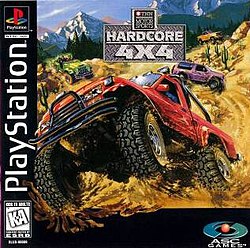

Hardcore 4x4 arrives like a muddy, growling uncle at a polite tea party: not subtle, but certainly memorable. Marketed under the TNN Motor Sports banner for PlayStation audiences in the mid-'90s, this is an off-road racer that cares more about wheel articulation and terrain nuance than about rainbow nitro bars and licensed glam trucks. If you approach it expecting an arcade joyride, you will be humbled. If you approach it wanting to be schooled in the small, sweaty arts of throttle modulation, line choice and roll-avoidance, Hardcore 4x4 is a guilty-pleasure classroom. This review concentrates on the game's challenge design and the player skills it demands. Hardcore 4x4 doesn't try to be everything to everyone; it doubles down on realistic handling quirks and demanding circuits. That makes it excellent training for patience, and a little bit of masochistic fun for anyone who enjoys learning to wrestle a physics model into submission. If you like your racing games with a side of 'read the terrain or face humiliation', read on.
Hardcore 4x4's core idea is deceptively simple: put you in the driver's seat of a Jeep-like 4x4 or a pickup and make the environment work against you. The trick - and the source of most of the game's challenge - is the way the vehicles are modeled. The developers split each truck into four independently reacting wheels, so every bump, rut and sloped bank affects your ride differently. That leads to situations where the right front wheel being stuck in a rut changes your steering input needs instantaneously. On paper it sounds like a cool physics flex; in practice it turns the game into a study in micro-adjustments. Tracks are cross-country loops rendered in 3D: tarmac, dirt, sand and ice all show up, and each surface forces a different skill set. Tarmac rewards aggressive acceleration and clean corner exits. Dirt is forgiving of mistakes but punishes sustained speed with sliding and unpredictable weight shifts. Sand is a slow-sucking sponge where momentum is king - stall, and you will be a sitting duck. Ice is the terror test: everything you learned about steering and throttle has to be rethought. The ability to sense surface grip (visually and through the car's behaviour) and then modulate throttle and steering accordingly is the game's bread and butter. Weather toggles are not a shallow cosmetic trick; rain or ice can make a previously manageable corner into a spin generator. Learning the line for a dry track is just the first half of the job - you must re-learn it when the weather changes. That's an excellent design choice if you like practice, repetition and getting marginally faster with each frustrating attempt. There are six selectable vehicles, each with its own handling, acceleration and suspension setup. The differences aren't just numbers on a menu - they matter. A stiffer suspension will reward precise lines and maintain roll control on fast sections; a softer setup will soak bumps but lose authority on sharp changes in camber. Choosing the right truck for the track and conditions is itself a strategic exercise. You'll find yourself swapping rides and forgiving your own mistakes less as you understand what each chassis wants. Racing modes are straightforward: single race, championship (six tracks back-to-back), and a time trial that supports up to eight players in a round-robin for fastest laps. Championship mode is where Hardcore 4x4's endurance demands show. The cumulative stress of consecutive tracks means mistakes compound - a bad finish sends you into the next race with lower confidence and more pressure. Time trial feeds the game's competitive side: raw track knowledge and precision driving beat flamboyant aggression here. The game quietly forces you to learn track-reading. Many reviewers praised the tracks for their thoughtful layouts and weather interplay, but they also highlighted two design decisions that turn learning into necessity: narrow circuits and the inability to drive off the track. Narrow tracks reward the defensive driving comparable to real rallycross lines - if you get ahead, you can block effectively, which can reduce overtaking excitement in multiplayer but also raises the importance of choosing passing windows carefully. More importantly, obstacles like steep slopes or hidden dips punish brainless throttle use; you can't bail off into a field to save time. A lack of an overhead map or convenient minimap is a cruel teacher. Without a map to cheat off of, you must memorize corners, identify braking landmarks and anticipate sudden changes in surface. That memorization is part of the fun if you like learning through repetition. If you're an impulse-button masher who likes being told where to go and how fast to drift, this will be irritating. Ballooning over jumps and landing correctly is another technical skill the game demands. Physics on jumps are satisfying: vehicle attitude in the air, the nose dropping or rising, and the need to put both throttle and steering inputs together on landing are all modelled well for the era. The penalty for botched landings is harsh - you can bounce, flip or lose forward momentum, and the game gives little sympathy to sloppy aerial grazing. Pacing across undulating terrain requires you to be part driver, part physicist: keep your center of mass manageable, anticipate weight transfer and don't treat the truck like it's mounted on a skateboard. The development backstory explains the challenge: Gremlin separated wheels into independent sections so they would react individually to the environment. That detail shows up as both realism and unforgiving complexity. Mastery means learning to manage each corner's combination of camber, surface and obstacle rather than relying on a universal 'brake-turn-accelerate' formula. There are also some quirky extras for people who like secrets. Hardcore 4x4 hides an Asteroids clone called Roids behind a cheat code - a little palate cleanser when the real game has ground your patience into gravel. It's a wink from the developers saying, 'We know the main game is strict. Have this for your downtime.' Where the challenge sometimes breaks from rewarding into irritating is in execution problems: low frame rates, pixelization and clipping issues that reviewers at the time called out. Responsiveness suffers when the screen judders, and that can make a precisely timed correction feel out of your control. Hardcore 4x4 is, therefore, an excellent teacher if you have the patience to look past its rough edges. It does not forgive sloppy inputs and, at times, it doesn't entirely forgive its own technical hiccups either.
Graphically Hardcore 4x4 sits in that awkward mid-90s territory where ambition outran hardware. The trucks and environments are built out of basic 3D models and textures, and at a glance you can appreciate the attempt: the environments have real variation in surface type, and the trucks have distinguishable silhouettes. That said, the textures are often drab and grainy; colors are muted rather than vibrant, and polygon pop and clipping occasionally break immersion. Some reviewers called the visuals 'incredibly grainy' - a fair jab when frame rate hiccups make what would otherwise be a tight handling game feel sluggish. The animation and vehicle responses are the game's saving grace visually. Suspension travel, the way wheels react independently to bumps, and the posture of a truck about to roll are convincing enough that you'll accept the low-res textures. The frame rate problems reduce the impact of these details, though: when the game slows, your muscle memory versus what you see can be slightly out of sync, which turns a visual quirk into a gameplay handicap. The soundtrack, a palette of hard rock, fits the aesthetic (and gives you something to rage-anthem to as you learn to not flip over a deceptively small rise).
Hardcore 4x4 is a niche game with a clear personality. It's less an arcade thrill ride and more a rough-and-ready off-road simulator wrapped in late '90s PlayStation aesthetic. If you prize realistic reactions, track-reading skills and careful throttle control, you'll find a lot to like: the independent wheel model, surface variety and weather systems all encourage a precise, thoughtful approach to racing. The game teaches patience, rewards memorization, and gives satisfying tactile feedback when you finally thread a perfect lap. If your idea of great racing is big jumps, bright visuals and instant thrills, Hardcore 4x4 will test your tolerance. Narrow circuits that allow blocking, the inability to leave the track, and the lack of an overhead map can make races feel tight and sometimes frustrating rather than liberating. Technical issues - low frame rate, pixelization and clipping - also temper the experience and occasionally interfere with the very skill the game asks you to develop. In short: pick Hardcore 4x4 if you like your driving games like a demanding teacher - strict, occasionally maddening, but capable of producing actual improvement if you put in the time. It's a rewarding grind for off-road aficionados and patience-trained racers, less so for players who want instant arcade gratification. The title did respectable business back in the day (around A32 million in revenue for Gremlin's releases), which suggests it found its audience. For those willing to learn the game's vocabulary - lines, weight transfer, surface sense and controlled aggression - the reward is mastery. For everyone else, the game will be a reminder that not every classic wants to hold your hand.
 Deca Sports DS on DS
 Alan Hansen's Sports Challenge on PS2
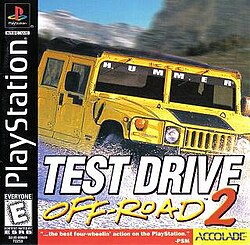
 Test Drive: Off-Road 2 on PlayStation
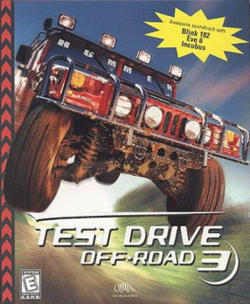
 Test Drive: Off-Road 3 on PlayStation
 Test Drive: Off-Road on PlayStation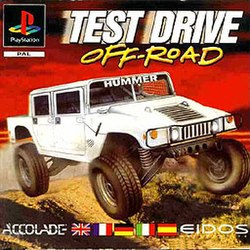
 Actua Golf 3 on PlayStation
 N2O: Nitrous Oxide on PlayStation
 Actua Ice Hockey on PlayStation
 Loaded on PlayStation
 Actua Soccer on PlayStation












 Another SquareThought Site