

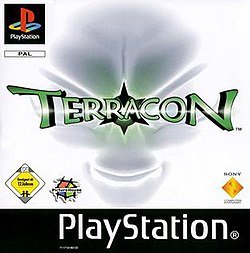

Terracon is one of those late-era PlayStation curiosities that tries to wedge puzzle-systems, resource economy and action-platforming into the console's familiar 3D sandbox. Developed by PictureHouse Software and published by Sony in Europe on 25 August 2000, it never made the jump to retail shelves in North America despite an announced Midway release. On paper the game is an ambitious blend: more than thirty levels scattered across the Solar System, a narrative about a rogue terraforming AI and a protagonist named Xed who collects launch code cartridges (LCCs) to turn planetary missile defenses against the titular mothership. The real conversation, though, is the plumbing - how Terracon's mechanical pieces fit together under the constraints of late-90s PlayStation hardware and whether those systems add up to a satisfying experience.
Terracon's spine is resource-driven level design. Genergy - a catch-all pickup with multiple varieties and values - is both a tool and a currency. Because genergy is required for moment-to-moment actions (destroying enemies, breaking containers) and macro-actions (building or destroying structures, creating beacons to exit a level), the player constantly juggles immediate survival with long-term goals. That dual use converts ordinary item collection into a small economy: do you spend genergy now to blast through a gating wall or hoard it to create a beacon and secure extraction? It's a tidy design move, especially for a PS1 title, because it forces decisions without resorting to convoluted menus. The core objective per level is straightforward: find the required number of LCCs (one to three depending on the level) and then generate a beacon so Xed's dropship will extract him. The LCCs themselves introduce a familiar mix of exploration and combat gating - most are found while traversing the level, but at least some are locked behind boss encounters. Bosses here function as both checks on the player's mastery of the game's systems and as reward gates for narrative progress. Because the game has over thirty levels, pacing depends heavily on how tightly each stage uses genergy gates and TOPS mechanics to vary the challenge. TOPS (Terracon outrider pick-up systems) are a clever mechanical flourish. These orbiting spheres attach to the player upon collection and provide passive or active benefits depending on their color. The orbit mechanic creates an interesting spatial relationship: the pickups are not static stat boosts but dynamic entities that travel with you and can be ejected if you collect too many. The four-item carry limit with a random ejection on the fifth pickup creates risk/reward calculus; overfilling your complement becomes a tactical hazard, which in turn feeds the replication-and-purchase meta-game. Completing levels with TOPS in tow grants replication points based on rarity and usefulness. Between levels you can spend those points to buy TOPS before starting a stage. That pre-level economy is a compact but meaningful meta-progression loop: skilled play (keeping TOPS alive to the end) translates directly into future-level advantages. Mechanically this acts like a light equipment system without a heavy UI overhead, which suits the PS1's controller layout and menus. The health and lives systems deserve attention because they deviate from the binary hit-or-die model common in action-adventure games. Health is numerically tracked on a 100-point scale and damage is applied in 25-point chunks - meaning each hit equates to a quarter loss and the player can sustain five hits before a death state due to the game's allowance for health to drop below zero. That quirk is revealing: it suggests the developers tuned enemy damage as discrete steps to simplify feedback and balancing. Life-force units refill health, and surplus life-force-regenerators convert into extra lives up to a maximum of four. This creates a secondary resource loop where excess pickups are not wasted; they buffer risk and encourage thorough exploration. A core technical and design consideration is how genergy interacts with level geometry. The documentation notes genergy can be used to build or destroy a wide variety of structures and meshes, which implies a local level-state system that tracks created or destroyed constructs per playthrough. For a PlayStation game this is nontrivial: the engine must stream relatively static geometry while tracking per-level state changes (what's been built/destroyed), the player's inventory (genergy amounts and types), and the dynamic TOPS orbs. That combination likely taxed memory and required conservative reuse of assets and mesh primitives to keep performance acceptable on fixed console hardware. The beacon mechanic is also a neat gate design: a constructed beacon serves as a level's exit, built with genergy at the player's discretion. The beacon spawns Xed's dropship above a green access point and the player is teleported on contact. Using an explicit buildable exit harmonizes the game's resource economy with progression pacing - running low on genergy can force backtracking or creative use of TOPS to survive until a beacon can be erected. Enemy encounters appear to be split into normal mobs and occasional bosses who drop LCCs. While the source material doesn't list enemy AI sophistication, the system-level design (genergy used as ammo and construction material) implies encounters reward both combat proficiency and resource management. Because genergy can destroy enemies directly, combat becomes another axis of the resource economy: fighting is an investment of genergy that might remove the need to use it to alter the environment. From a control and UI perspective the simplicity of the systems (collect genergy, manage TOPS, make beacons) suggests a minimal HUD that foregrounds the essentials: health, genergy quantity, TOPS count, and lives. The PS1 controller's limited inputs benefit from such prioritization; bundling meta-progression (TOPS replication and purchases) into a pre-level screen keeps menu interactions light and the player in flow during levels. Two potential friction points are implicit. First, random ejection of a TOP when collecting a fifth adds tension but can also feel punitive when it saps a rare TOP at an inopportune time. Second, genergy's many roles can produce accidental soft-locks if a player squanders it early and cannot restore enough to create a beacon - though the game's design likely provides scatterings of genergy pickups to prevent outright dead-ends. These are not fatal flaws but design trade-offs that shape the game's learning curve and reward careful play.
Evaluating Terracon's visual presentation requires context: this is a PlayStation title released in 2000, at the tail end of the console's life cycle when developers had chewed through many of its tricks and limitations. The art team credited - Dennis Gustafsson, James Duncan, Paul Helman and John Laws - leaned into stylized planetary environments that read well even with the PS1's low-res textures and affine texture warping. The game makes functional use of 3D primitives and tiling textures to deliver a sense of scale across varied locales like Venus, Jupiter and Earth, and their moons. Technically, the PS1's lack of a hardware z-buffer and its limited VRAM encourage certain trade-offs: short draw distances, low-poly models with detailed texture work, and occasional sprite billboarding to simulate complexity. Terracon's systems - orbiting TOPS, destructible/buildable meshes via genergy, dynamic beacons and dropship spawn points - suggest efficient memory management. Instead of holding large numbers of unique assets for every possible construct, the engine likely reuses modular meshes and texture sheets, then applies state flags to determine whether a mesh should be rendered as 'built' or 'destroyed'. That approach minimizes asset churn and keeps the pipeline feasible on console hardware. Animation and character models are not described in depth by the source, but the presence of over thirty levels implies a need for varied set pieces and distinct palettes so environments feel unique across the Solar System. Composer Jim Croft's involvement is worth noting: on a technical level, audio on the PS1 comes with constraints too - compressed samples and looping tracks with little streaming bandwidth. A good soundtrack in such a setup can mask polygonal shortcomings and heighten atmosphere, which is probably what happened here given reviewers' generally positive reception to the package as a whole. Given the era and the design choices, the visual identity of Terracon likely skews toward readable clarity rather than flashy fidelity. In practice that means level geometry prioritizes navigational clarity - platforms, access points, and beacon zones are visually distinct - while particle effects and lighting are used sparingly to conserve cycles. For players who cut their teeth on PS1-era 3D, the aesthetic is familiar and functional rather than jaw-dropping.
Terracon is an example of systems-first design on constrained hardware: it asks the player to think in resources and attachments. Genergy as both a tool and currency, TOPS as orbiting modifiers with an emergent meta-economy, and the beacon+LCC structure for level completion all stack into a coherent mechanical identity. Those ideas outshine some of the game's rough edges - PS1-era technical limits, occasional punitive randomness in TOPS ejection, and a gameplay loop that can feel repetitive if you grind the same mechanics across thirty levels. If you approach Terracon as an engineering puzzle wrapped in a late-90s sci-fi skin, it rewards attention. There is clear design intent behind the number-focused health system, the replication points economy and the resource-gated exits; the game feels like a small machine where every part affects the rest. For collectors, fans of PS1-era experimentation, or players who enjoy action-adventure titles with light strategic bookkeeping, Terracon is a satisfying oddball. For those expecting a fluid modern action game, it exposes its age. Given its ambition, the European-only release and the mixed-but-majority-positive contemporary reviews, I land on a 7.5 out of 10: a technically interesting title that mostly gets its systems to play nicely, and earns a recommendation if you're curious about what developers squeezed out of the PlayStation's last gasp.
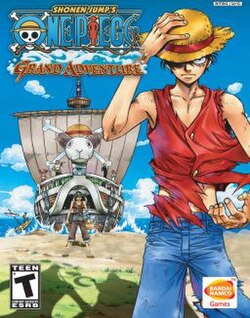
 One Piece Grand Adventure on PS2
 Taiko no Tatsujin: Dokodon! Mystery Adventure on Switch
 Onimusha: Dawn of Dreams on PS2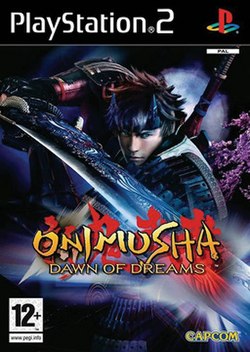












 Another SquareThought Site