



In an era when the PlayStation was still chewing through polygons like a hungry studio executive chews through marketing buzzwords, The Unholy War arrived with a curious pedigree and a conspicuous demo disc credit: it shipped alongside a playable slice of the eagerly awaited Legacy of Kain: Soul Reaver. Birthed by Toys for Bob and distributed under Eidos Interactive's banner (with a Crystal Dynamics name tucked into the small print), this is not your straight-ahead two-button street fighter. The Unholy War tries to build a hybrid: part arena brawler, part tactical hex-map contest. It's ambitious in the way late-'90s console experiments were-part bravado, part hopeful improvisation-and it wears that experimental streak on its sleeve. For players who remember when magazines came with cover CDs and reviewers routinely complained about 3D camera systems, this game will feel like an artifact of an excited, uneasy time in fighting-game design.
The Unholy War splits itself into two distinct toys in the box: mayhem mode and strategy mode. Mayhem is pure arena combat-one-on-one bouts fought in the game's so-called taeng arenas. Each fighter carries three attack moves that siphon energy from a continuously regenerating bar. Matches are fought in 3D spaces rather than flat planes, and arenas are hardly serene: hazards, teleporters and power-ups litter the floors, promising sudden reversals of fortune and a handful of 'gotcha' moments for the inattentive. Characters have distinct matchups, with strengths and weaknesses that encourage experimentation rather than button-mashing to the exclusion of everything else. Strategy mode is where Toys for Bob shows the chops of a developer not content to make yet another straight brawler. The tactical layer plays out on a hex-based map composed of interlocking hexes. Both sides usually possess a base hex that acts as a market for buying and selling units; your objective is the enemy base and the units shielding it. Turns are metered: up to three moves per turn, and a move is either moving a unit or using a unit's special skill. Buying and selling don't count against your move allowance, which introduces a nice economy-and-maneuver interplay. Units vary in movement range and mining ability. AUR, the game's magical resource, is mined by occupying hexes that contain it; some characters are better miners than others, and an occupied AUR hex pays out extra resources at the start of turns. Combat on the strategy map is resolved by committing units into arena fights when you move onto an adjacent hex and confirm an attack. The tactical exchange then shifts into direct arena combat; the loser can call in a nearby backup unit if one is adjacent to the contested hex, keeping the larger battle interesting and often longer than expected. The base itself generates a steady trickle of AUR (10 per turn) until someone physically marches a unit onto its hex and wipes out the guards. Between battles an omniscient narrator identified only as "the observer" drips story fragments to the player, revealing the planet Xsarra's lore-a world where the native Arcanes and the invading Teknos have fought decades-long wars over Aur, and where the love-sparked scandal of Katrina and Andrus threatens to ignite fresh carnage. The hybrid nature of The Unholy War is its defining virtue and its most honest liability. Offering both arcade-style and strategic play broadens the appeal, but it also means neither mode reaches the razor-sharp polish of genre leaders of the time. Arena battles can be rewarding and twitchy, and the tactical map has surprising depth, but players will find themselves juggling two different skillsets. Multiplayer helps, and the game rewards creativity and patience, but anyone seeking the immediate precision of a top-tier fighter or the encyclopedic depth of a full-blown strategy title may feel like they're getting the middle course rather than the feast.
The Unholy War sits firmly in the late-'90s aesthetic: blocky polygons, flat textures, and a handful of charmingly awkward animation transitions. Characters are modeled in full 3D and animated to reflect their curious, hybrid anatomies-winged Stygian constructs, metallic Teknos, and the slippery Quicksilvers-yet the technical limitations of the PlayStation hardware are never far from view. Textures are economical, stage geometry is simple, and draw distance is apologetically short, but the arenas are designed with practical gameplay in mind. Teleporters, hazards and elevation changes are visible and functional even if they aren't rendered with modern fidelity. Lighting and particle effects are minimal, which makes the game age like a photographed magazine ad: slightly grainy, but readable. Character design is, if nothing else, memorable. The roster leans into creature-concept work rather than straight-up martial-arts archetypes, which gives fights a narrative flavour-these battles feel like skirmishes between factions rather than isolated tournament matches. Sound design is serviceable; the score and effects perform their job without drawing attention away from the battle or the map. If you place this game beside contemporaries that favoured glossy, high-budget sheen, it will look modest. Placed in the context of experimental 3D fighters and hybrid strategy attempts of the era, it acquits itself well enough to avoid technical pity and often earns genuine appreciation for its ambition.
The Unholy War is one of those late-1990s curios that will split opinions along predictable lines: players who prize immediacy and the ironclad mechanics of arcade fighters might find it slow and a little woolly; those who enjoy tactical depth and the novelty of combining hex-based strategy with arena combat will be rewarded for their patience. Its aggregate reception-roughly 76.6% across contemporary outlets-was fair, reflecting a game that did many things right but seldom with the clinical perfection of the best titles in either genre. The strategy mode provides real replay value and occasional strategic brilliance, while the arena battles deliver enough variety to keep local multiplayer lively. For a PlayStation library still trawling for experiments, The Unholy War is recommended to curious players and collectors who love seeing designers try to fuse systems rather than re-skinning the same formula. It never became a household name, and the camera-and-control quirks that plague many of its peers are present here too, but there's genuine heart in its conception. If you stumble across a used copy and you remember those magazine review pages full of earnest developer interviews and cover-disk demos, this is a pleasant detour worth the small investment of time. Consider it a solid 7.7 out of 10: not flawless, frequently inventive, and defiantly of its time.
 Helldivers 2: The Ultimate Skill Test — How to Survive When Friendly Fire Is A Feature
 Transformers: War for Cybertron on PS3
 Ultraman Fighting Evolution on PlayStation
 ACA Neo Geo: Art of Fighting 2 on Xbox One
 ACA Neo Geo: The King of Fighters '98 on Xbox One
 Touhou Hyoibana: Antinomy of Common Flowers on Switch
 Crash Bandicoot 4: It's About Time on Switch
 Crash Bandicoot 4: It's About Time on Xbox Series X/S
 Crash Bandicoot 4: It's About Time on PS5
 Disney's Extreme Skate Adventure on PS2
 Crash Team Rumble on Xbox Series X/S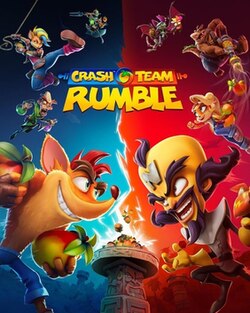











 Another SquareThought Site