

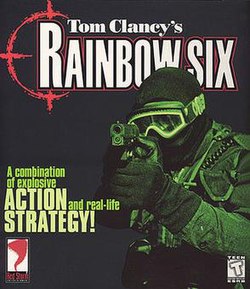

Tom Clancy's Rainbow Six arrived in the late '90s like a breath of tactical fresh air - a game that told shooters to hold their trigger-happy horses and to plan, recon, and maybe read a map once in a while. The original PC version was a milestone: permadeath for operatives, planning screens that let you feel like a miniature Special Forces director, and bullets that were not shy about killing you instantly. The PlayStation port, developed by Rebellion, tried to squeeze that same meat-and-maps experience into a much smaller console sandwich. The result is a curious animal: a game that occasionally lets you taste the sophisticated challenge of Rainbow Six but is hamstrung by a port that trims some core systems, jankifies the controls, and generally seems to have arrived with its tactical belt a notch too loose. This review looks exclusively at the PS1 version, and - in the spirit of Rainbow's own planning phase - we'll break down what makes the game challenging, which skills it demands (and punishes), and whether the PlayStation release rewards the kind of patience and thought that the series promises. Spoiler: if you like to think before you shoot, you'll appreciate the design philosophy. If you worship smooth aiming and ergonomic menus, you might want to keep both hands on your controller and your expectations modest.
Rainbow Six's DNA is all about planning, timing, and ruthless efficiency. The ideal mission is a short, tense ballet: brief the team, assign roles, choose kit, and then execute a plan you drew on a tiny two-dimensional map. The core design forces you to treat every bullet like it matters because most enemies will drop you with one good hit. That one-shot lethality, combined with permadeath for named operatives, turns every mission into a high-stakes puzzle. You can brute-force some encounters, but the game actively punishes spray-and-pray. The thrill comes from succeeding with finesse, and the disappointment hits hard when a single misread of a door leads to a failed run and the permanent loss of a favorite operative. On PlayStation the developers trimmed the team size to four (where other versions supported up to eight), and that change reshapes the tactical calculus. You can no longer throw waves of specialists at a problem; every operative matters more. This increases the weight of individual decisions: pick the right mix of Assault, Demolitions, Electronics, Recon, or Sniper, and you'll be able to cover the mission's technical needs. Pick poorly and you'll spend ten minutes figuring out which door can be breached and which should have been left alone. The smaller team can make some encounters feel more intimate and tense, but it also exposes the port's weaknesses: when an AI teammate does something silly, you feel it immediately, and there are fewer human (or AI) bodies to absorb errors. The planning stage is where the PS1 Rainbow Six still sings. The maps, the ability to issue preset orders, set paths, position breaching gear and flashbangs, and assign uniforms are all present - though the presentation differs from PC. In theory this preserves the strategic layer: the planning stage is a meta-skill you must master. Good planning reduces RNG (yes, Rainbow has a sprinkle of it) and turns the mission into a test of execution rather than luck. Learning to set team paths so they don't funnel into a single doorway, timing flashbangs with breaching charges, and sequencing team 'go' codes becomes second nature once you accept the game's lo-fi ergonomics. Execution, however, is where the PlayStation version is an uneven teacher. You control the active team leader and can snap to other leaders, but critics and players noted that the PS port often felt like it had abandoned some of the team-leadership finesse of the PC original. Teammates' AI is inconsistent - sometimes impressively competent, sometimes maddeningly literal - and pathfinding can be an Achilles heel in narrow corridors. On missions that require precision timing, clumsy AI routing will make you re-run an otherwise perfect plan just because an ally got wedge-stuck in the geometry. Expect to spend as much time babysitting your AI as you do outsmarting enemies. Skills required and rewarded by the game: - Patience: This isn't a twitch shooter. The victory here is slow and quiet. Rushing earns you a reload screen (or a funeral). - Map literacy: Successful runs depend on understanding the layout and visualizing line-of-fire and choke points. The planning grid is your friend; treat it like a Spotify playlist for tactics. - Resource management: You only get so many breaching charges, flashbangs, and medpacks. Use them where they swing outcomes. - Timing and sequencing: Opening doors, throwing flashbangs, and breaching in a coordinated way is the core tempo of success. - Adaptability: When the plan inevitably goes sideways (and it will), you must improvise while keeping casualties to a minimum. That means quick thinking under pressure. - Micro-management: Issuing targeted orders at runtime - positioning, hold points, who goes through which doorway - is part of the craft. Where the PlayStation port complicates the learning curve is in its interface and controls. Rebellion added visible weapons in first person and redesigned mission layouts for the platform, but the control mapping and limited precision of the DualShock-era sticks make fine aiming and quick command issuance clunkier than on PC. The PlayStation controller occasionally feels like it is translating your tactical genius through a pair of mittens. Add to that the absence of robust multiplayer on the PS1 release (no online play, and the port removed some of the cooperative spirit), and you lose an important outlet: testing plans with human teammates. On PC the multiplayer made learning faster and punished mistakes differently - with friends laughing at your tactical sins. On PS1 you learn mostly the hard way. Repetition is part of Rainbow Six's identity: missions are intended to be short but require multiple attempts. The PlayStation port retains that clockwork repetition, which is both good and bad. It's good because repetition is where you learn to refine plans. It's bad because when the port's technical rough edges - rough pathfinding, occasional glitches, and fiddly control response - throw a spanner in the works, repetition starts to feel like banging your head on a wall that occasionally moves. If you have the temperament to tolerate those teething problems, the PS1 release still hands you a tasty tactical challenge; if you want streamlined execution and responsive controls, you'll be frustrated faster than you can say "breach."
If you expect PS1-era visuals to shine like jewel-encrusted night vision, lower your expectations and maybe open a window for fresh air. Critics lambasted the PlayStation port's aesthetics; words like "aesthetically bankrupt" and "poor graphics" cropped up in reviews, and for good reason. The port shows its age and compromises: draw distance, texture detail, and character animations are serviceable at best and awkward at worst. Visible weapons in first person are a neat touch on paper, but the execution on PS1 made some firefights feel awkward - weapon models look chunky, and animations can be stiff. The presentation also affects tactical clarity. Clear sightlines and readable environments are crucial for planning and execution; when visual fidelity drops and sprites look muddled, identifying enemy positions and planning lines of fire becomes harder. This is a nontrivial issue in a game where one stray bullet decides if a mission becomes a triumph or a funeral procession. Sound design helps a bit - footsteps, door noises, and alarms cue you - but the overall package on PlayStation can't compete with the PC or Dreamcast ports, which were praised for being closer to the original's intent. If the game's challenge depends on perceptual clarity, then the PS1 version sometimes feels like playing detective with sunglasses glued to your face.
Tom Clancy's Rainbow Six on PlayStation is a study in frustrated potential. The underlying design - realistic weapon lethality, permadeath, role classes, and a planning-first approach - asks players to develop skills that aren't fashionable in every shooter: patience, deliberate planning, and an almost monastic respect for timing. Those systems still deliver moments of genuine tactical satisfaction on PS1: a well-planned breach executed perfectly, a hostage rescued with surgical efficiency, the glow of a cleared map. But the port's compromises - a reduced team size, awkward control mapping, inconsistent AI, and middling visuals - shorten those moments and lengthen the irritation. If you want an authentic Rainbow Six challenge and don't mind fighting the port's clumsier bits, the PlayStation version can still teach you how to think like a small-unit commander. It will demand practice, map study, and a patience you didn't know you had. If you're after the purest experience or the smoothest execution, hunt down the PC release or the stronger Dreamcast/N64 ports instead. Score-wise, this PS1 outing deserves credit for the ambition and the meat of the tactical challenge, but the rough polish and platform-specific flaws mean it falls short of greatness. Give it a shot if you like your shooters sprinkled with strategy and your victories earned, not handed to you by aim assist.
 Tom Clancy's Rainbow Six: Vegas on PS3
 Tom Clancy's Rainbow Six: Vegas 2 on PS3
 PixelJunk Shooter 2 on PS3
 Conflict: Global Terror on PS2
 PixelJunk Shooter on PS3












 Another SquareThought Site