

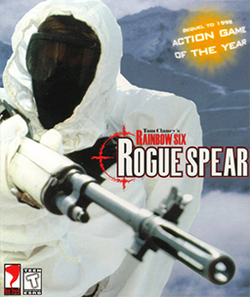

Rogue Spear arrived as the serious, no-nonsense sequel to the original Rainbow Six: think less Hollywood blockbuster, more clandestine missions where your biggest enemy is poor planning and the laws of physics (and bullets that don't care about your feelings). The PlayStation port landed in early 2001 - a couple of years after the PC crowd got cozy with it - bringing the franchise's tactical DNA to couches and memory cards. On the upside: you still have to plan, stealth is king, and one well-placed shot will make your favorite operative go from hero to a very permanent spectator. On the downside: the PlayStation version carries some of the porting woes console players have come to dread, and critics (and a handful of teammates) were not shy about pointing them out.
Rogue Spear is not the kind of game you sprint through while scarfing pizza. It rewards patience, coordination and the kind of micro-management that makes spreadsheet fans glow with pride. The core idea is brutally simple: Rainbow operatives can die from a single bullet, so you plan like your virtual job performance review depends on it. Before each mission you get a briefing, a planning board, and a roster of specialists categorized by role - Assault, Demolitions, Electronics, Recon and Sniper - each with their own strengths. You outfit teams, set waypoints and scripted orders (color-coded like someone organized a tactical fashion line), and then hit the mission. During play you can swap control to any team's leader, or sit back and watch your plans unfold in the 'watch' mode introduced in previous entries. A couple of mechanical wrinkles that made fans smile: a lean mechanic, so you can peek around corners without turning into an open target; camouflage selection, which sounds flashy but basically means you can look right for the mission and not like someone lost in a sporting goods store; and the return of watch mode, which lets you play the patient, smug general who never leaves the van. There are campaign missions with objectives ranging from hostage rescues to disabling bombs, planting surveillance and gathering intel - the usual spy-kit checklist. The campaign on the original release runs about 18 missions, and while the PlayStation port trimmed or adapted things for the console experience, the DNA remains intact. Outside the campaign there are Lone Wolf and Terrorist Hunt modes. Lone Wolf is exactly what it says on the tin: complete an entire level with one operative (welcome to extreme boredom with a hint of heroism). Terrorist Hunt is a pure survival arena where you clear the level of up to 30 bad guys, which is oddly cathartic if you like methodical chaos. On paper, the planning stage is the game's elegant core. In practice, especially on the PlayStation, it could feel clunky. Rogue Spear's planning interface was designed when mouse-and-keyboard was the archetypal gaming marriage; porting that to the PlayStation controller introduced some fiddliness. Reviewers pointed out that the already dense planning stage became more of a chore when levels grew in complexity. Combine that with the game's permadeath rules (if an operative dies, they're gone for the campaign), and the PlayStation player can end up feeling like they're babysitting an increasingly fragile team of pixel soldiers. Artificial intelligence is a major talking point. The game tried to push the AI forward from the original, and in many cases enemy reactions were improved - they investigate sounds, react to seeing you, flee, or sometimes insult your tactical choices with sheer aggression. Teammate AI, however, was described by several critics as flaky. On PlayStation, it sometimes felt like your teammates had the coordination skills of two sloths and a particularly indecisive pigeon. They were prone to accidents (falling off ladders, wandering into danger), getting themselves killed in ways that made mission failure feel unfair rather than deserved. Meanwhile enemies tended to be terrifyingly on-point with their aim, making some firefights feel like too steep a difficulty spike caused by inconsistent allies.
When Rogue Spear first raised its head on PC, it won praise for upgraded visuals and smoother animations compared to its predecessor. The PlayStation release, however, is a port and carries the compromises you'd expect from squeezing a relatively complex PC engine into the older console's hardware. Expect lower fidelity compared to the PC and Dreamcast versions: textures are muddier, draw distance is more modest, and the frame rate sometimes dips when the tactical ballet turns into a crowded gunfight. Still, the game manages to keep the serious tone with moody indoor lighting, believable (if blocky) environments and decent animations for door breaches and takedowns. Composer Bill Brown's score lends a stern, cinematic feel that helps sell the tension, even when the visuals are doing their best impression of being from a simpler time. From a UI perspective, things can be frustrating. The planning interface that made perfect sense with a mouse becomes less graceful with a controller, and the PlayStation HUD adaptations occasionally feel like someone tried to cram a Swiss Army knife into a matchbox. Sound and atmosphere are solid: gunshots have weight, hostages sound panicked (or annoyed), and the occasional guard chatter helps the immersion. If you're coming from the PC or Dreamcast versions, you'll notice the downgrade; if PlayStation is your only way in, you'll find the game still has enough of a tactical sheen to reward thoughtful play.
If you want Rainbow Six on a PlayStation and you're a fan of deliberate, tactical play, Rogue Spear is basically the franchise doing a serious faceplant into console territory - simultaneously impressive for its ambition and occasionally exasperating for its execution. The good parts are the same reasons the series hooked so many players: realistic damage model, mission variety, that deliciously satisfying planning phase, and the genuine thrill when a well-executed breach goes off without a hitch. The parts that make you mutter at the TV include the bumpy PlayStation controls, the occasionally incompetent teammate AI, and the planning interface that refuses to be as elegant with a controller as it is with a mouse. Critically, the PlayStation version received lukewarm to mixed scores compared to the PC original. Reviewers praised the concept and the core tactical gameplay but were put off by porting compromises and AI oddities. If you approach Rogue Spear on PlayStation like an old-school stealth-thinker rather than a twitch-shooter star, you'll find plenty to enjoy: it is rewarding, tense, and serious about consequences. If you want a pick-up-and-play, reflex-focused shooter with a jaunty soundtrack and a long killstreak meter, this probably isn't for you. Final verdict: a niche classic with a grumpy console face. Buy it if you like methodical, high-stakes stealth and can forgive a port that sometimes looks like it stayed up too late trying to translate keyboard wisdom into controller poetry. Otherwise, maybe find the PC or Dreamcast versions (or a less temperamental demo partner) - your virtual teammates will thank you, and so will your patience.
 Tom Clancy's Rainbow Six Siege on Xbox Series X/S
 Tom Clancy's Rainbow Six: Vegas on PS3
 PixelJunk Shooter 2 on PS3
 Conflict: Global Terror on PS2
 PixelJunk Shooter on PS3












 Another SquareThought Site