

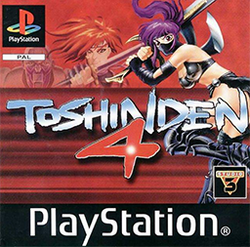

When Battle Arena Toshinden first carved its way into the mid-1990s fighting scene it did so with crunchy polygonal swords and a swagger the PlayStation had not seen since the arrival of its first 3D gladiators. Toshinden 4, released in Japan as Toshinden Subaru, arrives at the end of the decade as the series' swan song. It is the fourth and final instalment and, unlike its predecessors, it never made the leap to a North American street date. What we get instead is an odd mixture: new faces stacked on a familiar brand, a plot that sprinkles mythic MacGuffins about four holy weapons, and presentation choices that suggest the team was aiming for cinematic scope while tripping over the syntactic sugar of late 90s polygon fighting design. The package promises ambition - teams of three-on-three matches, cutscenes before fights, survival and time attack modes - but ambition does not always buy competence.
Toshinden 4 shifts the series' usual single-sparring focus into a team-based format. Story mode plays out as three-on-three battles, which on paper is a sensible attempt to broaden strategic options and lengthen matches. Extras include Survival, Time Attack and Practice modes, so the developers did not neglect the usual checklist of post-arc distractions. Before each encounter there is a short cutscene to push the plot about the Four Sacred Arms forward; it's a 1990s import reviewer's delight to see a fighting game try to stitch a coherent narrative to its bouts rather than rely on nothing but win screens and boss names. In execution the fighting, however, is where Toshinden 4 begins to show its teeth - and not in a good way. Critics of the period, and a prominent GameSpot import review in particular, noted that controls feel awkward and there is a worrying delay between input and action. Where a 3D fighter needs crisp timing and consistent responsiveness, Toshinden 4 often answers like a sleepy apprentice. Moves and attack animations lack the fluid immediacy required for competitive exchange: strings do not flow cleanly, special moves can feel unrewarding, and the delay undermines any attempt at nuanced spacing. If you try to build combos or bait cancels the game is liable to argue with you. Character-wise the roster takes a refresh. Only a few veterans from prior entries remain - Eiji, Vermilion and Naru - while the cast otherwise leans heavily on newcomers, including the titular protagonist Subaru, who is presented as Eiji's son. The Three Sacred Arms plotline gives each weapon a cosmetic flourish tied to Chinese cardinal beasts, a detail that is mainly window dressing but one that does add a little theatrical flair to certain attacks. Sadly, cosmetic flair only takes you so far when the underlying mechanics give up the ghost. The team battle idea could have been fertile ground for layered strategies - switching characters, sacrificial gambits, momentum play - yet the sluggish control scheme makes most matches feel muddled and arbitrary rather than tactical. If Toshinden 4 had offered a deeper, well-tuned tag mechanic or faster input recognition, the concept might have redeemed the series' late-90s fatigue. As it stands, the modes are present but hollow: extras for the checklist, not systems for mastery.
Graphically, Toshinden 4 is a mixed bag that exposes the limits of late PlayStation polygons wearing ambitious lighting. Character designs get some praise; the art direction leans towards anime sensibilities with an opening cinematic and voiced sequences that reviewers of the time liked. Voices and the anime opening are a bright spot, lending personality to otherwise rote matchups. Unfortunately the in-match visuals are less flattering: animations are sometimes staccato, and there are reports of jump cuts and sudden transitions in the European PAL release where warm-up animations for characters like Bang Boo and Eos had ends removed, producing jarring continuity jumps. GameSpot and other contemporary critics singled out graphical shortcomings as part of the overall problem set. The game does not feel like a generational leap forward; textures are flat, polygon counts are conservative, and some elemental effects are less convincing than their aspirations. The PAL release attempted a few cosmetic changes - an electricity-inspired effect replaced a plain string on one character's nunchuks, for example - but such tweaks are window dressing and do not address the chief issues. Where the series once enjoyed a certain crisp charm in its early polygon work, Toshinden 4 looks like a product that aimed at spectacle but settled for middling fidelity and inconsistent animation polish. On the plus side, character concepts and the occasional background flourish still show creative thought, and the presentation does try to be cinematic, even if the technology and implementation fumble the landing.
In the hierarchy of late-90s fighting games, Toshinden 4 is an unfortunate epilogue. It has the trappings of a proper sequel - a new protagonist in Subaru, a storyline about the Four Sacred Arms that ties into earlier entries, team battles, and a bevy of modes - but the fundamentals that make a fighter enjoyable are not convincingly present. Controls are described by import reviewers as awkward with perceptible input delay, move sets fail to sing together, and the graphics wrestle with the era's limitations. There are honest merits: an engaging anime opening, decent voice work, and some attractive character designs. Those positives, however, cannot compensate for a core fighting experience that feels lagging and compromised. If you are a completist or a curious collector of obscure PlayStation imports, Toshinden Subaru is worth a look for its narrative flourishes and series trivia. For anyone hoping to find a competitive or polished homegrown fighting contender to stand up to Tekken-era contemporaries, this one is best left on the shelf. As the final entry in a franchise that once seemed poised to maintain its foothold in the 3D fighting landscape, Toshinden 4 reads like a title that ran out of steam. It is ambitious in outline, but in practice ambition is no substitute for execution. Final verdict: a noble attempt with poor follow-through - 3 out of 10.
 Battle Arena Toshinden on PlayStation
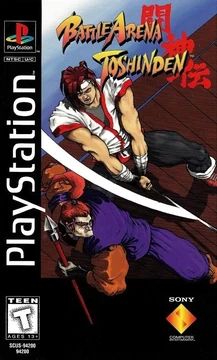 Battle Arena Toshinden 2 on PlayStation
 ACA Neo Geo: Art of Fighting 2 on Xbox One
 ACA Neo Geo: The King of Fighters '98 on Xbox One
 Touhou Hyoibana: Antinomy of Common Flowers on Switch
 Art of Fighting Anthology on PS2
 Bleach: Rebirth of Souls on PS4
 Bleach: Rebirth of Souls on Xbox Series X/S
 Choro Q 2 on PlayStation
 Choro Q on PlayStation
 Captain Tsubasa: Rise of New Champions on PS4












 Another SquareThought Site