

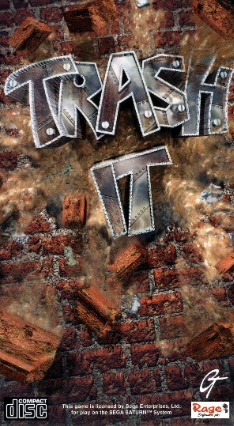

Trash It is one of those oddball 32-bit-era experiments that thought it could be both a smash‑and‑grab arcade romp and a brain‑bender puzzle-platformer. You play as Jack Hammer, a construction worker on a one-man demolition tour aimed at stopping Doctor Moonbeam from turning the world into a sugar lump (yes, really - the villain has a tea fetish). The core loop asks you to smash buildings with Jack's enormous hammer, scoop up the Timmies that spew out of wreckage, and spend those Timmy Points in the Hammer Shop to upgrade your destruction toolkit. The PlayStation version arrived in July 1997 for PAL territories and was given the sort of critical reception you get when your game's pace is slow and its palette is 'very brown'. This review zeroes in on what Trash It asks of the player: the specific challenges and skills it demands, and whether that challenge feels fair, interesting, or just tedious. If you like platformers that test timing, resource management and the willingness to repeat levels until the mechanics finally make sense, you might find something here. If you prefer kinetic, polished action - well, this game will test your patience more than your reflexes.
Trash It is built around a deceptively simple set of interactions that combine into a handful of distinct gameplay challenges. The first is time pressure. Each level hands you a countdown and a target: smash enough to meet a quota before the clock runs out. That turns each run into a study in prioritization - do you go for the big building that will spit out lots of Timmies but takes ages to break, or do you chain through smaller structures to secure a steady stream of points? The time limit forces risk-vs-reward thinking, and that's where the game's best skill demands live. Control-wise the game gives Jack an ungainly but powerful hammer. The hammer is the engine of every strategy and the source of most design wrinkles. Swinging it is satisfying in isolation, but the movement system ties running to whether the hammer is out or sheathed: Jack can only sprint when the hammer is tucked away. This mechanic turns what should be fluid platforming into a micro‑management problem. You need to anticipate windows of vulnerability and plan when to holster and unholster mid-combo to maintain momentum. That sounds clever, but in practice it requires a level of precision that the game's sluggish response doesn't always reward. Still, mastering the sheathe-run-smash dance is the clearest skill pathway Trash It offers: timing, choreography, and muscle memory. Resource management is the second pillar. Timmies are both score and currency. You vacuum them up after demolishing structures and then spend them in the Hammer Shop to buy weapon upgrades. The upgrade system creates an underlying metagame: should you save for a big upgrade that changes how you approach stages, or burn points on incremental improvements to make this immediate run easier? This economy makes later levels more interesting because your decisions persist - good investment choices can turn a slog into a surgical demolition spree. Playing badly means you stay underpowered, which the game will punish by making even routine objectives feel like uphill battles. Level design mixes puzzle and platform elements. Some stages demand pattern recognition and route planning: which walls will collapse, which elements will block you, and where the safest chain of destruction is. Others are more arcade-esque, throwing enemies and hazards that break your rhythm. Because the game leans toward methodical execution rather than twitch reflexes, the rewards favor players who can read a level, map an order of attack, and patiently execute it without panicking when time drops into the red. That mental patience is a skill in itself but isn't everyone's cup of tea. Arcade and multiplayer modes add a chaotic skill set to the package. Up to four players can bumble into the same level in Arcade mode, converting the game's focus from precise solo planning into social mayhem. Here the skill becomes opportunism: knowing when to steal a freshly exposed Timmy, when to engage another player, and when to hog a high-value target. Battle mode emphasizes direct competition and quick adaptation; you need to react to other players' moves rather than to the level layout alone. These modes give Trash It replay value that the single-player Quest mode struggles to sustain, because human opponents introduce unpredictability that covers up some of the core design's slow pacing. Where Trash It falters is consistency and feedback. The pace is sluggish - animation and control response often lag behind what the game asks of you - so the precision needed by the holster-run-smash mechanic feels punishing. Levels are described by contemporary reviewers as 'samey and uninspired', which matters because the game's loop depends on seeing new variations on its destruction puzzles. If levels stop teaching new tricks and start repeating the same obstacles, the skill cap becomes a treadmill rather than a ladder. Still, if you enjoy a challenge that rewards careful planning, resource allocation, and mastering a quirky movement system, there's a core of satisfaction here when everything clicks. To beat Trash It efficiently you need several concrete skills: precise timing (especially when switching between hammered and unhampered movement), spatial awareness to chain collapses, quick economy decisions for upgrades, and patience to grind levels when necessary. Add social instincts for multiplayer, and you've got a toolkit that toggles between goosebump-inducing cleverness and the rare, soul-crushing repetition.
Visually, Trash It wears the era's limitations on its sleeve. Contemporary reviewers called the graphics 'blocky', 'very brown' and 'dull', and those descriptions stick. The levels have a chunky, low‑poly look with a muddy palette that makes picking out interactive elements harder than it should be. When you're under time pressure, you want visual clarity; Trash It rarely gives it. Animations are serviceable but not snappy, which compounds the sluggish controls and makes the advanced timing the game asks for feel unfair. That said, the aesthetic does communicate the game's theme: a dingy, cartoonish metropolis meant to be demolished. There's a certain charm in watching buildings crumble and Timmies pop out like living confetti. If you're the sort who enjoys retro textures and can forgive a washed-out color scheme, the spectacle of systematic destruction can be oddly satisfying. Just don't play with expectations of the crisp, colorful look of other mid-90s platformers - Trash It went for a grittier tone and ended up leaning heavily on brown. Technical issues reported at release - slowdowns in busy scenes and some camera framing problems - further undercut the immersion. When the camera doesn't show the edge of a platform or the oncoming hazard, the game's demand for precise timing becomes a source of frustration rather than skill testing.
Trash It is a weird little hybrid that asks for measured skills - timing, planning, resource management, and a capacity for repetition - but binds those demands to a control and visual package that often undermines the satisfaction of mastering them. In single-player Quest mode it can feel like an exercise in patience: interesting design ideas are present, but the sluggishness and repetitive level design make climbing the skill curve feel more like slogging up a muddy hill than a rewarding ascent. The multiplayer modes spice things up, converting the game's slower mechanics into amusing chaos that can be a hoot with friends. If you're hunting for a polished platformer with tight, crisp controls and vivid presentation, Trash It will disappoint. If you enjoy the idea of a puzzle-platformer that forces you to think about sequencing, economy and the awkward ballet of holstering a giant hammer mid-fight, and you don't mind doing it in a sepia-toned world, there are moments of genuine pleasure here. Score-wise, consider it a middling cult curiosity: an interesting concept bogged down by execution. Bring patience, bring friends, and maybe a spare controller to throw when Doctor Moonbeam's plan finally grinds you into the brown dirt.
 Deponia on Switch
 Goodbye Deponia on PS4
 Puzzle by Nikoli 4: on PS4
 Twinbee Taisen Puzzle Dama on PlayStation
 Tokimeki Memorial: Taisen Puzzle-Dama on PlayStation
 Professor Layton and the Last Specter on DS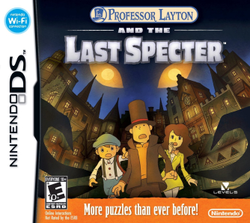
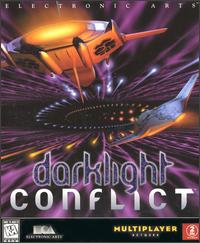
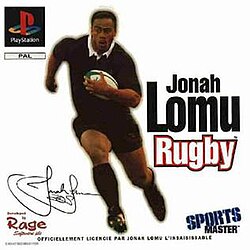 Darklight Conflict on PlayStation
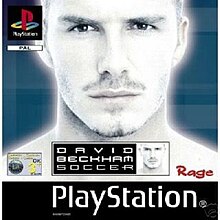
 David Beckham Soccer on PlayStation
 Crashed on PS2












 Another SquareThought Site