

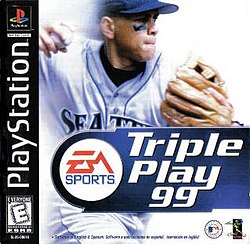

Triple Play 99 arrives like a baseball card come to life: glossy cover (Alex Rodriguez proudly front-and-center), a full roster of protagonists and antagonists, and just enough drama to keep you invested between innings. Calling TP99 a mere 'sports game' sells it short because EA shoved into this disc an entire theatrical troupe - managers who scheme, pitchers with tragic stamina arcs, and an announcer duo who function as a persistent Greek chorus. The game pitches itself as a simulation-heavy entry in the Triple Play series, boasting 3D hardware support, a career mode, manager mode and a league-wide draft. It even includes the new expansion teams - the Arizona Diamondbacks and the Tampa Bay Devil Rays - as if to say the drama is bigger than before. This review is less about whether your batting average will improve and more about reading the beats of the characters inhabiting TP99. Who grows? Who falters? Who looks incredible in slow motion and who trips on their own laces because of modern console limitations? Spoiler: sometimes the frame rate plays the villain.
If Triple Play 99 were a baseball novel, the first act would be its rosters and modes: all 30 Major League teams, real stadiums (with the notable absence of Seattle's Kingdome), three secret stadiums like the hidden chapters of a fanfic, and modes that promise long-term investment - career and manager modes plus a league-wide draft. The career mode attempts to trace a player's arc from hopeful rookie to seasoned veteran; it isn't deep enough to be an RPG, but it provides enough continuity that you start caring about individual stats and who sits on the bench. The manager mode is the game's scheming mastermind, whispering substitutions and strategy that let you play chess with nine men on the field. Pitchers in TP99 are tragic heroes whose arcs revolve around stamina. The game tracks pitch count, balls, strikes, hits, home runs allowed, and walks, and even has a stamina meter that determines whether your ace is composed or crumbling. There are moments where a pitcher looks indomitable, blowing heat via a well-timed fastball, only to have his stamina dissolve mid-teleplay, forcing a bullpen rescue and a dramatic scene change. Injuries add another layer to the plot: collisions in the outfield can send characters to the infirmary, substitutions happen on the fly, and sudden, unexpected injuries make you feel like a manager who must adapt on the fly to a twist no one saw coming. Fielding and batting form a buddy-cop duo whose chemistry varies by play session. Batting and pitching interfaces drew mixed responses from critics: some felt the batting felt intuitive and cinematic, while others (notably IGN) argued that the pitching-and-batting system risked being too simplistic for hardened baseball sim fans. The game gives players a variety of maneuvers - offering a palette of actions for those who want flashy play - but if your emotional investment is in nuanced control and micro-management, TP99 occasionally throws you a curveball you can't read. Fielding, meanwhile, is sometimes the game's awkward supporting character. Fielding controls and AI can misbehave, leading to comical misreads or heartbreaking errors that feel like an actor forgetting a line. Multiplayer and single-player modes let you direct different arcs: you can shepherd a rookie through a career, micromanage a franchise as a manager, or just grab a buddy and let the on-field drama play out in competitive fashion. The inclusion of 3D hardware support was a sign that EA wanted the staging to look cinematic, but as with any production, the set can be gorgeous while the lighting (read: frame rate) betrays the mood. The audience in the stadiums is practically a character too. Ambient noise - vendors hawking popcorn, disgruntled fans, occasional stadium announcements - layers texture into the experience and often sells the illusion of being in a real ballpark. The camera work deserves a standing ovation for recreating broadcast angles; it's the game's way of telling you you're watching a national telecast of your own tiny tragedies and triumphs.
Visually, Triple Play 99 sits in that awkward but fascinating era when 3D was still proving itself. Stadiums are lovingly recreated: each ballpark has distinct geometry and atmosphere, and the visuals frequently capture the feel of a TV broadcast. Players look good for the time - there's enough detail to recognize faces and uniforms - and the secret stadiums feel like Easter eggs for players who want to explore off-script. Unfortunately, the villain of the visual story is frame rate. Critics were widely split on how egregious the issue was. GameSpot shrugged it off as a minor blemish, whereas Electronic Gaming Monthly's team felt the erratic frame rate and choppy animations turned play into slog - 'like playing baseball in mud,' as one reviewer put it. GamePro thought the frame rate interfered with gameplay but could be adjusted to over time. Practically, this means there are sessions where animation choppiness and dropped frames interrupt the emotional flow of a game: a would-be diving catch becomes a stilted mime, or a pitch's speed becomes harder to read because the temporal cues are scrambled. If the game were a movie, these would be jump cuts that remind you you're watching a production and not living the moment. On the audio side, Triple Play 99 practically steals every scene that the visuals struggle to sell. The announcer duo has been widely praised: they deliver accurate play-by-play, peppered with amusing anecdotes, fabricated ads and delightful trivia that elevate routine plays into memorable moments. Other stadium noises - the murmur of crowds, the vendor cries - are layered so deftly that they often mask graphical shortcomings and make the ballpark feel lived-in and alive.
Triple Play 99 is a character-driven sports title dressed in a clean baseball uniform. Its strengths are in creating an atmosphere - the stadiums, the broadcast camera, and especially the announcer commentary come together to make the player feel like a part of a larger baseball world. The career and manager modes give you a satisfying sense of narrative continuity: you can follow a player's arc from hopeful to veteran, watch pitchers' fortunes wane with stamina, and shepherd a franchise through the daily grind and draft-day machinations. Where TP99 stumbles is in the way it sometimes undermines its own drama. Fielding quirks, inconsistent AI, and most importantly a wobbly frame rate sabotage moments that should feel cinematic. Critics at the time split on whether those faults were forgivable: some called the game a top simulation of its era while others saw the technical issues as crippling. If you prioritize immersion, sound design and announcer charm, this game will reward you handsomely; if you demand the smoothest animations and the most granular control in pitching and batting, you may find the experience frustrating. Viewed as a human ensemble rather than a pure simulation, Triple Play 99 tells an engaging if imperfect story - the high-budget sports drama with occasional continuity errors. For nostalgia, personality, and those times you just want to hear the announcer spin an unexpected yarn about some obscure player while you hit a pinch-hit home run, TP99 remains a worthy watch. Score: 7/10 - a strong cast and a charismatic production hampered by uneven direction.
 Triple Play Baseball on PlayStation
 Triple Play 2000 on PlayStation
 Accolade Sports Collection on Xbox Series X/S
 Deca Sports DS on DS
 Alan Hansen's Sports Challenge on PS2
 EA Sports MMA on PS3
 Def Jam Vendetta on PS2
 UEFA Euro 2008 on PS3
 Def Jam: Fight for NY on PS2
 FIFA: Road to World Cup 98 on PlayStation
 FIFA 2000 on PlayStation












 Another SquareThought Site