

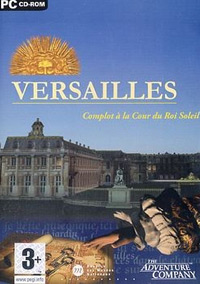

Versailles: A Game of Intrigue (also known as Versailles 1685) is the kind of historical adventure that treats the Palace of Versailles like an escape room staffed by temperamental artists, secretive courtiers, and one very busy valet. Released in 1997 by Cryo Interactive, the game famously reconstructs Louis XIV's court from painstaking archival sources, then peppers that realism with a plot that reads like someone gave Aesop a pen and a penchant for arson. If you like wandering through meticulously rendered baroque hallways while eavesdropping on people whose job titles are longer than your college major, this is your jam. More importantly for this review, the game is carried by its cast: a motley ensemble of historical figures whose little dramas form the true meat of the experience. This review zooms in on those characters and their arcs - how the players, even in a fairly puzzle-heavy adventure, manage to feel human, cunning, pompous and, occasionally, ridiculous.
At the center of it all is Lalande, a young valet de chambre whose job description is basically "fetch things and not get noticed until the plot demands otherwise." Lalande's arc is satisfyingly simple: he starts as a service worker in a world of nobles, but he grows into an active problem-solver. His progression isn't about becoming noble; it's about learning how to navigate information powerfully. The game uses Lalande's position - an obsequious, everywhere-at-once servant - to justify access to secrets, and that access becomes his character growth. Each pamphlet and stolen sketch nudges him from observer to participant. By the end, when Louis XIV offers him an ambassadorial post, it reads less like a fairy-tale promotion and more like the court finally recognizing the utility of someone who bothered to read all the memos. Alexandre Bontemps functions as Lalande's guardian and gatekeeper. He's the mentor who gives permission slips and moral rolling-eyes; he grants Lalande access to restricted rooms and, crucially, gives him the authority to move the plot forward. Bontemps' arc is small but meaningful: a practical reminder that the machinery of power is run by a thousand small favors. The game uses him to underline one of its themes - that influence in this world is more about who can open a door than who owns the door. The artistic trio of Charles Lebrun, Jean Racine and Jean-Baptiste Lully provide comic and structural counterpoints. Lebrun, the painter demanding sketches, exposes the vanity and theatricality of court artists. His repeated declaration that sketches are "not mine" becomes a running gag and a subtle look at reputation: Lebrun is protective of authorship in a place where everyone fabricates an image. Racine, the playwright, is the crafty observer, whose presence is a reminder that words and narratives are themselves political tools. Lully, the composer sweating over transcriptions and insults, offers an arc from irritation to grudging cooperation: he transcribes a gibberish pamphlet into meaning, becoming a bridge between the cryptic riddles and Lalande's decoding efforts. These interactions show how artists, despite being court entertainers, are also information nodes. The antagonistic energy comes from the unknown courtier and the Marquis de Scaparella, whose literal arson attempt provides the game's climax. Scaparella is less a three-dimensional villain and more a perfect foil: his threat is theatrical, his motives left murky, and he revels in satire. He embodies the danger of pamphlet culture - the mockery of power turned into literal combustible consequence. The game's portrayal of him comments on the era's real pamphleteers without turning him into a modern villain archetype. In a clever twist, the real threat isn't grand conspiracy but clever misdirection and the court's own complacency. Louis XIV and his circle - the Dauphin, Philippe d'Orléans, Madame de Maintenon - are treated like weighty set pieces more than heroes. Louis is the immovable center, regal and aloof; he rewards Lalande but never truly shifts. The court around him, however, moves in smaller, human arcs: the Duc du Maine's moment of vulnerability in the Bosquet d'Esope shows that these people are not just costumes; they can be ill, petty, and sincere. André Le Nôtre, the gardener, and Père Lachaise, the confessor, are cameo moral supports, each giving Lalande a nudge toward the right clue at the right time. Even minor characters like the Swiss guard, the queen's usher, and the marquis de Croissy function as puzzle-placing personalities whose small needs and quirks make the palace feel lived-in. Mechanically, character arcs are entwined with puzzles. The Aesop fable motif is a narrative through-line: each pamphlet references a fable («the frogs and Jupiter», «the hens and the chicks», «the head and the wolf», etc.), and as Lalande collects them, he is also assembling pieces of people. The puzzles - keys hidden in pots, rubbed medal impressions, ladder-climbing attic mechanics, the Bosquet d'Esope labyrinth - don't just test inventory logic; they force Lalande to interact with the court. When Lully transcribes text or the marquis translates inscriptions, Lalande isn't solving puzzles alone; he's leveraging relationships, which gives the game a social-engineering flavor that complements its character focus. The final sequence, where Lalande locates four keys (including a frantic orange-pot search in the orangery) and defuses a bomb, is a neat synthesis of his arc. He has moved from passive servant to active organizer of a small coalition: he borrows skills, information, and tools from every arc we've followed, then uses them to prevent catastrophe. The celebratory reward - an offer to be ambassador - is almost comic in its dramatic irony, but it also reflects the game's consistent message: in a court of masks, the person who can read the masks is the one who holds power.
Visually, Versailles earns its reputation: Cryo worked with the Museum of Versailles and spent years reconstructing spaces from hundreds of documents. The result, even on PlayStation-era hardware, is lush: Hall of Mirrors reflections that look like they should be conservation-classified, ornate tapestries rendered with enough fidelity to make you squint for brushstrokes, and staircases that feel architecturally plausible. Reviewers of the day (and rightly so) called the 3D environments "exquisite." The trade-off is that character models occasionally stumble - faces are blocky, lip-sync can be a little wooden, and animation sometimes betrays the hardware limits - but those flaws become part of the game's charm rather than a fatal flaw. When you're wandering a faithfully reproduced Apollo salon, the occasional awkward blink is the price you pay for convincing historical atmosphere. The development note that the Ambassadors' Staircase was rebuilt from 800 documents is not trivia; it shows. The palace feels researched, not imagined, and that gives the social interactions the gravitas they need to carry the story.
Versailles: A Game of Intrigue is not the most mechanically revolutionary adventure, and its pacing leans toward the leisurely and scholarly. What it lacks in twitch or combat it makes up for in atmosphere and a wonderfully interpersonal approach to puzzles: every clue is a conversation, every locked chest a social contract. Characters are the game's beating heart - Lalande's quiet ascent, Bontemps' pragmatic mentorship, the artists' petty grandeur, and the villainous pamphleteer who nearly burns everything down together form an ensemble that is surprisingly resonant. If you approach it like a walking play in which you are the stagehand detective, you'll find a game that rewards curiosity, listening, and gentle persistence. For players who want a historical playground with real personalities and puzzles that require more social cunning than button-mashing, Versailles is a gilded treat. Score: 7.5/10 - stylish, occasionally sluggish, but richly populated with people worth listening to.
 Press Your Luck on PS3
 Game Dev Story on PS4
 Tintin: Destination Adventure on PlayStation
 One Piece Grand Adventure on PS2
 Taiko no Tatsujin: Dokodon! Mystery Adventure on Switch
 Taiko no Tatsujin: Don to Katsu no Jikū Daibōken on Switch
 Dreams to Reality on PlayStation
 Egypt 1156 B.C.: Tomb of the Pharaoh on PlayStation
 China: The Forbidden City on PlayStation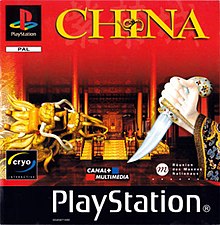












 Another SquareThought Site