

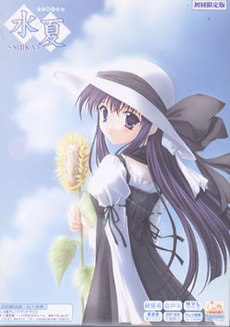

There is a particular cadence to mid-summer nostalgia in Japanese media: cicadas, narrow country roads, and the kind of small-town secrets that comics, OVAs and PC games insist were waiting for you when you were out buying ice cream. Water Summer is the PlayStation incarnation of a title originally known as Suika, a visual novel first released on PC by Circus in 2001. The port removes the adult content of the original but keeps the atmospheric heart of the piece, swapping explicit scenes for a gentler, all-ages mood felt in the narrative and art. Released for the PlayStation in July 2002 under the PrincessSoft banner, Water Summer arrives at a time when import shelves still smelled faintly of cigarette smoke and magazines insisted every polygon mattered. This is not a title that will wow you with physics or 3D fireworks; it aims for something quieter: the craft of pacing, the economy of branching choices, and the mise-en-scène of a rural village whose summer refuses to let go.
Water Summer follows the familiar visual-novel rhythm: long stretches of reading punctuated by decision points that steer you through five main plot lines and several heroine routes. The game is divided into four chapters, each with its own protagonist and set of heroines, all orbiting the same small town-Tokiwa Village-and the shared seasonal memory that binds them. The PlayStation port adapts this structure faithfully. The player begins with a short prologue as Hiroshi Inaba returns to the village, and then steps into the shoes of different leads over the next chapters: Akira Kazama (chapter one), Souji Kamishiro (chapter two), Yoshikazu Masaki (chapter three) and finally Hiroshi again in chapter four. Each chapter introduces one or two central heroines, and the narrative rewards repeated playthroughs by unlocking alternate endings and character revelations. Interaction is deliberately minimal. This is a reading-first experience: text blocks present dialogue or inner monologue, and you occasionally reach a decision point where the plot will fork. The variety comes not from minigames or action sequences but from the craft of choice architecture-how a single line of dialogue can tilt a character toward confession, avoidance or reconciliation. There are five principal plotlines related to the heroines, so completionists will find themselves running the game multiple times to see every strand. For players used to contemporary visual novels with complex stat systems and lengthy flowcharts, Water Summer feels like an exercise in discipline: the stakes are emotional rather than mechanical. The original PC release included adult scenes as a mechanical goal for completion; PrincessSoft's PlayStation version excises these in favor of all-ages storytelling, which changes the texture of the game more than its shape. The decision points still exist, the branching remains, but the emotional payoffs are reframed toward wistful revelations and tender, rather than explicit, moments. Voice acting is present on the PlayStation port, and while not every line is lavishly produced, several performances-most notably those attached to Itsuki Minase, Sayaka Shirakawa and the nameless heroine of the final chapter-lend weight to the quieter beats. The game encourages a slow approach: save often, savor the soundtrack cues, and let the summer linger. Progression is designed around replayability; unlocking each heroine's route is the primary reward. For players importing the game at the time, the limited edition PlayStation pressing (15,000 units) was a sign that niche visual novels could still justify small print runs and collector-focused releases.
Graphically, Water Summer is the product of character designers who understood that emotion can live in an eyebrow twitch or the tilt of a shoulder. Naru Nanao and Takanon Ikuta split art duties on the original project, and their influence carries over into the PlayStation release: character portraits are crisp, expressive, and shaded with the soft palette that suits seaside heat and late-afternoon conversations. Background art emphasizes rural details-worn wooden fences, sun-faded road signs, august skies that look like they were painted with patience. These are 2D, mostly static compositions, but the strength here is compositional: poses and close-ups are staged to emphasize the conversational beats, and CG event illustrations punctuate important scenes with higher detail and mood lighting. If you are looking for technical fireworks, you will be disappointed. This is a PS1-era port in sensibility even when running on the PlayStation hardware of 2002: no real-time effects, no 3D environments, just carefully drawn frames and the occasional dissolve or wipe. Where the game earns its keep is in character design clarity and the soundtrack, which scaffolds scenes with gentle themes composed by Tororo and Kometto Nekono. The opening theme for the ports was recorded by Yozuca*, and the PlayStation soundtrack was released as a separate disc-an indulgence that fans of the genre appreciated. Voice work and music pair with the art to sell moments: a confession, a stormy argument, a silent walk through rice fields at dusk. The package reads like a visual postcard from an era when visual novels relied on aesthetic coherence more than processing power.
As a PlayStation release Water Summer is not trying to reinvent the wheel. It is the kind of port that respects the original's structure while reshaping its content to suit console sensibilities and a wider audience. The removal of adult scenes softens the edges of the PC original, but it does not hollow out the narrative backbone; the writing retains its focus on character, and the art and music continue to carry the emotional atmosphere. For the impatient player raised on twitch reflexes and instant gratification, the game's slow burn will likely feel quaint. For those who remember flipping through print previews in the late 1990s, who enjoyed the hush of dialogue boxes and the slightly melodramatic pulse of entrance themes, Water Summer offers an effective slice of seasonal melancholy. It is modest, well-crafted, and occasionally moving. Award it points for ambition in mood and restraint in adaptation: a solid 7 out of 10 for anyone willing to sit on a wooden bench under a pixelated sun and let the summer speak.
 Hydrophobia Prophecy on PS3
 The Land Before Time: Big Water Adventure on PlayStation
 Root Film on PS4
 Tokimeki Memorial Drama Series Vol. 3 Tabidachi no Uta on PlayStation
 Princess Princess on PS2
 Oshiete! Popotan on PS2












 Another SquareThought Site