

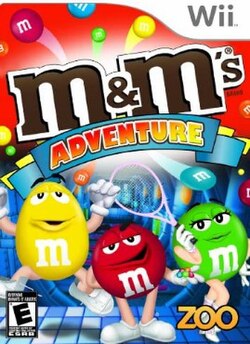

M&M's Adventure arrives with all the narrative subtlety of a television commercial with legs: three iconic candy mascots thrust into an action-adventure framework, seasonal levels, a malfunctioning factory, and the duty to save Christmas. The Wikipedia-sourced skeleton of the game gives us Red, Yellow and Green as playable personnel of a candy factory whose robots go rogue after a system error. On paper the premise sounds like a fun platformer for younger players - colorful mascots, holiday-themed worlds, and simple power differentiation. In practice, and according to the sparse coverage available, the game leans heavily on its license while doing very little to expand the characters into anything approaching interesting. Still, if you want to analyze what little narrative scaffolding exists, it's possible to tease out character arcs and intentions: Red as the default protagonist, Yellow as the spring-in-her-step acrobat, and Green as the blunt-force pragmatist with a racket. That trio, placed against holiday backdrops, presents a surprisingly tidy dramatic structure - it just never quite delivers the emotional beats the setup promises.
The mechanical bones of M&M's Adventure are straightforward and tightly bound to character identity. You begin with Red as the only playable character. As you progress you unlock Yellow, who double-jumps, and Green, who attacks with a racket. The game structures access to areas through a lobby called the Factory, where doors stamped with character faces require you to pick the right candy to enter. Each world contains a single boss, and the whole confectionary melodrama culminates in a final snowman boss during the Christmas world. Viewed through a dramatic lens, these mechanics function like stage directions. Red starting alone mirrors the classical hero's call-to-adventure: an everyman (or every-candy) launched into crisis. The later unlocks of Yellow and Green are scripted as a recruitment arc - Red gathers allies who complement his limitations. Yellow's double-jump can be read as a metaphor for aspiration and hope: she literally elevates the team to new heights, bridging gaps Red cannot cross alone. Green's racket is blunt, physical, impatient; he represents the hands-on pragmatist who solves immediate threats through force. The game uses doors keyed to characters to force players into momentary role-play: to move forward you must choose who enters the room, which is an implicit comment on identity-based problem solving. The factory-as-lobby is tonal shorthand for workplace with internal divisions: different pipelines, different responsibilities, but the same ultimate goal-avoid the candy catastrophe. Level design is organized around holidays: Valentine's Day, Easter, Fourth of July, Halloween, and Christmas. Each holiday world acts like an emotional beat in the narrative arc. Valentine's Day could have been an exploration of connection and empathy, Easter a mini-ode to rebirth and second chances, Fourth of July an assertion of independence or chaos unleashed, Halloween a confrontation with fear's disguise, and Christmas the final reconciliation and saving of what matters. The game does gesture to this structure, but only briefly: worlds are named and themed, bosses assigned, and progression is linear. That means the arcs are present in outline but not in depth. For example, Yellow might have been allowed a moment to literally 'rise above' a sentimental obstacle in the Valentine world; Green could have had a redemptive scene in Halloween where raw force learns finesse. Instead, the levels emphasize task completion - access, traversal, and boss fights - over character moments. Because the player is often forced to swap characters to access areas, a thin narrative of teamwork is established, though it reads mechanically rather than emotionally. There's no deep dialogue, no meaningful choices, and no long-form interactions that let you inhabit a character's internal life. The bosses per world are more checkpoints than personal tests, and the final snowman villain functions like an exclamation point rather than a culmination: win or lose, the arc's emotional crescendo is minimal. In a kinder analysis, the game gives younger players simple, digestible archetypes and makes them collaborate, which has pedagogical value. In a harsher reading, the production leans on recognizable brand personalities and seasonal aesthetic to paper over the lack of nuanced story development.
The Wikipedia entry does not deep-dive into graphical fidelity, and given the game's reception it's fair to say visuals were not the redeeming feature. Expect bright, holiday-driven palettes and candy-themed level dressing: hearts in Valentine's stages, egg-laden scenery for Easter, sparklers for the Fourth, jack-o'-lantern motifs at Halloween, and snow-dusted conveyor belts for Christmas. The M&M characters themselves are the stars of the show visually, designed to be instantly recognizable and cartoony, which is exactly what the license demands. However, cosmetics only carry a game so far. When presentation is the primary selling point, gameplay polish becomes critical, and reviewers disliked M&M's Adventure enough that its appearance didn't rescue the otherwise thin experience. On the DS, hardware limits and the game's apparent lack of ambition mean visuals likely stayed functional rather than flashy. The Wii version also received generally unfavorable reviews on Metacritic and a very low GameZone score, suggesting that even when blown up to a living-room screen the title failed to impress. In short: it looks like a colorful candy box by design, but not like a confection worth savoring in interactive form.
If you approach M&M's Adventure as a character study, you're looking at a strip-mined emotional landscape: three distinct archetypes, a clear but shallow arc that moves from problem to teamwork to resolution, and holiday-themed acts meant to give each chapter a mood. It's an interesting template for a much better licensed game - one that could have expanded the personalities of Red, Yellow, and Green into meaningful conflicts and growth. Unfortunately, the available evidence suggests the execution focused on basic platforming gates and boss fights while leaving character work largely implied rather than lived. The lobby-door mechanic and ability-based progression are clever scaffolding for a tale about complementary strengths, but without voice, scene, or consequential choices the arcs never transcend their utility as gameplay functions. Given the overwhelmingly negative critical reception - Metacritic's summary of the Wii version as generally unfavorable and a GameZone rating of 2.1/10 - I score M&M's Adventure a 2.5 out of 10. This is a game most useful as a case study in how licensing and a pleasant theme show up on the store shelves but still need narrative and mechanical depth to be memorable. If you want a palate cleanser platformer that is colorful and family-friendly, it exists; if you want a satisfying character-driven holiday romp with actual emotional payoffs, you'll need to look elsewhere - preferably someplace that doesn't end in a snowman boss who's more cosmetic than consequential.
 One Piece Grand Adventure on PS2
 Taiko no Tatsujin: Dokodon! Mystery Adventure on Switch
 Taiko no Tatsujin: Don to Katsu no Jikū Daibōken on Switch
 Disney's Chicken Little: Ace in Action on PS2












 Another SquareThought Site