

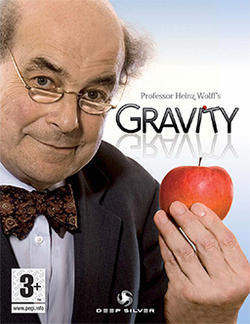

Professor Heinz Wolff's Gravity arrives with the modest ambition of teaching you one thing and one thing only: what happens when you give a marble, a plank and a questionable understanding of torque the freedom to act. The DS version packages 100 physics-based puzzles, a handful of party mini-games, and a level editor that lets you dream up contraptions even a retired television scientist might raise an eyebrow at. The objective is consistently simple - press the red button - and yet the route there is never straightforward. Fans of Rube Goldberg diagrams and people who enjoy watching digital objects make baffling life choices will find plenty to tinker with. The game's reputation is, like its physics, somewhat uneven. Critics were divided: the DS release sits in the 'mixed' range on Metacritic while its mobile incarnations fared better. This is a game that knows what it is and mostly succeeds at it, but if you were expecting the sort of deep, varied puzzle diet that justifies a full-price dinner out, you may leave mildly hungry. If you just want to place a cart on a ramp, flick a switch, and watch decades of classroom physics finally make a decision, then this is the menu.
At the centre of Professor Heinz Wolff's Gravity is a pleasingly literal respect for Newton's work. Each of the 100 levels gives you a handful of pieces - beams, blocks, see-saws, marbles, cannons and the like - and the explicit goal: cause something, anything, to press the red button. There is no prize for nobility in the form of which object does the pressing. A sentient plank, a lucky pebble, or a runaway cart are all equally acceptable. This removes any pretense of moral judgment and replaces it with the far superior quest for efficiency and chaos. Gameplay breaks into two readable phases. Phase one involves arranging your mobile elements while everything remains obediently at rest. This is where you act like a patient engineer, nudging beams and blocks into place, approximating angles, and thinking in terms of inertia rather than revenge. Phase two is the 'start' phase: you press the green arrow and the game releases a large sphere or a powered cart from a black portal. Physics happens. Joints creak. Marbles fall. Your careful plan either blossoms into triumph or collapses into an aesthetically pleasing heap of planks. The physics engine is the star performer here. Gravity and friction are the core ingredients and the interactions are forgiving enough to allow multiple solutions. This is not one of those puzzle games that insists on a single sacred method carved into silicon; often, there's more than one way to deliver the ceremonial button press. That makes experimentation rewarding instead of punitive. It also turns each failure into data rather than insult. You can learn why a seesaw behaved like a drunken cat and then adjust accordingly. For players who like to nudge the sandbox rather than march through the campaign, the DS version includes 20 sandbox levels. These unlock in sets as you clear game levels (every five beaten levels unlock another sandbox), which feels like a small, decent reward scheme rather than a bold economic strategy. Sandboxes give you the freedom to poke at the physics engine: you can switch gravity off to observe how objects behave without the universe's opinion, or submerge the bottom quarter of the scene in water to test buoyancy. Watching blocks bob or carts flounder in digital water is unexpectedly satisfying, like putting a rubber duck into an explanation that finally makes sense. There is also a full level editor, which is an encouraging inclusion. You can build puzzles comparable to the supplied 100, saving and sharing your own designs if you have the means. On DS that sharing is more limited than modern cloud-friendly platforms, but the editor itself gives the game longevity beyond its initially packaged challenges. If you enjoy the idea of designing a stage specifically to exploit a single physics quirk until it becomes a meme you alone understand, the editor is fertile ground. To break up the brain-bending campaign, the game offers four mini-games under 'party mode', each repurposing the same physics engine for something either competitive or compulsively mechanical. Tallest Tower asks you to build a tower that survives an earthquake - a charmingly blunt exercise in structural hubris where the score depends on how high the structure remains after simulated tectonics. Up and Down gives you a cannon and 40 balls to score points into differently valued buckets; it's essentially carnival practice for people who secretly want to man a mid-century seaside arcade. Clear the Decks turns you into a colour-matching artillery operator where balls only destroy blocks of the same hue, which introduces a modest dose of strategy to the ballistic chaos. Tower Topple is the most directly vindictive: knock a tower off its pedestal with the fewest shots. These modes are short, straightforward, and oddly addictive in small doses, though none of them fundamentally reinvent the wheel. The game's pacing is deliberate and occasionally stubborn. Some levels are quick wins that make you feel clever; others require careful rebalancing and patience. IGN noted that there was potential for a sleeper hit but criticized the game for feeling light on content relative to price - a fair point if you measure a game's value by hours alone rather than the quality of tinkering. On the DS, the experience is a tidy physics toybox with a respectable number of puzzles, but it doesn't always stretch into the kind of depth that turns a puzzler into an obsession.
Visuals in Professor Heinz Wolff's Gravity are functional with the kind of modesty you expect from a DS-era puzzle title. The world doesn't try to distract you with high drama or photorealism; instead it opts for clear, readable assets so you can tell a marble from a very slightly different marble at a glance. The aesthetic is utilitarian: platforms, beams, buttons and carts are rendered plainly, with an emphasis on clarity over style. This suits the game's priorities - when the point is to watch how elements interact, visual noise is a liability. There are the occasional moments where the camera framing and sprite clarity remind you the DS is not trying to be a next-gen art installation; the screen can feel cramped during complex setups, and tiny visual details sometimes require squinting or careful repositioning of the stage. Performance is stable enough that the physics remain consistent and dependable, which is more important than flashy lighting. If you were hoping the DS version would astound you with palette gymnastics or poetic shaders, you will be disappointed in the way a person is disappointed when they open a textbook and find equations instead of a surprise party. For players interested in clean mechanics rather than eye candy, the trade-off is acceptable.
Professor Heinz Wolff's Gravity is a polite, competent physics puzzler that knows which rules are negotiable and which are not. Its core joy comes from setting up an elegant chain reaction and then watching the world obey (or spectacularly disobey) Newtonian law. The inclusion of sandboxes and a full level editor shows a welcome attention to players who want to tinker beyond the prescribed curriculum, and the four mini-games add a little competitive salt and pepper. Where the DS release falters is in ambition relative to market expectations; reviewers called it mixed and pointed to a feeling that the game is light on content for what you pay. That criticism is fair if you're buying by the gigabyte of gameplay; less fair if you're the kind of person who will spend three evenings obsessively perfecting a single Rube Goldberg solution. The physics are reliable, solutions are varied, and the presentation is clear if unglamorous. For an economical recommendation: if you like quiet engineering challenges, sandbox toys, and the occasional sense of mechanical poetry, Professor Heinz Wolff's Gravity will satisfy. If you need a puzzle title that constantly surprises with scope and narrative, this is not your comet. Score: 6/10 - competent, occasionally brilliant, and conservative in all the ways that keep it focused on physics rather than posturing.
 Gravity Rush Remastered on PS4
 Gravity Rush 2 on PS4
 Puzzle by Nikoli 4: on PS4
 Professor Layton and the Last Specter on DS
 Puzzle Kingdoms on DS
 Puzzle de Harvest Moon on DS












 Another SquareThought Site