

 Aug 2025
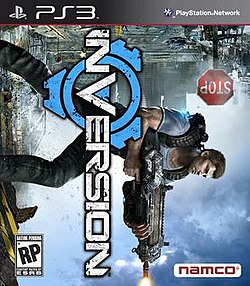

Inversion arrives like that kid at school who'd obviously read the rulebook but still tried to bend the laws of physics for extra credit. Marketed as a third-person shooter with a gravity-manipulation twist and a taste for breaking the scenery, the PS3 version (developed by Saber Interactive and published by Namco Bandai) tries to slap a novel mechanic onto fairly familiar cover-shooter bones. The result is a title that asks you to be a decent shot, a patient tactician, and - weirdly - a part-time physicist. Reviews at launch were lukewarm and for good reason: the game is competent, occasionally clever, and occasionally painfully predictable. If what you want is a focused look at the challenge aspects and the skills this game expects you to bring to the table, you're in the right place. I'll try to explain how Inversion tests reflexes, spatial reasoning, resource management and patience, and whether it's worth bringing your controller (and dignity) to the battlefield.
At heart, Inversion is a cover-based third-person shooter that borrows heavily from the big names that perfected the formula. If you've played Gears of War, you'll recognize the cadence: duck for cover, poke out, spray bullets, retreat when the tide turns. What Inversion adds to this ritual is gravity manipulation and destructible environments - a pair of ideas that should, on paper, turn every firefight into a tasty tactical puzzle. Where the challenge starts is in learning how that gimmick actually changes how you fight. The grav-related mechanic is the game's stated unique selling point, and it nudges fights away from pure snap-aim dueling into territory where vertical thinking matters. Enemies and level geometry sometimes behave strangely when gravity is shifted; objects fall, platforms become hazards, and your usual line-of-sight calculations go sideways. That demands spatial awareness above and beyond the usual cover-shooter checklist. You'll need to re-learn how to approach chokepoints because a ceiling that becomes a floor will suddenly make your cover into a launchpad or a pit. Mastering Inversion's more interesting encounters rewards players who can keep a running mental map of shifting geometry. Instead of the straightforward 'peek-shoot-hide' loop, some rooms force you to predict trajectories, trap enemies with collapsing floors, or use falling debris as both shield and projectile. Timing becomes crucial: trigger gravity changes too early and you'll fling a healthbox into the void; too late and you'll be crushed under a pile of formerly-useful scaffolding. The destructible environments give the combat a satisfying sense of consequence - walls won't protect you forever - which ups the tension in firefights, especially on tighter difficulty settings. Enemy variety plays into the challenge as well. The Lutadores (the game's invading soldiers) and their heavy robot toys require different responses: light grunts can be suppressed with accurate burst fire and good positioning, while larger mechanical opponents force you to stop, break cover, and actively manipulate the environment to create openings. Learning when to switch from conservative cover play to aggressive environment-based tricks is the learning curve here. It's not an overwhelmingly punishing climb, but you'll die a few times to things that feel avoidable - often because you misread a gravity shift or assumed your cover was permanent. Skills required spell out like a weird résumé: decent aim, cover discipline, and situational awareness top the list. Add to that the ability to mentally juggle changing level geometry (spatial reasoning), fast decision-making when the battlefield reconfigures (reaction time + prediction), and some low-level resource management - since ammo and health stops aren't infinite when the world keeps flipping around. If you like your PvE to reward planning and lateral thinking more than twitch headshots, you'll appreciate how gravity forces you to be adaptive. If, however, your main skill is 'rely-on-auto-aim-and-spray-forever,' Inversion will punish you for it. Multiplayer exists, and the same gravity tricks can be a riot with friends: suddenly competitive matches have an extra axis for mind games. A gravity trick that sends a teammate flying into an enemy or drops a wall between squads feels satisfying in a way that pure shooting rarely is. That said, the root mechanics are familiar enough that multiplayer won't feel like a revelation; instead it's a fun playground for players who already appreciate how the single-player levels ask you to think differently. Difficulty spikes are present but not constant. The game is approachable for players who don't want to be punished for minor mistakes, yet it rewards those who take the time to learn its gravitational maneuvers. Most of the frustration comes from moments when a clever gimmick could have been built into a level more elegantly. A few encounters feel plonked in because the gravity mechanic was supposed to spice things up, but the actual execution asks more patience than strategy. In short: the game challenges players more in their approach to space and cover than in pure aim or reaction, and that's refreshing - when it works.
Visually, Inversion sits comfortably in the mid-tier of its era. The Saber3D Engine can render decent-looking ruins, grimy urban destruction and the occasional sci-fi set-piece with enough polish to sell the grim tone. The destructible environments, more than raw fidelity, are what help combat scenes feel alive: walls crumble, cover degrades, and environments rearrange themselves enough to keep you on your toes. It doesn't have the high-end sheen of the biggest PS3 exclusives, and character models sometimes feel generic, but the lighting and particle effects during gravity shifts - dust, debris, sparks - do a fine job of making you feel the chaos you caused. Performance on PS3 is acceptable; there aren't massive slowdowns during most firefights, though dense set-pieces with lots of physics interactions can feel frame-y. That's exactly the kind of trade-off you'd expect when a game leans on destructibility as a mechanic. The artistic direction leans toward gritty realism: muted colors, lots of rubble, and a late-apocalyptic city vibe. It underscores the game's tone - competent, earnest, and occasionally a little too safe.
If Inversion were a midterm exam, it would be the one where the professor threw a curveball about gravity halfway through and expected you to adapt without a study guide. The game's strength is in asking players to think in three dimensions and to use the world itself as a tool in combat. That idea makes several encounters genuinely satisfying; the destructible cover and shifting geometry force you to adapt tactics, not just aim. The downside is that the rest of the package is comfortable familiarity: the story beats, the AI behavior and the level flow all nod toward established cover-shooter conventions rather than redefining them. For someone who enjoys tactical shooters and wants a little brain-teasing from physics tricks, Inversion is a middling but occasionally clever time. The PS3 version gives you enough to learn and master - situational awareness, timing for gravity shifts, cover-minded patience and a dash of platforming intuition - to keep fights interesting. If you were hoping for a true reinvention of the genre, the game's mixed reviews and modest Metacritic score (around 56/100 on PS3) should temper your expectations. Play it for the gravity, stick with it for the destructible chaos, and don't be surprised if the rest feels a touch too familiar. You'll walk away having flexed some useful skills, and maybe with an appreciation for physics class you never asked for.
 Puddle on PS4
 Persona 4: Arena on PS3
 PixelJunk Shooter 2 on PS3
 Tom Clancy's Rainbow Six: Vegas on PS3
 Crimson Sea 2 on PS2
 Tower of Guns on PS3
 MX Nitro: Unleashed on PS4
 Star Wars: Knights of the Old Republic — Remake on PS5
 Warhammer 40,000: Space Marine 2 on Xbox Series X/S
 Warhammer 40,000: Space Marine II on PS5
 Evil Dead: The Game on PS4










 Another SquareThought Site