

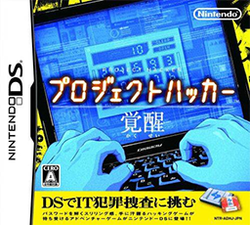

Project Hacker: Kakusei is the DS's slightly nerdy answer to detective drama - you play Satoru Amatsubo, a hacker-for-good employed by the internet crime-fighting GIS, partnered with detective Rina Okubo. On the surface it's a point-and-click adventure with the usual talking-to-people, item-collecting, and plot-moving, but the DS's touch screen puts the hacking puzzles front and center. If you like your mysteries served with stylus-driven logic tests instead of just reading exposition, this one scratches that itch. The title enjoyed a modest reception in Japan (a Famitsu aggregate of 27/40 and about 37,000 copies sold in its launch week), and an English localization flirted with existence before quietly bowing out. Whether that means it's a hidden gem or a niche curiosity depends mostly on how much you enjoy getting your brain gently roasted by puzzle-based 'hacking.'
Project Hacker splits its time between conversational investigation - think Ace Attorney-lite: talk to witnesses, poke through environments, follow leads - and a suite of mini-games that represent the hacking work. The game leans hard into the DS's stylus: program repair and password cracking tasks are performed with the stylus as the primary input method, and the feel of the game is built around that tactile relationship. If you came expecting a cinematic hacker fantasy with lines of scrolling code like a 90s movie, you'll be disappointed. Instead, the challenge is puzzle design: the developers translate abstract cyber-operations into concrete tactile challenges that require logic, pattern recognition, and sometimes speed and precision. The difficulty profile here is less about twitch reflexes and more about cognitive stamina. Program repair sections often present segmented problems where you must identify faulty modules and restore them by recombining snippets or rerouting connections. These are essentially logic puzzles disguised as circuit maintenance: you need to spot inconsistencies, deduce the correct order of operations, and manipulate small on-screen pieces without dropping the thread of the larger goal. They reward methodical thinking. Players who like to break problems into smaller parts and test hypotheses will feel at home; those who try to brute-force their way through will find themselves retracing steps and redoing fiddly stylus gestures. Password cracking exercises are where the game leans into pattern recognition and lateral thinking. These aren't random number guesses; the puzzles give you clues and constraints that you must apply to eliminate possibilities. Sometimes the game asks you to reconstruct a passphrase from partial data, other times to use logic gates of deduction to narrow down the correct combination. This is where the narrative-investigation and minigame design intersect cleverly: paying attention to dialogue and the details in environments often supplies the critical hints you need to solve a lock. In that sense, the game promotes two linked skill sets: careful listening/reading and analytical application. Ignore the story, and you're making the puzzles harder on yourself. Beyond pure reasoning, the DS controls demand steady stylus control. Program pieces can be tiny, password input may require precise taps, and some puzzles punish sloppy dragging. It's not a finger-trap difficulty, but if you tend to treat touch inputs like swiping a phone screen in a hurry, expect to slow down. On the flip side, the DS's tactile feedback makes the puzzles feel more immediate than menu-based mini-games - you are literally dragging wires and tapping code fragments. This approach elevates the satisfaction when you nail a difficult repair; it's not just 'I solved it' but 'look, I soldered this digital limb back onto the machine.' One crucial skill the game encourages is structured note-taking. The adventure portions drop clues through conversation and scenery, and the puzzles often require connecting disparate bits of information. Players who scribble notes, test small hypotheses, or mark potential solutions will steamroll the harder sections. The game doesn't hold your hand with an aggressive hint system - instead, it trusts you to inspect everything and keep mental (or physical) maps. That slow-burn investigation style rewards patience and curiosity. If you treat Project Hacker like a checklist game (find X, do Y), you'll struggle more than if you treat it like a logic hunt. A minor hurdle is pacing. The alternation between talking segments and hacking puzzles can feel abrupt. After a long stretch of investigation, the game will throw a concentrated block of minigames at you. That ramp can feel brutal if you haven't been keeping mental notes or your stylus dexterity is rusty. The game's designers clearly intended the puzzles as the highlight, and there is a definite shift from narrative mood to problem-solving mode that takes getting used to. For players primarily attracted to story, this can be jarring; for those who live for the puzzle, it's prime time. Replayability is modest. The core enjoyment comes from solving the puzzles the first time - the solutions are seldom randomized and once you know the process, subsequent runs lack surprise. That said, the way the game ties puzzle solutions into the investigative beats means your first playthrough can be deeply satisfying, especially if you relish the moment when a clue clicks and the next hacking segment suddenly makes sense. The title's strengths are in designing puzzles that feel integrated into the casework rather than slapped on as filler. If you're measuring challenge on a spectrum from 'casual-mobile' to 'hardcore-logic,' Project Hacker sits in the thoughtful middle: demanding enough to frustrate if you rush it, but accessible to anyone who enjoys step-by-step problem solving. Recommended skills checklist: good attention to detail, basic deductive reasoning, willingness to take notes, patient stylus control, and an appetite for puzzles that are more brain-teaser than action test. Players who bring those will find a consistent and cleverly themed challenge; those who don't will find themselves boxed into backtracking and the occasional hair-pulling session.
Graphically, Project Hacker plays to the DS's strengths without trying to be a technical showpiece. The game uses clear, readable interface layouts and stylus-friendly visual elements so that puzzle components are never lost in clutter. Character portraits and backgrounds are serviceable and expressive enough to carry the narrative beats, but you won't mistake this for a system-seller on visual flair. The important thing is legibility: buttons, code fragments, and wiring puzzles are drawn with a focus on contrast and clickable space, which is exactly what a title dependent on precise touch input needs. Because the game emphasizes function over flash, the aesthetic ends up being functional and slightly utilitarian - fitting for an internet crime unit. If you're the kind of person who judges a puzzle game's visuals by how tidy its UI is rather than its polygon count, you'll appreciate the practical design choices. Also, small touches of character art during conversations help keep the story engaging between puzzle sessions.
Project Hacker: Kakusei is a niche pick for players who enjoy puzzles with a narrative wrapper. Its real mission is to test your thinking, not your reflexes: program repair and password cracking are the game's bread and butter, and they require methodical logic, pattern recognition, and decent stylus control. The adventure parts, similar in structure to Ace Attorney, matter because they feed the clues you need to succeed at the hacking segments, so investigative thoroughness pays off. The game's moderate critical reception and modest sales reflect its focused appeal - it's not for everyone, but for the patient, puzzle-minded player it delivers a consistent, tactile challenge that's oddly satisfying in that 'I fixed the machine' way. If you like detective stories with hands-on problem solving and don't mind a lack of flashy visuals or randomized replayability, Project Hacker is worth seeking out. If your gaming patience runs out when puzzles aren't spoon-fed or if you prefer cinematic hacking drama over actual puzzle work, you might want to pass. For the rest of you: charge your stylus, clear your desk, and prepare for a gentle brain-burn.
 Time Crisis: Project Titan on PlayStation
 Project Awakening on PS4
 Project Cars on PS4
 PlayStation Home on PS3
 Ōkami on PS2
 Crash Bandicoot: The Wrath of Cortex on PS2
 MLB The Show 22 on Switch












 Another SquareThought Site