

 Jul 2021
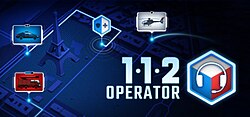

112 Operator is the kind of game that treats emergency response like a logic puzzle you solve while someone else nervously juggles timers in the background. Developed by Jutsu Games in Unity and ported to the Switch by SONKA, it drops you into the role of a 911-style operator on a simplified map of districts, where calls arrive, decisions must be made, and consequences are delivered on a predictable-but-cruel schedule. The core pitch is refreshingly narrow: no driving, no exploding cinematics, just a steady stream of incidents that you triage and resolve by dispatching the right vehicle and personnel. That mechanical purity is both the game's greatest strength and its limiting factor. From a technical lens, 112 Operator plays like a systems designer's notebook-compact systems interacting to produce emergent pressure. It's single-player, strategy-simulation fare that runs on Unity, which explains much of its architecture: modular scenarios, data-driven incidents, and a UI-first approach that privileges information density over visual flourish. The game launched with a baseline set of emergencies and expanded through DLC-Facilities, Water Operations, Pandemic Outbreak and The Last Duty-each adding new systems (CCTV, jetskis, PPE, even a zombie mode) that slot into the same core simulation. If you're the type who gets nerdily excited by rule sets and interaction edges, the Switch port provides a tidy implementation of those ideas in a handheld package.
At its heart 112 Operator is an event manager and resource allocator. Gameplay loops are simple to describe but tricky to optimize: calls are queued over a map, each call contains metadata (type, severity, location, time-sensitivity), and the player assigns units-ambulances, fire trucks, police cars, specialized boats or drones-based on suitability. The appropriateness mechanic is binary in design: the right unit increases success probability and shortens resolution time, the wrong one can lead to failure states. This clarity is a deliberate design choice; it reduces ambiguity in player intent and makes each dispatch a crisp, testable decision. Under the hood the game appears to follow an event-driven architecture common in Unity-based strategy sims. Incoming incidents likely instantiate as scriptable objects or data entries with state machines that transition from 'incoming' to 'responding' to 'resolved/failed' depending on timers and unit assignment. This makes it easy for DLC to introduce new incident types or assets without disturbing core logic-the pandemic add-on introduces PPE and quarantine status flags; Water Operations adds water-capable vehicle classes and terrain checks for shoreline proximity; Facilities inject passive systems like CCTV which likely act as modifiers on incident detection or response times. The economic model is straightforward: complete calls to earn money, expand districts to increase call volume, purchase vehicles and hire personnel. From a technical balance standpoint that's a feedback loop: more coverage -> more income -> more calls -> more complexity. The three difficulty modes tweak this loop likely by adjusting call frequency, severity multipliers, or starting resources, which is an effective way to scale complexity without altering the core mechanics. AI and pathing are intentionally abstracted. The game does not simulate vehicle movement in a physically detailed way; units are resources assigned to tasks with travel time as a simplified function of distance, vehicle type and perhaps traffic modifiers. This abstraction is a practical engineering trade-off: it keeps CPU and memory costs low on platforms like the Switch and concentrates the gameplay on decision-making rather than micromanagement of movement. One of the game's technical triumphs is its scenario system. Real-world-inspired scenarios (for example, the 2020 California wildfires) and the DLC scenarios act as curated event queues and environmental multipliers, layering custom constraints atop the base systems. This data-driven scripting makes the content modular and extensible-developers can add disaster types, scripted events, or persistent modifiers without changing the engine. The modular DLC approach also reduces coupling between content and engine, which is a sign of competent Unity architecture. Where the simulation shows its seams is depth versus surface complexity. Reviewers called the mechanics "addictive" but "superficial," and that criticism is accurate from a systems perspective. The rules are tightly scoped and predictable; once you understand matching vehicle classes to incident tags, the challenge becomes scheduling under time pressure rather than uncovering deeper, interlocking systems. For players who want deeper simulation fidelity-detailed logistics, personnel skill progression, or multi-layered supply chains-the game will sometimes feel intentionally shallow. But as a technically clean, portable systems game, it succeeds in delivering a robust, hackable core loop.
Graphically, 112 Operator errs on the utilitarian side, which suits its design goals. The art language is iconography-first: small overhead map tiles, clear unit icons, and interface panels that prioritize legibility. The Switch thumbnails and screenshots included with the title emphasize information density-lists, timers and colored status bars dominate the screen. This is a sensible UI decision; when seconds matter on a call you want typography and contrast, not particle effects. Using Unity makes this portability-friendly. The visual assets read as low-to-medium poly 2D UI assets and sprite-based map elements, which keeps memory usage modest on Switch hardware. The tradeoff is obvious: no high-fidelity lighting or advanced shaders here. Instead the fidelity budget goes to clarity-distinct vehicle sprites, readable text at handheld resolutions, and interface affordances for quick selection. Effective iconography reduces cognitive load and is more valuable than graphical spectacle in a systems-heavy game. Given the game's focus, audio and animation are minimal and functional rather than cinematic. Animations serve to confirm state changes (a vehicle icon moving, a call panel flashing) rather than to entertain. From a performance standpoint this reduces the risk of frame drops and long load times on the Switch, and it matches the developer's emphasis on deterministic simulation over audiovisual flash.
112 Operator on Switch is a tidy, technically sensible implementation of a compact simulation. If you appreciate data-driven design, modular scenario scripting and a UI that prioritizes decision-making, the title delivers a satisfying, tension-filled loop that rewards pattern recognition and resource planning. The SONKA Switch port benefits from Unity's portability and a minimalist visual style that keeps focus where it should be: on systems and timing. The title is not for everyone. Players seeking deep logistics sims or narrative-driven emergency dramas may find the systems a touch shallow; the emergent tension depends on the rate and variety of calls rather than on layered simulation fidelity. Still, for strategy-simulation fans who like their games served as precise rule sets with DLC expansion, 112 Operator is an engaging choice on Switch. It earns a solid 7.5/10: competent, occasionally brilliant in its clarity, and ultimately rewarding for players who enjoy optimizing under pressure.
 Not Tonight on Switch
 Uno on Switch
 Nobunaga's Ambition: Iron Triangle on PS2
 Nobunaga no Yabou Online: Haten no Shou on PS2
 Planets Under Attack on PS3
 911 Operator on Switch911 Operator on Xbox One










 Another SquareThought Site