

 Jul 2021
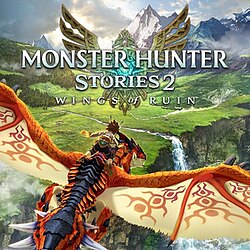

Monster Hunter Stories 2: Wings of Ruin is the turn-based, monster-breeding cousin of Capcom's long-running hunting franchise - a JRPG that borrows the creature taxonomy and bestiary of Monster Hunter and recasts hunting as friendship, egg theft, and tactical rock-paper-scissors. Released on Switch (and later PC and PS4), it trades live-action swing-and-dodge for an orderly sequence of decisions: pick Power, Speed or Technical; watch the Head-to-Head; hope your Monstie and buddy sync up to trigger a Double Attack. On paper it sounds modest; in practice it is a tightly designed encounter loop with a surprising amount of mechanical nuance. If you want an RPG that focuses on party synergy, team composition, and readable combat telegraphing rather than frame-perfect inputs, Stories 2 is the kind of design that will make your inner spreadsheet weep with joy.
At the heart of Stories 2 is a combat system engineered around categorical clarity and emergent synergy. Every attack falls into one of three discrete types: Power, Speed, and Technical - arranged in a rock-paper-scissors triad where Power beats Technical, Technical beats Speed, and Speed beats Power. The game layers two primary tactical constructs on top of that triad. First is the Head-to-Head mechanic: whenever an enemy targets a character who attempts to attack, their attack types are pitted directly against one another and the stronger type wins the exchange. This makes targeting information vital; the UI telegraphs target selection clearly so you can plan whether to force a Head-to-Head, bait one, or avoid it entirely. The second layer is the Double Attack: if the Rider and their Monstie choose the same attack type and that type has advantage while the enemy is targeting either of them, both attacks resolve together and the enemy is denied retaliation. Double Attack is mechanically elegant because it rewards party coordination and prediction rather than raw numbers. It turns what could be a bland type-choosing minigame into a deeper study of probability, enemy behavior, and composition. You find yourself thinking several turns ahead: which Monstie has which innate type tendencies, which moves add bonuses or multipliers, and how likely is the AI to target my Rider versus the Monstie. Beyond those core interactions, the Buddies system adds a third combat slot: an allied Rider and Monstie pair joins your fights, creating 2v2 dynamics where positioning and selection multiply complexity. Buddies are not just cosmetic; their skills, elemental coverage, and move pools meaningfully alter decision trees. In practice, battles evolve into handshakes between the triad-of-types and the synergy-of-roles. You will plan for elemental counters, technical setups (status-inflicting Technicals open windows), and burst timings (stacked attacks that break enemy shields). The game rewards players who read move descriptions and understand move categories rather than merely spamming the highest-damage button. Progression is straightforward but thoughtfully balanced. Riders and Monsties gain experience and level up; Monsties learn moves and can be customized via inheritance and egg hatching. The egg-stealing-and-hatching motif is more than flavor text: breeding mechanics let you chase specific skill lines and stat distributions. Equipment and items exist to round out builds, and subquests provide predictable pacing hooks between major story beats. Combat pacing is tuned to be accessible: encounters tend to resolve in a handful of turns, and the visual clarity of type interactions keeps the cognitive load reasonable even when screen clutter increases with Buddies present. The rock-paper-scissors core does have limitations. The mechanical space, while deep, is finite; prolonged play highlights repetition in enemy archetypes and move interactions. Capcom counters this via encounter variety, boss mechanics that change the triad dynamics, and the occasional forced strategy shift (environmental hazards, rage states, or mechanics like Oltura's wing weak points in the late game). Still, if you are someone who expects constantly unfolding mechanical novelties, you'll eventually hit the loopiness ceiling. That said, for players who enjoy optimizing teams, re-rolling eggs for ideal inheritances, and squeezing incremental efficiency from predictable systems, the combat loop is a satisfying engineering challenge. The UI and feedback are commendable from a systems perspective. Attack types, targeting, status icons, and anticipated outcomes are all presented in a readable, low-latency fashion. Combat animations are long enough to be enjoyable, short enough to avoid boredom, and they consistently map to backend calculations - what you see is what you get. The game avoids the common RPG sin of hiding hit resolution behind obfuscated probabilistic text; instead it emphasizes deterministic-looking interactions that allow players to form reliable mental models. Outside combat the loop is more conventional: exploration, dialogue, gathering, and sidequests. The story provides purpose and episodic objectives, and the Monster Hunter lineage shows up in how world encounters are structured. There is cross-compatibility with Monster Hunter Rise as a meta-note - the game links into the broader Capcom ecosystem, which can be satisfying for series fans. Multiplayer exists but the single-player experience carries the design work; the systems present in solo play scale neatly into multiplayer contexts without feeling shoehorned.
Stories 2 runs on Capcom's MT Framework - an engine with a long pedigree across the company's catalog. MT Framework is not the newest kid on the block, but it excels at delivering consistent cross-platform assets and predictable runtime behavior. On the Switch, that translates to a judicious balance between fidelity and performance. Capcom and Marvelous opted for a stylized aesthetic rather than photorealism, and that choice plays to the platform's strengths: art direction, palette, and silhouette readability matter more here than raw texture resolution. Art direction is one of the game's strongest technical decisions. Character and monster designs are clear at small resolutions, which is important for a handheld-first platform. Artists listed in the credits bring cohesive visual language to the roster of creatures - the Monsties are expressive, readable, and varied enough to make breeding for looks as satisfying as breeding for stats. The animation pipeline prioritizes clarity: attack telegraphs, hit reactions, and stagger animations convey mechanical state changes without relying on particle spam to do the heavy lifting. From an engine perspective, MT Framework's mature toolset shows in the game's asset streaming and LOD decisions. Environments feel dense enough to be interesting without taxing the Switch beyond reasonable limits. Developers often face the classic trade-off between texture resolution and memory footprint on Nintendo's hardware; Stories 2 leans toward consistent framerates and stable load times, which benefits a tactical RPG where gameplay rhythm matters more than single-frame cinematics. The switch between docked and handheld modes is handled gracefully; UI elements scale, and nothing vital is lost when you slide the console into portable mode. The UI is functional and crisp, favoring typographic hierarchy and iconography rather than flashy overlays. This helps in combat when information density is high. Sound design and score also deserve a technical nod: the mix prioritizes clarity of combat cues and voice lines where present, ensuring that audio feedback complements on-screen indicators rather than competing with them. The composers and sound team construct arrangements that support pacing rather than dominate it. If there is a visual complaint, it is architectural repetition in some overworld areas and an occasional sense of padded traversal between story nodes - typical of RPGs that need to gateized content across a larger map. But stylistic consistency, readable combat visuals, and the engine's reliability make the graphics package appropriate for the Switch target and the game's design goals.
Monster Hunter Stories 2 is a systems-driven JRPG that treats its combat like an engineering problem: define a clear set of interactors, give the player readable feedback, and let emergent strategies arise from predictable rules. The Power/Speed/Technical triad, Head-to-Head exchanges, Double Attacks, and the Buddy system form a compact but deep mechanical toolkit. The MT Framework-powered presentation opts for artful clarity over brute-force fidelity, which suits the Switch hardware and the game's strategic focus. Reception metrics - an 81 on Metacritic for Switch and solid sales performance - reflect a product that resonated with both fans and newcomers. If you like tactical clarity, team optimization, and the satisfying itch of breeding the perfect Monstie, this game will reward obsessive play. If you demand an endlessly surprising combat palette or relentless mechanical novelty, you may eventually find the loop familiar. For most players looking for a technically sound, thoughtfully designed RPG on Switch, Stories 2 is a confident, well-executed package - equal parts friend-making and number-crunching, and oddly cathartic for anyone who has ever wanted to micro-manage a pocket-sized dragon army.
 Monster Rancher Hop-A-Bout on PlayStation
 Monster Hunter Generations Ultimate on Switch
 Combat Elite: WWII Paratroopers on PS2
 The Banner Saga 2 on PS4
 Arcania: The Complete Tale on PS3
 Predecessor on PS4










 Another SquareThought Site