

 Apr 2020
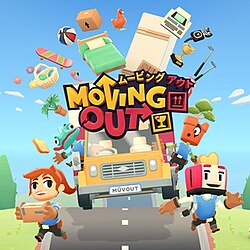

Moving Out is a gleefully chaotic co-op puzzle-action game that dresses the soul-crushing mundanity of hauling a couch in a bright, cartoony outfit and hands you a marching band of physics to orchestrate. On Switch, this is a local multiplayer party staple - though it also works single-player - where your goal is deceptively simple: get marked furniture and appliances from the house into the truck before the timer bleeds out. The challenge isn't just the clock ticking; it's the nonsense physics, environmental hazards, and the way the game insists you solve spatial puzzles while your teammate decides that a grand piano is best moved by launching it through a window. If your measure of fun involves teamwork, quick thinking, and the warm glow of imminent property damage, Moving Out has you covered.
Moving Out's core loop is a masterclass in short-form challenge design: you enter a level, the game tells you what needs to go in the truck, gives you a time limit, and then proceeds to throw rakes, ice, fires, ghosts, and common sense at you. Levels are cleverly designed to force prioritization - that upright fridge is heavy, needs two people, and sits at the far end of a house where the staircase hugs the wall like a sad snake. Some items are fragile and easily shattered; others require two bodies and choreography to extract. Those simple rules create a sandbox of escalating constraints that keeps the game feeling brisk and brutal in equal measure. From a skills perspective, Moving Out is less about twitch precision and more about combination play: communication, spatial reasoning, timing, role specialization, and improvisation. Communication is the obvious MVP in a two- to four-player session. If you and your group are constantly arguing over whether to throw the TV or carry it through the door, you will waste precious seconds and probably one gold rating. Successful runs feel like a ballet where players assume roles on the fly - one person clears obstacles and opens pathways, another wrestles big items, while a third hustles the small stuff to the truck. In single-player, that role management becomes a solo juggling act; the AI won't help you, but the levels are still tuned enough that an organized approach converts into a satisfying, if sweatier, experience. Spatial reasoning comes up constantly. Rooms are puzzles: how do you get an L-shaped couch around a choke point? Where do you place boxes so that they don't topple the second you run past them? The game rewards pre-planning - a quick scan of the environment to spot ramps, hazards, and alternate routes can shave entire minutes off your time. Time management goes hand-in-hand: the bronze/silver/gold ranking system (based on how fast you pack everything) is an excellent lever for players who want a higher-stakes experience. Optional objectives, like breaking all the windows or packing an unmarked item, add secondary goals that push you to adapt on the fly or leave them for speedruns once you master the basics. One of Moving Out's most entertaining difficulty modifiers is its exaggerated physics engine. Objects have personality: they wobble, snag, and occasionally teleport to spite you. This unpredictability injects chaos into even the most well-planned runs, forcing teams to improvise. Throwing items is part strategy, part sudoku: fling too hard and you lose the item; toss too soft and someone will lag behind trying to drag it across a room. The game tempts players into risk management - should you attempt a bold throw that saves 10 seconds but might break a fragile vase (and your optional objective), or is carrying it safe and boring? Obstacles are where Moving Out shines as a puzzle game masquerading as slapstick. Rakes trip you up and spin your character into a confused tumble. Ice patches turn simple corridors into low-budget figure-skating dramas. Fires funnel movement and demand attention or the object gets toastier than you'd like. Ghosts appear in levels and add an extra layer of mayhem; they roll through rooms, displacing items and your plans. The Movers in Paradise DLC (available on Switch) introduces additional mechanics like cranks, jetpacks, fans, breakable walls, and rafts. These mechanics are small in isolation but enormous in how they change problem solving - suddenly you are timing fan bursts to float sofas into awkward corners or using rafts to ferry an appliance across water. For players who prefer a less punishing experience, the game's Assist Mode is a thoughtful inclusion. Assist Mode can add extra time, make objects lighter, vanish delivered objects, remove obstacles, or even skip levels. Instead of gating content behind difficulty, Moving Out lets you tune the challenge to your group. If your playgroup includes a kid, someone with limited mobility, or an attention span that might be described as "mercurial," you can lower the barrier to entry without sacrificing the core design. For people chasing gold medals and perfect runs, Assist Mode is a cheat code you probably won't touch - but it's nice that the option exists. The game's pacing of difficulty is deliberate. Early levels teach you core skills: how to carry, how to throw, how to deal with two-person items. Levels quickly escalate in complexity and demand tighter coordination and faster decision-making. This is where the game's learning curve is clever: each new hazard or mechanic is introduced in a controlled environment before being combined with others, building a layered difficulty that keeps you on your toes. However, it also means certain later levels can feel punishing if you rely on chaos over strategy. Reviewers noted that frustration sometimes peeks through; parts of the design are purposely antagonistic. If you bristle at repeated failures or hate the randomness of wobbly physics wrecking an otherwise perfect plan, this game will call your bluff. A final design wrinkle that affects challenge is the local-only co-op emphasis in the original release. Playing with friends in the same room is where Moving Out hums: that communicative immediacy and tactile laughter are part of the skillset you develop. The sequel handles online co-op differently, but on Switch, the original experience rewards collaborative skills in a way online latency can't replicate.
Visually, Moving Out on Switch adopts a colourful, cartoony style that keeps the tone light even when you're angrily shoving a refrigerator through the wrong doorway. The characters and environments are stylized, expressive, and designed for readability - you can instantly tell which items are marked for the truck and which are scenic background clutter. This clarity is critical for the game's fast decision-making: when a room is full of stuff and the clock is an unforgiving tyrant, visual legibility reduces needless errors. The exaggerated physics are mirrored by the art direction: things pop, bounce, and break with satisfying little animations that make failure feel comedic rather than cruel. On Switch the performance is generally solid; there are no high-end graphical flourishes here, and that's by choice. The focus is on smooth local play and readable chaos, both of which the game delivers. DLC levels introduce new thematic visuals - tropical colors, beach props, and water effects - which complement the new mechanics and keep the later stages visually fresh. If you're expecting photorealism, this isn't the game for you. If you want a visual language that supports rapid decision-making, communicates hazards clearly, and gamifies destruction into comedic spectacle, Moving Out's style is spot on.
Moving Out is a delightful exercise in controlled chaos that turns menial labor into a test of teamwork, strategy, and improvisational skill. The challenge emerges from a clever mix of time pressure, physics-driven unpredictability, and environmental puzzles that demand communication, spatial reasoning, and quick role decisions. It's the sort of game that rewards planning as much as it rewards happy accidents, and that tension - between a perfect, practiced run and the joy of a gloriously botched heave - is where the fun lives. The Assist Mode and the way the difficulty ramps let almost anyone enjoy the game while still giving competitive players a decent runway to chase gold medals. The DLC content and free update (which reversed gameplay on a set of levels) add enough variety to keep the formula fresh. Critics mostly enjoyed the multiplayer experience, with Metacritic scores landing in the high 70s for Switch and an IGN 8/10 review pointing out the game's strengths; some outlets found occasional frustration in the chaos. That frustration is, for many players, part of the point - Moving Out is a playground where coordination and communication feel earned. If you like puzzle games that make you think on your feet, or party games that let your pals sabotage your plan in the name of laughter, pick up Moving Out on Switch. Make sure to invite friends, establish roles, keep the tossing to a minimum until you master the angles, and remember: never trust someone who suggests "just throw it through the window."
 Moving Out on PS4
 Moving Out 2 on Switch
 Onimusha: Dawn of Dreams on PS2
 Puzzle by Nikoli 4: on PS4
 Puzzle Quest 2 on DS
 Action Man: Operation Extreme on PlayStation










 Another SquareThought Site