

 Nov 2017
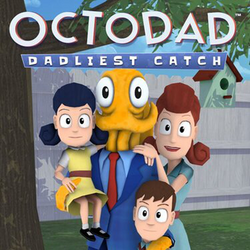

Octodad: Dadliest Catch on Switch is the game that dares you to parent like a cephalopod while looking eminently human doing it. What began as a student project blossomed into a commercial indie darling, and the Switch port lets you shepherd the schleppy, suction-cupped protagonist through suburban life with the joy and mild panic normally reserved for IKEA trips and in-laws. At first blush it's a physics-based comedy about clumsy limbs and spilled milk, but under the cartoon moustache and slapstick soundtrack is a surprisingly tender story about identity, secrecy, and what a family chooses to accept. This review digs into those character arcs - Octodad, his wife Scarlet, the kids Tommy and Stacy, and the moustache-twirling Chef Fujimoto - while evaluating how the Switch version and its flailing controls serve the story.
If you want a mechanical summary: you control Octodad by manipulating two sets of tentacles, switching between them, flinging items, and attempting not to behave like a giant mollusc in public. A stealth gauge tracks how suspicious nearby humans are, and if you botch too many aisle crossings or security encounters you restart at a checkpoint. There are set-piece chapters - household chores, a supermarket run, an aquarium visit - and a multiplayer mode where friends can join to control extra limbs and make the farce even better. But mechanics are not merely comedy tools; they're the storytelling language of Octodad. Every awkward arm flick, every dropped carton of milk, communicates the central conflict: Octodad wants to be a dad who fits in, but his body literally refuses to let him be 'normal'. The game's control scheme makes you complicit in that concealment. When you slowly, laboriously pick up a child's stuffed toy and cradle it with three separate button presses, you feel how much effort Octodad invests to mimic human tenderness. It's tactile empathy: the controls are awkward on purpose so you understand the character's constant small deceptions. This interplay peaks in stealth sections and the aquarium chapter. The stealth mechanic, driven by a suspicion meter, is mechanically thin but narratively potent. It frames the stakes: keeping the family oblivious is not just a button to be pressed; it's a daily performance. The supermarket level, which could have been an innocuous fetch quest, becomes a comedy of errors and a peek into domestic life - grocery lists, family responsibilities, the small humiliations of suburban adulthood. The aquarium level levers the game's themes into darker tones: Chef Fujimoto, the antagonist who wants to expose and cook Octodad, escalates the stakes from 'don't spill the beans' to 'protect your family at all costs'. Octodad's arc is constructed less through dialogue and more through action. Flashbacks sprinkled throughout the game reveal how he adopted his human persona and fell in love with Scarlet. These sequences are short and sweet, illuminating rather than overwhelming. Scarlet is written as both the unaware spouse and an emotional anchor. Her inclusion in gameplay - the moments where Octodad must behave 'normally' around her - exposes the tender comedy of a partner who loves someone that doesn't quite align with reality. The children, Tommy and Stacy, are less developed in screen time but essential to the emotional payoff: Stacy's revelation near the end that she always knew her dad was an octopus reframes the entire narrative. It turns secrecy into a shared family secret rather than a tragic deception. The game's climax, which culminates in Octodad being thrown into a shark tank and later revealing his true self, is both predictable and satisfying. The melodrama of being unmasked is a classic arc, but what makes it feel fresh is the way the gameplay has primed you to sympathize with Octodad's clumsy efforts. When the disguise comes off and Octodad stands there, tentacles exposed, the game relies on the emotional labor you put into managing his body and relationships. The reveal is written as forgiveness rather than catastrophe. Fujimoto's attempted violence and subsequent incapacitation resolve in an unexpected olive branch: Octodad forgives. Family acceptance, not retribution, is the game's final note. On Switch, the motion and Joy-Con controls can be an amusing optional layer, but the core experience is the same: victory feels like parenting well despite all odds. The game's short length is a double-edged sword - it keeps the character beats tight, but some reviewers (and players) have complained the second half leans on conventional boss fights and stealth in a way that dilutes the quirky intimacy of the opening chapters. That's fair. Still, the moments where you fumble a stuffed toy into a child's arms and the game rewards you with a cutscene of genuine warmth are worth the price of admission.
Visually, Octodad opts for cartoony, clean aesthetics that complement its absurd premise. Characters have exaggerated, rounded features and the suburban environments are bright and intentionally mundane, which makes the surreal presence of an octopus in a cardigan feel both ridiculous and plausible. The art style reinforces the central dramatic irony: everything in the world is normal, which highlights how out-of-place Octodad is. The Switch hardware handles the game's stylized visuals without fuss. Textures are simple but expressive, animations are often intentionally wonky (in service of comedy), and the level designs are coherent enough to support the physical puzzles. The flashbacks are rendered with slightly altered palettes and framing, giving them a nostalgic sheen that clarifies their role in the narrative. There's a pleasing contrast between slapstick animation and moments of quiet emotional sincerity, and the soundtrack - with occasional nods to old silent-film accompanists - accentuates both beats. Some camera issues mentioned in other versions persist on Switch: the sometimes wayward camera can frustrate tight sections, and there are occasional difficulty spikes where repetition feels tedious rather than hilarious. Those complaints matter more if you come to Octodad purely for optimal gameplay rather than the character-driven comedy.
Octodad: Dadliest Catch on Switch is less a precise puzzle game and more a small, affectionate play about what it means to be accepted by your family despite being fundamentally different. The design choice to make the protagonist awkward to control is a brilliant piece of ludonarrative harmony: you physically participate in Octodad's secret-keeping, and that creates empathy in a way cutscenes alone rarely do. Character arcs are surprisingly well-handled for a comedy about a man who is an octopus; Octodad's quiet devotion, Scarlet's grounding presence, the children's eventual acceptance, and even Fujimoto's hammy villainy coalesce into a story that lands on forgiveness and familial bonds. If you prize tight mechanical design and hours of challenge, the game's brevity and some stealth-heavy late sections will grate. If you want a funny, occasionally touching indie experience that uses its awkward controls to make you care about a tentacled dad, the Switch edition is an excellent, portable way to play. The result is a charmingly weird family drama disguised as a physics comedy, and while it sometimes flirts with frustration, it never forgets that its heart is the most important limb of all.
 Tony Hawk's Pro Skater 5 on PS3
 Ace Angler on Switch
 Tintin: Destination Adventure on PlayStation
 One Piece Grand Adventure on PS2
 Taiko no Tatsujin: Dokodon! Mystery Adventure on Switch
 Taiko no Tatsujin: Don to Katsu no Jikū Daibōken on Switch
 Bugsnax on PS4
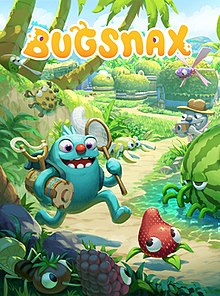 Bugsnax on Switch










 Another SquareThought Site