

 Oct 2021
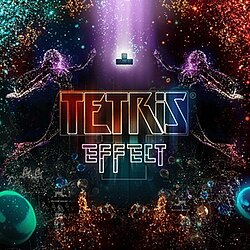

Tetris Effect: Connected on Switch is the kind of Tetris that looks like it moonlights as an art installation and a wellness retreat. It began life as a PS4 game in 2018, matured through VR conversions and a PC release, then had a cooperative personality transplant called "Connected" before showing up on the Switch in October 2021. If you have ever wondered what happens when someone dresses classic tetromino stacking in a sound-and-visual system so convincing it could induce mild bliss, this is the answer. The developers listed are Monstars, Resonair and Stage Games, the music comes from Hydelic, and the publisher is Enhance Games. It is a puzzle game whose chief innovation is making you reconsider whether you are playing Tetris or being played by it.
Tetris Effect: Connected is, at its core, the oldest videogame in the book: place tetrominos to make complete lines and clear the playfield. If you know how to rotate an L-block into the tiny, obvious hole you always miss, you are already ahead. What sets this version apart is a carefully applied sense of occasion. Thirty themed stages come packed with visuals and music that breathe in rhythm with the play. Each stage is less a background and more a collaborator. The soundtrack, composed and produced by Hydelic, features tracks like "Connected (Yours Forever)" and a pleasant parade of titles-"Pulse," "Joy," "World of Colors"-that will do the things music does when it decides to be immersive: swell, loop, and make subtext feel like a second controller. Mechanically there is a notable new toy called the Zone. Zone lets you pause the relentless advance of the stack long enough to plan something that would otherwise be impossible: clears greater than four lines at once. For a franchise built on simplicity and timing, this is the equivalent of adding a tasteful Swiss Army knife. It expands the decision tree without turning the game into a physics simulator. The meta-game levelling system quietly encourages small goals and provides a sense of progression; it's not intrusive, which is to the game's credit because nothing ruins existential calm like a neon XP bar demanding attention. Connected, the expansion that made the jump onto Xbox and later arrived on other platforms, introduces multiplayer options that are actually useful. Co-op mode allows players to work together to reach zone-based combos and score thresholds. The competitive mode tiptoes toward the strictness of classic NES-era rules for those who prefer their Tetris to come with the emotional intensity of a tax audit. There is also a "classic" aesthetic option that pays homage to the simplified visuals of early console Tetris, which is a polite way of saying you can make this look like it's running on a tiny wooden box if you want. System-wise, Connected was released across Xbox One, Series X/S, Windows and later made its multiplayer expansion freely available for the original platforms. For the Switch specifically, the game launches as the Connected edition, so the multiplayer and added modes are part of the package. The single-player Journey mode is where the game earns its reputation as something like a sensorial spa for people who enjoy methodically stacking blocks until their hands ache. Journey strings different visual and auditory palettes together; stages react to your actions, and success triggers audio-visual flourishes that are oddly satisfying in a way modern games are still not allowed to be unless they win awards. Speaking of awards, it did win a few-Best VR/AR Game at the 2018 Game Critics Awards and various audio-related trophies-so these sensory choices were not purely decorative. Controls on Switch are serviceable. The Joy-Con is not the natural habitat of the hardcore Tetris player, but it is competent. If you have higher ambitions you can plug in a Pro Controller and pretend you are a serious person controlling falling shapes with the calm of an old chess master. The AI and matchmaking for online modes are competent; latency is not a common complaint, which is important in a game where a single misplaced T-spin can read like betrayal. If there is a complaint to lodge, it is that the sensory design is so persuasive you might find yourself playing longer than advisable. The Zone mechanic encourages experimentation and the cooperative modes add a new route for social time-sunkness. For people who take pride in eating responsibly and not letting videogames dictate how many deep breaths they take, this is either a feature or a problem depending on your willpower.
Visually, Tetris Effect: Connected is trying to coax you into a very specific emotional state. The game uses Unreal Engine (and later Unreal Engine 5 on some platforms) to stitch together scenes that range from softly abstract to aggressively pretty. The Switch, with its modest horsepower, does not produce the same polish as a PS5 in VR, but the visual identity survives the downgrade with dignity. Colors bloom, particle effects trill, and each stage has a personality so vivid you might start introducing yourself to background jellyfish. The Connected edition also includes a throwback competitive visual mode that simplifies the look to something resembling the first console Tetris games. This is not a limitation; it is a feature for purists. It saves you from having to choose between sensory overload and nostalgia-now you can have both, depending on which menu option you pick while pretending you are only going to try one round. On Switch the framerate and image quality are stable enough for gameplay precision; none of the extravagant lighting will get in the way of line clears. The lack of the PSVR experience is felt only if you are specifically looking for it-the Switch is not a VR machine and the game does not pretend otherwise. Instead it offers a portable, visually pleasing Tetris experience that substitutes the immersive hug of VR with well-crafted imagery and crisp, functional interfaces. If the game were a suit, the Switch version would be an impeccable but slightly less theatrical one.
Tetris Effect: Connected on Switch is a peculiarly grown-up form of Tetris: someone took a 40-year-old toy, taught it to appreciate music, and gave it a couch to lie down on. The Connected expansion's cooperative and classic competitive modes add meaningful longevity without betraying the game's single-player soul. The Zone mechanic is a clever twist that rewards spatial thinking and timing without turning the rules into a parody of themselves. The soundtrack-Hydelic's work, including the memorable "Connected (Yours Forever)"-is more than window dressing. It is an active participant in the experience, and the game's many awards for audio are not accidental. Ported to Switch, the experience trims some of the graphical shine from the console and VR versions but keeps the heart. Playing this version feels like being handed a polished jewel in a modest box: you know there is more sparkle elsewhere, but that does not make this any less beautiful. If you own a Switch and are the sort of person who can be persuaded to spend an hour fixated on a T-spin triple while the soundtrack holds your hand, then buy the game. If you are worried about being seduced into long sessions of calm obliteration, set a timer. Either way, this is Tetris done with intent, aesthetics and a surprising amount of human warmth, which is one way to make falling blocks feel like the best decision you have made all week.
 Tetris Effect: Connected on Xbox Series X/S
 Tetris Forever on Switch
 Puzzle by Nikoli 4: on PS4
 Professor Layton and the Last Specter on DS
 Puzzle Kingdoms on DS
 Puzzle de Harvest Moon on DS










 Another SquareThought Site