

 Aug 2020
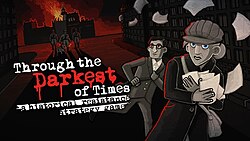

If you're the sort of person who enjoys historical guilt trips wrapped in minimalist art and moral decision-making that makes you feel alternately noble and incompetent, Through the Darkest of Times on Switch might be the awkward dinner conversation you didn't know you wanted. Developed by the German indie duo behind Paintbucket Games and published by HandyGames, this single-player strategy title casts you as the leader of a tiny resistance group in Nazi Germany, starting in 1933 and trying very hard to survive the next dozen years without getting flattened by history (or the Gestapo). This is not a pew-pew shooter, nor is it an action-adventure with cinematic heroics. Think of it more like a grim, inked board game crossed with an interactive history lesson and a mobile app that got a Switch cartridge because it heard the Switch has good posture. The game is earnest, occasionally brilliant in its storytelling, and stubbornly rigid in ways that will annoy anyone expecting a weighty strategy sandbox. It also had the distinction of being one of the first games published in Germany allowed to show Nazi symbols after regulatory changes - a fact that matters, because the game isn't reveling in the imagery; it's trying very hard to remind you why that imagery is horrible. On the Switch, Through the Darkest of Times wears its seriousness lightly. The portable format actually suits the game's short, weekly turns: ten or twenty minutes of clandestine leaflet-distribution followed by a forced gulp of reality, and then you put the console down and live your life for a while. If that sounds bleak, it is - but the game periodically surprises you with compassion, historical texture, and those rare moments where a small act of sabotage feels like a tiny victory against a monstrous machine. It's imperfect, repetitive in parts, and occasionally frustratingly shallow in its strategy options, but it is also thoughtful and occasionally devastatingly effective at conveying what it meant to resist.
Gameplay is built around structure. You begin as a resistance leader with a randomized background - the game gives you a little biography and a handful of stats that shape what your crew can do. Each chapter covers a period in Nazi Germany and consists of twenty weekly turns; each week is a turn in which you assign group members to missions, manage supplies and morale, and navigate a small web of choices. Missions are the heart of the experience and they're straightforward: distribute leaflets, paint anti-Nazi slogans, sabotage equipment, or sneak documents. The simplicity is intentional - the developers wanted to spotlight the human scale of resistance rather than deliver a complex war sim - but that decision both helps and hurts the game. On the plus side, the missions create a steady rhythm and recurring tension: each action can increase suspicion, cost supporters, or result in arrest and, worst-case, death. You learn to calculate risk, prioritize who does what based on traits (a certain character might be stealthy, another stern and persuasive), and sometimes accept that losing a friend is a grim inevitability. The strategic layer is less ambitious than it looks on the box. Choices feel meaningful in the moment but rarely ripple far beyond immediate consequences. The main objective is blunt: survive the era and resist as effectively as you can. Interludes of dialogue and scenes - often historically-informed and occasionally harrowing - appear between chapters and at the start of turns. These narrative beats are the game's emotional engine: meticulously researched newspaper clippings greet you each week, grounding the play in real events. The writing here is the game's strongest suit; its delivery of historical texture is usually dignified and thoughtful, even when the story's arc stubbornly refuses to change major historical outcomes. The game makes no pretense of altering history; it instead offers a portrait of resistance that emphasizes survival, small victories, and heartbreaking losses. Where Through the Darkest of Times runs into trouble is its repetition and lack of strategic depth. After a few chapters the loop can feel predictable: pick missions, hope for success, deal with arrests or casualties, and repeat. Reviewers at the time of release (and players on Metacritic) pointed out that the strategic choices don't always integrate tightly with the story: the interludes are powerful, the missions are pedestrian, and they don't always talk to each other in satisfying ways. Some critics even suggested the game might have been more at home as a mobile title - which, in a weirdly practical way, makes the Switch port feel very natural: same short-session friendly loop, but with bigger screen and better posture. Randomization gives the game some replay value: different party compositions, randomized leader backgrounds, and the way events unfold can produce alternate plays. Still, many players found the repeat sessions ultimately underwhelming because the variations don't fundamentally alter the experience. If you're coming to this for tight, branching strategy with deep systems, you'll be disappointed. If you want an accessible, narratively-driven look at resistance efforts with tense micro-decisions and meaningful atmosphere, this hits home more often than not. Expect moral discomfort, occasional triumph, and a few too many weeks of painting walls.
The game's art style is an aesthetic choice that deserves a standing ovation for mood. Inspired by 1920s German expressionism, the visuals lean heavily on inked silhouettes, warped cityscapes, and stark contrasts that make the whole thing look like a living woodcut. On the Switch, this stylized approach translates beautifully: the washed monochrome palette and jagged shadows read clearly in handheld mode and pop on docked screens without taxing the hardware. It's cinematic in a low-fi way, like watching a propaganda film through a mourning veil. UI and presentation are simple and clean - occasionally too simple. The menus, character portraits, and mission cards are serviceable, if not particularly flashy. The period-accurate newspaper clippings that introduce weeks are the smallest luxuries that the game offers: they're beautifully produced, historically meticulous, and painful in the best possible way, because they remind you that the world outside your small group is changing in brutal ways. Sound design is tasteful and unobtrusive: eerie chords, distant sirens, and the occasional bark of an authority figure give the game emotional punctuation without ever feeling manipulative. A few reviewers at launch criticized the art as 'nightmarish' or 'overly stylized' - that's a fair take if you prefer realism - but personally, the aesthetics fit the subject. This is not pretty history; it's memory rendered with conscience and a sharpened nib.
Through the Darkest of Times on Switch is a strange, sincere little game that wants to teach you about resistance by making you feel its costs. It excels at mood, historical texture, and short bursts of meaningful decision-making, and its German-expressionist visuals and week-by-week newspapers are quietly brilliant design choices that keep the game anchored in time and place. Where it falters is in mechanical ambition: the strategy layer is simple, missions can feel repetitive, and replay value is limited because the game's choices rarely cascade into radically different narratives. On the Switch, the package mostly works. Portable sessions suit the game's cadence, and the touchscreen-friendly mission flow (in the mobile versions at least) translates well to a controller-driven experience that doesn't demand marathon play sessions. If you want a sprawling strategy epic, look elsewhere. If you want an accessible, emotionally weighty portrayal of ordinary people trying to do extraordinary things in horrifying circumstances, this is a respectable and often affecting pick. It's earnest rather than elegant, memorable in parts rather than consistently brilliant, and worthy of a playthrough for its humanity alone. Final verdict: a thoughtful, imperfect experience. Play it for the story, stay for the mood, and bring tissues. Or a strong cup of coffee, because history is exhausting.
 Tokyo Dark: Remembrance on Switch
 Hydrophobia Prophecy on PS3
 Nobunaga no Yabou Online: Haten no Shou on PS2
 Planets Under Attack on PS3
 Nobunaga's Ambition: Iron Triangle on PS2
 Culdcept Expansion on PlayStation










 Another SquareThought Site