

 Aug 2025
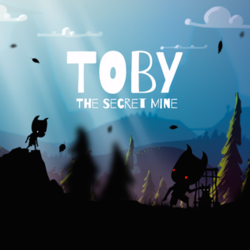

Toby: The Secret Mine arrives on Switch like a moody poem written in black ink, then accidentally splashed with a handful of neon paint. It's a side-scrolling puzzle-platformer that wears its Limbo inspiration on its sleeve but insists on having personality of its own. You play as Toby, a small silhouette with surprisingly expressive posture and morals that can be rewritten depending on whether you accept a crown or not. The plot is the kind of fairy-tale shorthand most indie platformers use-friends are kidnapped by ominous red-eyed cats, you go on an adventure, you confront the leader, and then you make the game developer's favourite kind of dramatic choice: murder or monarchy. This is a review with an odd specialty: we will take a microscope to the game's cast and their arcs. It's not exactly a Broadway play with soliloquies and 12-course character development, but Toby: The Secret Mine is compact enough that every twist and silhouette pose counts. Developer Lukáš Navrátil crafted the whole thing almost single-handedly over roughly a year and a half, using Unity and a minimalist visual language. The music by Matthew Steed gives emotional ballast to the wordless moments, and the whole package fits comfortably on Switch for on-the-go brooding and puzzle-solving. The game is short-21 levels-so its storytelling is economical. What it lacks in dialogue it tries to make up in symbolic beats, gameplay choices, and two very different endings. Those endings turn this game from a tidy rescue mission into a tiny morality play: accept the crown and watch Toby go red-eyed and sinister, or deny him the throne and return home with your friends freed. Both conclusions are sharp, and they make the silhouette silhouettes mean more than the sum of their pixels.
At its core, Toby: The Secret Mine is a precisely tuned puzzle-platformer. It borrows Limbo's silhouette aesthetic and side-scrolling choreography-run, jump, pull levers, dodge traps-but it then sprinkles in its own variety: 21 discrete levels set across forests, caves, a mine, and a blizzard. Each environment solves a different mechanical problem for the player. Forests introduce stealthy navigation and environmental hazards, caves and the mine lean into light-and-shadow puzzles and traps, while the blizzard levels crank the clock and demand timed platforming that can make you respect gravity and hate your thumbs. The puzzles are rarely about flashy gadgets; instead, they're about reading a scene and using momentum, physics, and timing to squeeze through. Hidden along the route are Toby's kidnapped friends-collectibles that serve as both an incentive to explore and tiny emotional payoffs for better players. Finding them is satisfying in a collectible-hunter sort of way: not mandatory for the plot, but they pad the game's emotional currency. Traps in each zone are tailored to the environment: the blizzard levels emphasize timed jumps and gusty betrayals from the elements, while mine levels flirt with verticality and the claustrophobic thrill of near misses. The game's puzzles sometimes rely on what reviewers called 'guesswork'-moments when the solution is less about deduction and more about experimentation. This can be divisive: when you're on a roll, figuring out a fiendish little contraption feels clever; when you're stuck, the game's silence can make you feel like you're being punished by a cruel, minimalist oracle. The platforming is generally tight-controls feel responsive, which is crucial since the game demands exactness. The sense of risk and consequence is heightened because many traps are easy to overlook unless you're constantly alert. On Switch this translates well: the portable nature means you can stew over a puzzle on the bus and then solve it when you feel vindictive enough. If you want a story analysis, the gameplay doubles as storytelling. The levels are less a sequence of cutscenes and more a litany of trials that sculpt Toby's character. He starts as a determined rescuer - small, vulnerable, but moving forward. The kidnapped friends are revealed via exploration rather than exposition, so their rescue is a mechanical achievement that also reads as an emotional one. The final encounter with the kidnapper doesn't let you leave as a passive victor; instead, it hands you a crown and an ethical choice. Accepting the crown is mechanically meaningless beyond the ending, but narratively it's everything: an invitation to power and a quick lesson on corruption-by-accessory. Killing the kidnapper ends the physical threat and restores the town, while taking the crown flips Toby and his friends' eyes red and ends with the protagonist on a cliff watching his world burn. That last beat is bold for a game of this scale. The choice is blunt but effective: you either choose restorative justice (kill the tyrant) or succumb to a power that promises control and converts you. The game trusts the player to feel the weight of that single decision despite its sparse presentation. In the context of gameplay, the decision arrives after a string of trials where you have only the agency of movement and timing. Handing you a moral agency at the end is like being given a paintbrush after a lifetime of coloring inside the lines; it reframes everything you've done as either righteous or damned.
Toby: The Secret Mine uses silhouette graphics with a color palette that, while rooted in black outlines, allows more color and less despair than its obvious spiritual ancestor. Where Limbo was a smoky charcoal funeral, Toby occasionally lets color leak in-warm glows in the mine, cooler blue washes in the blizzard, pockets of foliage that read as slightly less terminal. The silhouette aesthetic does more than look moody: it forces the game to rely on composition, animation, and level design to convey character and emotion. Tiny gestures-Toby's posture during a fall, the way he stumbles when hit, the tilt of the kidnappers' crown-become narrative shorthand. On Switch the visuals translate faithfully. They aren't a showcase of technical bravura, but this is a style that benefits from clarity over detail. Environments are legible, enemies read well as threats, and traps are usually visible enough to be fair. The trade-off is obvious: you won't be plumping your screenshots feed with photorealistic vistas, but you will get crisp, atmospheric frames that communicate mood efficiently. Matthew Steed's score supports the visuals with low-register chords and spot-on environmental cues; the audio does the emotional heavy lifting where words are absent. The artistic language also helps the character arcs. Because there is almost no spoken dialogue, changes in Toby and his friends are signaled through visual motifs-eye color, crowd behavior at the ending, and the crown's presence. The moment Toby's eyes turn red after accepting the crown is small but narratively devastating, precisely because the game has cultivated empathy through silhouette animation for nearly its entire length.
Toby: The Secret Mine is not trying to reinvent the platformer wheel. Instead, it polishes a modest, familiar form into a compact morality tale that fits in your pocket. Its gameplay is solid and occasionally prickly, with puzzles that range from satisfying to slightly opaque; its graphics are stylish, muted but not miserably dark, and the music completes the emotional triangle. The cast is small and mostly iconographic-Toby, kidnapped friends, red-eyed cats, and a crowned villain-but Navrátil squeezes surprisingly meaningful variations out of these archetypes. The game culminates in one of those indie endings that punches above its weight: a binary, symbolic choice that turns your platforming sweat into a sentence for a character. For players who value atmosphere, tight controls, and a short, thought-provoking experience, Toby delivers. If you were hoping for a sprawling narrative with pages of backstory, you're in the wrong mine. Instead, expect a concise experience that asks: what would you do when handed a crown at the foot of a defeated tyrant? That's a lot for a 21-level, silhouette platformer to ask, and Toby: The Secret Mine mostly makes the question stick. Score: 7/10 - a charming, if sometimes blunt, puzzle-platformer that earns its emotional sting through minimalism and a neat, morally ambiguous finale.
 Deltarune on Switch 2
 Secret Files: Tunguska on DS
 Puzzle by Nikoli 4: on PS4
 Tokimeki Memorial: Taisen Puzzle-Dama on PlayStation
 Professor Layton and the Last Specter on DS
 Tokimeki Memorial 2 Taisen Puzzle Dama on PlayStation










 Another SquareThought Site