

 Aug 2016


Valley is a first-person action-adventure from Blue Isle Studios that dresses up an old-school exploration loop in a shiny new physics-driven suit: the L.E.A.F. (Leap Effortlessly through Air Functionality). The game shipped on PC and consoles in 2016 and eventually padded into the Switch's library in 2019. It's the sort of title that invites you to zipline, wall-run, and generally treat verticality like it owes you money. Review consensus has been mixed-critics praised the sense of speed and the world's mood while grumbling about technical hiccups and a runtime that feels like a tasteful appetizer rather than a full meal. As someone who enjoys poking at engines and parsing frame hiccups like a hobbyist cardiologist, I spent time dissecting what makes Valley feel so kinetic and where the Switch port's technical seams show.
At the center of Valley's mechanical identity is the L.E.A.F. suit. From a systems vantage it's a neat example of a single gadget bifurcating the game's design: traversal and resource/affinity interactions. Traversal-wise the suit grants sustained boosts to momentum, higher jumps, and an explicit air-control vector that turns the world into a playground of chaining mechanics-springboards, tunnels, and ruined architecture are all designed to be strung together. Technically, this means the game's input-to-velocity pipeline needs to be tight. When it works, the acceleration curves and aerial damping give the sensation of continuous motion; the player's velocity delta between frames feels smooth, and chaining boosts produces an adrenaline spike comparable to any good platformer. This is the part critics called "exhilarating." The suit's other half-its life-taking/giving link to the valley-provides design counterbalance. It's not just a glorified jetpack: the game layers in a narrative and mechanical cost for toggling between life-giving and life-draining interactions. From a technical perspective this adds state complexity: different world objects respond to player state, and the engine has to toggle behaviors and visual states on the fly. Unity's component model (the engine Valley uses) makes these on/off object states straightforward to implement, but they still demand careful event management to avoid race conditions or janky state transitions. Reviewers flagged occasional bugs; those are often the kinds of problems that arise when multiple subsystems (physics, AI, VFX) are triggered simultaneously on a state change. Level design is sparse and deliberately paced around the suit. Instead of gated progression via puzzles or inventory, Valley's maps are tuned to support momentum chains and exploration. That design is a double-edged sword: it makes each traversal moment meaningful but also means if momentum is broken-by a collision bug, awkward geometry, or a momentary frame hitch-the feeling is disproportionately punished. Several reviewers noted pacing and length concerns; from a systems point-of-view, a short runtime can be conscious design (tight, focused experiences) or a symptom of limited content budget. For Valley, the tradeoff reads as intentional: a compelling first act that leaves you wanting more rather than sprawling into filler. Controls on Switch are a different conversation. The game's first-person movement and precision-dependent jumps put a premium on analog stick fidelity and consistent frame pacing. Unity ports to Switch can vary widely depending on optimization choices (texture budgets, physics timestep adjustments, post-processing toggles). The Switch release lets you carry the valley in a handheld device, but portability also magnifies any microstutter or frame dips because you're often playing on a smaller screen and expecting fluid motion. Player-reported technical issues across platforms suggest the port had to balance visual fidelity against steady performance, and that balancing act is visible in a few places: occasional pop-in, texture LOD transitions, and moments where the physics feels lighter or heavier than expected.
Valley's visual identity is one of its strongest selling points: sweeping Rocky Mountain-inspired backdrops, sun-bleached ruins, and a score-praising soundtrack create a mood that many critics highlighted. Technically, the art direction leans on high-contrast environments and large draw distances, which is both a blessing and an optimization challenge. Large vistas reduce the need for dense foreground detail, but they put pressure on shader complexity and shadow cascades. On a platform like the Switch-whose GPU and memory budget are more constrained than a PC or last-gen console-developers often rely on baked lighting, aggressive LOD (level-of-detail) systems, and reduced shader permutations. That's likely why some users report visible LOD swapping and texture pop as you zip through the world. Post-processing and particle systems are used sparingly but effectively to sell speed: motion blur cues, bloom on boosters, and ephemeral particle ribbons trailing the suit enhance the sensation of velocity. These effects are cheap to the player's perception but not always cheap to render; toggling them down can improve frame stability. Unity's renderer allows scalable quality settings, so the Switch port almost certainly ships with conservative defaults-lower shadow resolution, simpler reflections, fewer active particles-to hit a target performance profile. The end result is still striking: the game's silhouette language and palette do more heavy lifting than brute-force technical fidelity, which suits the handheld experience well unless you're a pixel peeper demanding 4K textures and ultra-detailed vegetation.
Valley on Switch nails the part that matters most for its core promise: movement that feels alive. The L.E.A.F. suit delivers satisfying acceleration and chaining potential, and the world gives you enough vertical playground to justify the suit's existence. On the flip side, the title's shorter length, some uneven pacing, and reported technical issues keep it from ascending to must-play status on the platform. The Unity engine makes a multi-platform release straightforward, but porting to the Switch required trade-offs you'll notice if you spend time examining LOD swaps, particle density, or the occasional collision oddity that interrupts momentum. If you're buying Valley for the thrill of high-speed exploration, the Switch version offers a charming, portable take on that experience. If you demand long-form narrative depth or utterly pristine technical polish, you may be left wanting. Critics' scores ranged widely (Metacritic averages in the 60s-70s depending on platform; standout reviews praised soundtrack and momentum while others dinged the lack of challenge), and user sentiment on Steam leans very positive. For a nimble, technically interesting indie that prioritizes traversal and atmosphere over length and mechanical brutality, Valley earns a solid 7.5/10. It's a delightful, if occasionally imperfect, sprint through a beautiful valley-best consumed in short, enthusiastic bursts rather than as a marathon.
 Disney Dreamlight Valley on PS5
 Disney Dreamlight Valley on Switch
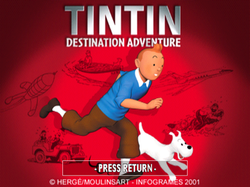
 Tintin: Destination Adventure on PlayStation
 Disney's Chicken Little: Ace in Action on PS2
 One Piece Grand Adventure on PS2
 Pirates: The Legend of Black Kat on PS2










 Another SquareThought Site