

 Sep 2020
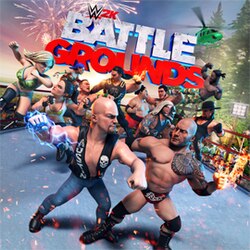

WWE 2K Battlegrounds is the scrappy, neon-tinted answer to the bloated simulator approach of the mainline WWE 2K series. Built by Saber Interactive as a playground-style spin-off running on Unreal Engine 4, Battlegrounds trades realistic grappling sims for larger-than-life moves, cartoonish proportions, and arcade pacing. It was shipped in the wake of WWE 2K20's troubled launch and positioned as a lighter, party-friendly alternative - a deliberate design choice that helps explain both its strengths and its compromises on Nintendo Switch. In short: if you want physics lectures and bone-cracking realism, this isn't it; if you want over-the-top signatures, quick matches and a couch party vibe, it mostly delivers - albeit with some technical caveats and a microtransaction-shaped hangover.
Battlegrounds commits fully to an arcade DNA that prioritizes spectacle over simulation. The core loop is straightforward: pick a superstar, chain together basic strikes and grapples, build a super meter and then unload exaggerated finishers. Combat is deliberately shallow compared to mainline WWE titles - there's less emphasis on stamina wheels and reversals as nuanced timing events, and more on readable telegraphing and input-friendly windows. That design suits the Switch: simple inputs, recognizable states and clear visual feedback make matches accessible with Joy-Cons or a Pro Controller. From a systems perspective, the game favors deterministic outcomes over emergent chaos. Collisions and throws feel like scripted transitions between animation states rather than being fully physics-driven ragdoll interactions. That reduces simulation complexity and improves animation blending stability on weaker hardware. The developer also included co-op and multiplayer modes, which critics and players cited as the game's social high point - couch co-op works particularly well because matches are short and roles are easy to parse. Where Battlegrounds falters for the more detail-oriented player is in progression and content pacing. The title ships with a base roster that includes marquee names and eccentric legacy acts, but the game leans heavily on unlockables and post-launch character introductions. The documentation and critical reception make it clear that many of these unlockables were gated behind either long in-game grinds or microtransactions, a design decision that transforms what should be a pick-up-and-play party game into a repetitive unlock treadmill. This negatively impacts perceived replayability: once you've sampled the arenas and signature moves, the carrot-on-a-stick economy becomes the dominant motivator rather than emergent match variety. On the mechanical front, hit detection and animation transitions are generally competent for the arcade intent. Inputs reliably produce expected moves, and the visual cues for grapples versus strikes are distinct enough to keep accidental reversals to a minimum. That said, the simplified mechanics reveal their limits in longer sessions: depth is shallow, and the loop can feel repetitive outside multiplayer sessions. Also worth noting is the decision to scale back certain simulation systems (detailed hitboxes, stamina drain complexity) likely for cross-platform parity and to keep the frame budget under control on consoles like Switch. Networked multiplayer - where available - follows the same design ethos: fast matches, minimal load between screens, and predictable state machines governing player actions. However, the online implementation is not the game's selling point; Battlegrounds is pitched and reviewed most favorably in local co-op environments where latency is not a variable.
Visually, Battlegrounds opts for a stylized, caricatured aesthetic that lets it punch above its technical weight. Character models are exaggerated, textures are bold, and particle effects for finishers are loud by design. This art direction is a smart technical choice for the Nintendo Switch: by embracing cartoonish proportions and cel-adjacent shaders, Saber Interactive avoids the uncanny-valley costs of photorealism and reduces the pressure on texture fidelity and high-frequency detail. Under the hood, the game runs on Unreal Engine 4, which provides solid out-of-the-box tools for material LODs, animation blending and scalable post-processing. On the Switch, those tools must be balanced against strict CPU/GPU budgets. The practical result is a loadout of compromises commonly seen on the platform: constrained resolution, reduced texture memory usage, simplified shadows and pared-down particle density during hectic moments. These trade-offs are defensible because the art style conceals them; the bold color palette and hard-edged silhouettes keep readability high even when individual assets are lower-resolution. Performance-wise, the Switch edition sits within the expected 'mixed' territory. Review aggregates put the Nintendo Switch version around the mid-50s on Metacritic and earned a 4/10 from Nintendo Life, reflecting that not all reviewers were satisfied with technical compromises or the feature set. While the game generally maintains playability during standard matches, there are occasions where animation complexity and particle-heavy finishers expose the hardware limits: you can see LOD popping, simplified effects, and occasional frame pacing inconsistencies. These are not catastrophic, and many players will find them tolerable given the game's price point and arcade intent, but they are technically noticeable if you are sensitive to framerate stability or resolution fidelity. One last visual/technical note: the UI and HUD design favor clarity over flair, which helps match readability on the smaller Switch screen. Load times are reasonable for a multiplatform UE4 title converted to Switch, and the simplified physics and deterministic animations help keep state synchronization straightforward in multiplayer sessions.
WWE 2K Battlegrounds is a competent technical execution of an arcade wrestling concept on Nintendo Switch: Saber Interactive leaned into a stylized art direction and simplified systems to make a party-friendly experience that runs acceptably on constrained hardware. The core gameplay loop is accessible, animations and hit feedback are serviceable, and the co-op/multiplayer modes are the genuine highlight if you intend to play with friends on the couch. However, the game is held back by shallow mechanical depth, a progression design that encourages grinding and microtransactions, and visible technical concessions that will bother players who expect steadier performance or richer systems. Critically, the game's reception reflects that split: praise for art and social modes, criticism for monetization and limited replayability. For Switch owners looking for a light, knockabout wrestling party game this is a reasonable pick, especially at a lower price point. For players wanting a durable, simulation-heavy wrestling experience with deep mechanics and a robust post-launch plan, Battlegrounds will feel like an interesting prototype rather than a satisfying long-term destination. Score: 5/10 - technically competent and occasionally charming, but compromised by design choices and a monetization model that undercuts longevity.
 WWE '12 on PS3
 WWE 2K14 on PS3
 Street Fighter V: Arcade Edition on PS4
 WWE SmackDown vs. Raw 2008 on PS3
 NHL Hitz Pro on PS2
 Ultraman Fighting Evolution on PlayStation










 Another SquareThought Site