

 Nov 2007
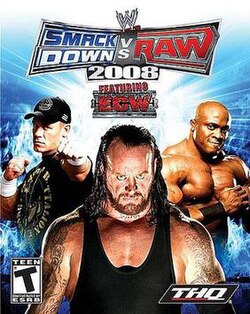

If you've ever wanted to learn the art of timed reversals, momentum management, and how to set a barbed-wire bat on fire without burning your thumbs, WWE SmackDown vs. Raw 2008 on PS3 is a surprisingly rigorous crash course. Behind the glitz of entrances and the joy of making a tank of a wrestler fly over the top rope lies a game that actually asks for skill, strategy, and patience. This entry brought ECW into the series, tightened up submissions with an analog 'struggle' system, and introduced the Fighting Style System - all design choices that made matches feel less like random chaos and more like chess with spandex. The learning curve is real, but once you understand the knobs and levers (and the occasionally questionable preset abilities), the PS3 version rewards thoughtful play and mechanical precision.
At its core, SmackDown vs. Raw 2008 is a momentum-based fighting game disguised as pro wrestling. The key mechanical pillars you'll be pestering your controller with are reversals/timings, momentum management, fighting-style synergies, and the struggle submission analog. These elements combine into the primary challenge: win the mental game while executing crisp inputs. Reversal timing is the bread-and-butter. Grapples, strikes, pins and counters all hinge on split-second reads; a missed reversal means eating a combo or getting caught in a finisher setup. Different fighting styles change how effective your reversals are. Technical wrestlers automatically counter quick grapples until their arms are trashed, which forces an opponent to attack limbs or change tactics. Brawlers, on the other hand, punish you with multi-hit combos that lock out defensive options after the first blow connects - so predicting and stopping the opener becomes a skill in itself. The Fighting Style System is the game's strategic layer. Each wrestler has a primary and a secondary style chosen from powerhouse, showman, hardcore, dirty, brawler, high-flyer, submission and technical. These presets give characters distinct strengths: powerhouses break pins easy and toss opponents over ropes with hammer-throw style Irish whips; high-flyers evade with rolls and threaten impossible-to-break possum pins; dirty wrestlers manipulate the ref and weapons for big momentum gains. Learning what each style can and cannot do is half the battle. There are legitimate complaints - some presets strip wrestlers of moves fans expect (yes, some springboard attacks are missing for specific characters) - but from a challenge perspective, these constraints create interesting rock-paper-scissors matchups rather than allowing one-size-fits-all button spamming. Submissions are where the PS3 pad earns its keep. The new 'struggle submission system' leans heavily on analog control: the player applying a hold chooses how much pressure to exert, while the trapped wrestler uses the analog stick to escape. This turns submissions into mini-duels of stamina and stick-work, rather than rote meter watching. Mastering this requires timing, reading how much damage your opponent has in certain limbs, and knowing when to cut pressure to bait an attempted counter. Momentum management is the silent meta. Momentum affects access to finishers, special abilities and unblockable windows like Rampage or Wreck Shop. Each fighting style typically has an adrenaline-rush special: powerhouses get Rampage so their grapples can't be reversed, brawlers have Wreck Shop for unblockable strikes, and technical wrestlers can counter everything for a short time. Learning to build, conserve and spend momentum - by taunting, using signature moves, taking carefully chosen risks - separates button mashers from competent players. Hardcore and ECW-influenced matches add environmental complexity. ECW presence increases the weapon pool (guitars! barbed-wire bats! tables that can be set ablaze), so positional control, threat assessment and weapon-specific risk-reward calculations become critical. Dirty wrestlers turn the referee into a shield, creating scenarios where crowding the ref or timing shove maneuvers is as much part of the skillset as landing a DDT. Modes like 24/7 combine a wrestler's micro challenges with macro time-management. Playing as a performer demands both in-ring skill and out-of-ring decision-making: training, resting, or running PR moves all have pros and cons. The General Manager side is a different kind of challenge - roster drafting, scheduling, staffing and popularity management require strategic thinking and a sense for long-term planning. Tournament Mode tightens the gauntlet into chosen single-elimination tests (King of the Ring, Money in the Bank, beat-the-clock events), where adapting your approach for each match type is rewarded. There are pitfalls. The Fighting Style presets can feel arbitrary at times - characters may lack moves you'd expect, and balance quirks exist (some lighter wrestlers get access to surprising strengths). Create-a-Moveset is useful but constrained by style choices, which can frustrate players who want total freedom. Still, these limitations are also part of the skill ceiling: top players learn the engine's boundaries and exploit them. If you want a practical training regime: start in Exhibition to learn reversal windows, practice submissions in isolation to master thumb-stick duels, experiment with different styles to learn each special ability, and then dive into 24/7 or Tournament Mode to apply mechanical skills under meta pressure. Online and multiplayer matches raise the stakes further; human unpredictability forces you to stop relying on muscle memory alone and start reading tendencies.
On PS3, the presentation is glossy for its era. The entrances get an extra touch: Sixaxis control lets you play first-person director with where your superstar looks during the ramp walk. Arenas are recognizably faithful to the 2006-2007 WWE landscape and ECW arenas add grime and weapon-littered ringside that visually telegraphs danger. Character models are decent - not photorealistic by modern standards, but expressive enough that signature moves and taunts land with impact. Animations benefited from a reported sweep of rewrites, which helps matches feel more fluid and less like a pile of canned clips. For a game released in late 2007, the PS3 build strikes a solid balance between spectacle and readability: you can clearly see telltale signs of an impending reversal or a limb damage state, which matters because the gameplay demands you read those visual cues.
WWE SmackDown vs. Raw 2008 on PS3 is equal parts arcade spectacle and a surprisingly deep mechanical toybox. If you're after pick-up-and-play chaos, it'll give you that - but if you stick around long enough, the game's systems reward players who cultivate timing, analog finesse on submissions, momentum economy and an understanding of fighting-style matchups. The presets and occasional balance oddities can be annoying, but they also create a meta that skilled players can learn to exploit. For anyone wanting a wrestling game that forces you to level up your technique rather than just mashing the biggest button, this one still teaches useful lessons: patience, timing and knowing exactly when to light a table on fire. Consider the PS3 version a solid training ring for your thumbs and brain - and one of the more satisfying wrestling sims of its era.
 PES 2008: Pro Evolution Soccer on PS3
 UEFA Euro 2008 on PS3
 Deca Sports DS on DS
 Accolade Sports Collection on Xbox Series X/S
 Alan Hansen's Sports Challenge on PS2
 EA Sports MMA on PS3
 WWE '13 on PS3
 UFC 2009 Undisputed on PS3
 WWE SmackDown vs. Raw 2010 on PS3
 UFC Undisputed 2010 on PS3
 Earth Defense Force: World Brothers on PS4










 Another SquareThought Site