

 Jul 2025
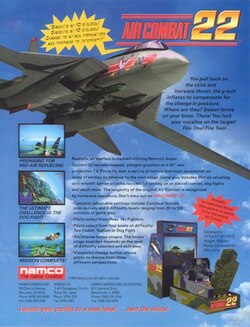

Arcade Archives 2: Air Combat 22 is the modern re-release of Namco's mid-90s arcade dogfighter, updated for Xbox Series X/S as part of Hamster Corporation's Arcade Archives 2 line. The original ran on Namco's Super System 22 hardware in 1995 and was offered as both a dedicated deluxe cabinet and a conversion kit for the earlier Air Combat cabinet. If you remember arcade flight games as polygonal landscapes glued together with aggressive texture-mapping and big CRT bezels, Air Combat 22 is that memory, brought forward to a console that can output 4K without breaking a sweat. This review looks at the port through a technical lens: how the System 22-era architecture and design choices translate to modern hardware, what the gameplay architecture reveals about its limitations, and whether the reproduction on Xbox Series X/S honors the arcade original or simply dresses it up in HD clothes.
On a surface reading Air Combat 22 is a direct, no-frills arcade shooter built for coin-op sessions: single-player, short missions, and an emphasis on spectacle and immediate feedback rather than simulation fidelity. The re-release preserves the original structure - you pick one of three aircraft (Grumman F-14 Tomcat, Sukhoi Su-35, or the Lockheed YF-22), fly close in to enemies and ground targets, and trade hits in tightly choreographed skirmishes. Mechanically it inherits the same DNA as the 1993 Air Combat: simplified flight model, lock-on weapon mechanics, and enemy patterns geared toward theatrical evasion rather than realistic aerodynamics. From a systems perspective Air Combat 22 is interesting because of what it chooses not to do. Unlike contemporary PC flight sims that model lift curves, torque, and HUD depth, this is a state-machine driven action loop: player inputs drive a constrained set of animation and physics states, and the game keeps the camera, collision volumes, and enemy AI in tight, predictable corridors. That predictability is deliberate - it ensures consistent quarters-per-minute economics in arcade play and makes the game feel punchy. The inclusion of three different fighters is more about visual and minor handling variety than deep mechanical divergence; the aircraft are effectively different skins around a common input-response model with small tweaks to acceleration and turning radii. Technically, the original arcade implementation benefits from dedicated hardware timing and a bespoke graphics pipeline. That pipeline provided stable framerates and deterministic timing for enemy spawns and hit detection. A modern console port must either emulate that timing with high fidelity or replicate it in software, and that's where re-releases live or die. On Xbox Series X/S the challenge is mostly trivial from a raw-performance standpoint - the system can handle the original polygon counts and textures without stress - but latency and input timing are the real concerns. Arcade joysticks and physical cockpit rigs produce a different feel than an Xbox pad; good ports compensate with input buffering and configurable responsiveness. The Arcade Archives 2 release generally sticks to the original timing model, which preserves the game's intended pacing, but it also highlights the limited input complexity: there are no advanced flight controls to map, just thrust/turning and fire/lock conventions. That makes the game comfortably playable with a controller, but some tactile fidelity is inevitably lost compared to the deluxe cabinet's force-feedback and joystick geometry. Reception-era comments still fit: reviewers called it 'a good facelift' and noted the gameplay improvements are marginal. That's accurate - this is a preservation-first release with intact arcade logic rather than a redesign. If you want emergent flight-sim depth, you won't find it here. If you want compact, high-energy aerial encounters that are tightly tuned for short-session thrills, Air Combat 22 still delivers.
Air Combat 22's visual identity is proudly of its hardware generation. The Super System 22 (often referenced as Namco System 22 family hardware) was designed to push textured polygons and surface detail for mid-90s arcades, and the original game took advantage of that with improved ground detail and aircraft models compared to its predecessor. Edge's contemporary praise that the surface detail is 'gorgeous' wasn't hyperbole for 1995: textures were denser, and the geometry budget was spent on readable silhouettes and close-range surface detail to sell the 'close-combat feel'. On Xbox Series X/S the port faces two distinct graphical tasks: faithfully reproducing the original assets and mapping them to modern resolutions without creating visual artifacts. The underlying assets are low-poly by modern standards, so the port typically uses integer upscaling, bilinear filtering, or mild post-processing to reduce blockiness. If Hamster's implementation mirrors their usual Arcade Archives approach, you'll get options for screen filters, scanline emulation, and aspect-ratio toggles that help bridge the gap between a 1995 CRT presentation and a 2020s flat panel. Those filters are crucial because raw upscaling can make texture seams and polygon edges stare you in the face; a good filter maintains the soft blend and motion smear that made the original feel believable. Frame pacing is where the re-release must stay honest to the arcade. The Namco System 22 produced a consistent frame rhythm that arcade cabinets relied on for synchronization between visuals and input. The modern port's framerate on Series X/S will be rock-solid; the trick is preserving the timing of animations and spawn logic tied to that framerate. Where ports cheat by decoupling animation timing from input polling, you notice either lag or overly twitchy responses. Air Combat 22's presentation on the re-release generally keeps the close, punchy feel intact, and the cockpit framing - lauded in Game Players for its 'authentic cockpit' and 'huge screen' - translates into widescreen impressiveness when the viewport is scaled correctly, though some of the intended peripheral compression of CRT displays is necessarily lost.
Arcade Archives 2: Air Combat 22 on Xbox Series X/S is a conservative, technically respectful port of a mid-90s arcade dogfighter. It won't convert simulation purists, nor does it substantially alter the original's gameplay loop, but it does what a preservation-minded re-release should: it keeps timing, enemy choreography, and visual identity intact while giving modern hardware the headroom to display the game crisply. The primary value here is historical and experiential; the Deluxe cabinet's spectacle is distilled into a controller-session spectacle - fast, sometimes shallow, but satisfying in short bursts. If you're the type who enjoys inspecting legacy rendering pipelines, System 22-era texture work, and how arcade timing maps to modern systems, this is worth a spin. If you expect a revamped gameplay model or deep systems-level changes, this is the 'facelift' Next Generation mentioned - a polished relic rather than a reinvention. Score: 7/10 - technically solid, historically important, and fun in short sessions, but still limited by its arcade-first design.
 Street Fighter V: Arcade Edition on PS4
 Oretachi Game Center Zoku: Rabio Lepus on PS2
 Neverway on Switch
 Orphen: Scion of Sorcery on PS2










 Another SquareThought Site