

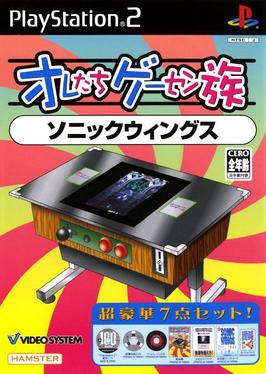

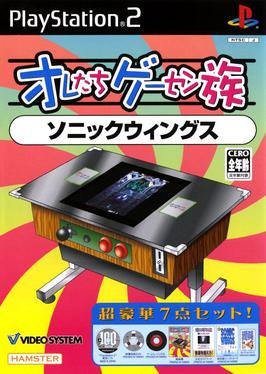
Oretachi Gēsen Zoku was Hamster Corporation's love letter to the dimly lit arcades of the 1980s, a series of individual PlayStation 2 releases that packaged single emulated arcade titles with a surprising amount of physical goodies. Volume 14 in the series is Rabio Lepus, a 1987 arcade entry originally from Video System now resurrected on PS2. This release is less a modern "remaster" and more a boxed, museum‑grade reproduction of the arcade experience: the ROM on disc, the soundtrack on mini CD (with Super Sweep arrangements), a miniDVD of trailers and a Masterplay video, and a handful of collector items. For anyone interested in the technical side of emulation and preservation, Rabio Lepus's PS2 incarnation is an instructive case: Hamster aimed for faithful reproduction and collector appeal rather than flashy new features, and the result is one that will please preservationists if you're willing to tolerate the limits of a console-era emulation package.
Because this release is an emulation of the original Video System arcade board, the "gameplay" discussion is twofold: the original game's mechanics (which this package preserves) and the way the PS2 environment mediates that experience. Hamster's Oretachi Gēsen Zoku series is sold as emulated arcade ROMs burned onto a PS2 CD-ROM, which means that at run time you are interacting with a software layer that mimics the original arcade PCB rather than a reimplementation in native PS2 code. That choice has obvious implications. On the positive side, ROM-based emulation is the most direct route to authenticity: enemy timings, frame budgets, hitboxes, and sprite priorities are governed by the original binary and the emulation layer attempts to reproduce the hardware signals that the original did. For players who care about the mechanical fidelity of 1980s arcade titles, that is a huge win. Hamster pairs the disc with documentation that includes information about the original Arcade PCB, and the presence of a Masterplay video on the miniDVD is a nice technical reference - you can watch an expert play the same code you're running and compare inputs and outcomes. The tradeoffs are practical. The PS2 is a 480i/480p era console with a GPU and display pipeline that expect different output than CRT arcade monitors. Depending on Hamster's emulator options (the series, in general, did not advertise elaborate modern enhancements), you will likely be playing at the console's native output resolution with the PS2's standard filtering and scaling applied. That means pixel geometry and scanline behavior are mediated by the TV and any scaling filters enabled in your display chain. For purists, that can mask subtle timing differences and change apparent hitboxes by a pixel or two; for most players it will not disrupt the arcade feel. Control mapping to the DualShock 2 is straightforward for joystick-and-buttons titles, but the PS2 controller's analog sticks and digital pad have their own tactile characteristics compared to an arcade stick. If you value legal accuracy of inputs, an arcade-style USB adapter would be preferable - but note the PS2 era did not have universal support for modern adapters, so anyone hunting absolute parity might be frustrated. The packaging also changes the way the game is consumed. The ¥2,000 price buys you not only the emulated game but a miniDVD with trailers and the aforementioned Masterplay, a soundtrack mini CD with both the original tracks and Super Sweep remixes, an instructions booklet with PCB specs, an official mini strategy guide, and collectible cards. From a technical-archival perspective, that material is gold: the PCB documentation can inform emulator developers or hobbyists attempting to understand the hardware-level behavior, while the soundtrack CD demonstrates how audio from the original board translates to CD-quality tracks and arrangements. Ultimately, Rabio Lepus on PS2 is presented as an archival package: you get the ROM as faithfully as possible, and additional media that contextualizes the original hardware. If you expect modern conveniences such as save states, rewind, widescreen remapping, or built-in netplay, this release is unlikely to satisfy - it's focused on faithful playback rather than modern feature augmentation.
The graphic identity of Rabio Lepus is inherently that of a late-80s arcade title: chunky sprites, limited palettes, and hardware-driven layering. On PS2, the visual presentation is the product of three layers: the original arcade graphics as encoded in the ROM, the emulator's framebuffer handling, and the PS2/TV display pipeline. Hamster's approach across the Oretachi Gēsen Zoku series favored preserving the original raster, which is appropriate for pixel art that relies on precise color indexing and sprite priority. The PS2's output is, however, a progressive scan environment by the time you get to modern displays. Without a specifically emulated CRT shader (which is not documented in the series materials), the crisp, non-interpolated pixels can look either too sharp or too soft depending on your TV's scaling. If you play on a CRT or use an upscaler that respects integer scaling, the image will better match the original arcade feel. On modern HDTVs, the game's native resolution will be scaled to fit, and unless your TV supports clean integer scaling you can get minor blurring or shimmering artifacts. Sprite layering and priority are areas where ROM-based emulation shines: you will see the same sprite multiplexing, flicker, and palette swapping behaviors as the arcade because those are artifacts of the same source data. The included instruction booklet that documents the original Arcade PCB is a useful reference for understanding how those effects were originally generated - useful if you're curious about why certain on-screen elements flicker or why colors shift when too many sprites are on a line. Audio is delivered two ways: the game's runtime sound handled by the emulation core, and the soundtrack/arrangements on the included mini CD. The latter is a clean, studio-quality demonstration of the original themes, which is a neat technical contrast: you can hear how limited FM or sample-based arcade audio would be interpreted when arranged and recorded at CD quality by Super Sweep. This juxtaposition makes it easy to appreciate the constraints of the original hardware and the creative solutions composers used at the time.
Oretachi Gēsen Zoku: Rabio Lepus is a technical artifact rather than a modernized re-release. If your interest is preservation, hardware history, or studying how arcade ROMs behave when run on a consumer console, this PS2 package is a compact and thoughtful offering: a faithful ROM, PCB documentation, a Masterplay recording, and a soundtrack that bridges original sound hardware and arranged CD-quality music. The ¥2,000 price point and the inclusion of seven physical items make this feel like a collector's kit rather than a simple emulator dump. For players who want accessibility and modern conveniences - widescreen modes, save states, robust input options, or online leaderboards - this is not the definitive edition. The collection makes clear design choices: authenticity and physical extras over introduced quality-of-life features. Region locking to Japan limits availability, which is the biggest practical barrier for many curious players. Score: 7.0/10. This score reflects the release's strengths as an archival, technically faithful emulation with excellent supplemental materials, and its weaknesses in terms of modern usability and global availability. Recommended for collectors, historians, and emulation enthusiasts who want a boxed, source-near piece of arcade history; casual players expecting a modernized re-release should look elsewhere.
 Press Your Luck on PS3
 Oretachi Game Center Zoku: Trio the Punch on PS2
 Oretachi Game Center Zoku: Quarth on PS2
 Oretachi Game Center Zoku: Super Volleyball on PS2
 Ninja Assault on PS2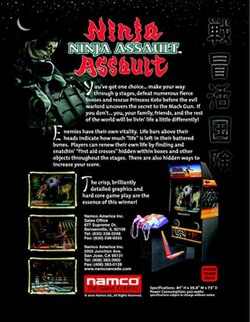












 Another SquareThought Site