

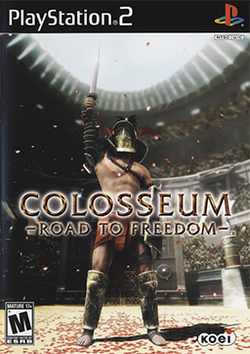

Colosseum: Road to Freedom is the kind of niche PS2 title that looks at ancient Rome, nods, then says, "What if Gladiator met a light RPG system and forgot to bring a steady camera?" Published by Koei and developed by Goshow, the game drops you into the sandals of a slave-turned-gladiator and hands you a career ladder made of spears and coin purses. The design clearly prioritizes systemic play - training modules, stat growth, and arena matchups - over narrative hand-holding. That ambition is both the game's strength and its Achilles' heel. Critics were lukewarm (Metacritic aggregates it to roughly 56/100, with outlets like GameSpot and IGN hovering around 6/10), which reflects a product that often excels at mechanical promise but stumbles in the implementation details that matter on seventh-generation hardware. This review is a technical autopsy of that implementation: input, animation, AI, systems, UI and performance - the nuts and bolts that determine whether your gladiator's rise to freedom feels heroic or like grinding through a poorly optimized chore.
Colosseum's core loop is a tidy three-act machine: prep, fight, profit. You customize a gladiator at the start via a questionnaire that maps to base stats - the approach is light and approachable, resembling RPG archetype selection without the wall of sliders. That design choice is smart on a UX level: it removes the intimidation for players who want to start fighting instead of min-maxing spreadsheets. Once the blood has been metaphorically chosen, the game leans heavily on training sessions. These sessions are not flavor text; they're mechanical levers. Training modules improve attributes (stamina, strength, speed, technique) and unlock moves. This creates a clear progression loop, and because the game allows you to keep fighting as a freedman - or remain a paid-off freeman gladiator - there's emergent player agency in career planning. From a systems perspective, the combat is a hybrid fighting/RPG affair with light combos, guard/parry windows, and stamina management. The inputs are deliberately simple (good for the dual-analog PS2 pad), but that simplicity exposes two crucial implementation factors: animation responsiveness and hit detection fidelity. On the former, animations can feel weighty and satisfying when they land, giving a visceral sense of impact that fits the gladiatorial theme. However, weightiness sometimes turns into input lag: button presses that should cancel into evasive maneuvers occasionally get swallowed by a recovery animation. For a game that markets itself on gladiatorial skill, that inconsistency in cancel windows undermines player expression. Hit registration and collision are functional but uneven. The game often resolves hits based on animation frames rather than an explicit, visible hitbox display (which is normal for console titles of the era), so close calls can feel arbitrary. In practice this manifests in frustrating moments where a thrust visually clips through an opponent without registering, or a heavy overhead lands from what looked like a blocked position. These are not fatal flaws, but in a combat loop where timing and positioning are meant to matter, they reduce the skill ceiling and make some fights feel like a dice roll. AI behavior is serviceable but predictable. Opponents are scripted around archetypes: aggressive berserkers who spam heavy attacks, defensive turtles who wait for openings, and more balanced gladiators that mix feints and counters. The problem is variance: enemy tactics scale mostly by aggression and stat buffs rather than emergent decision-making. That leads to a readable, teachable system - you'll learn enemy tells - but also to repetition. Without deeper AI state machines or adaptive learning, later challenges rely more on inflated enemy stats and cheaper attacks than on genuinely new behaviors. The economy and progression frameworks are where the RPG trappings shine. Matches reward money and reputation; money buys freedom or equipment, and reputation gates access to higher-tier arenas. The design encourages a minigame of risk vs reward: take tougher fights for bigger paydays, or grind training to ensure survival. Multiple endings based on your performance and whether you buy freedom add replay value from a systems perspective. This is a good example of emergent narrative via mechanics: the story bends around your career choices rather than delivering a prescriptive campaign. Control design is pragmatic but not elegant. Mapping attack, block, and dodge to the face buttons with contextual prompts works for casual players, but the lack of deep combo variety means veterans will find the inputs repetitive. Camera control is fixed in many arenas, which simplifies spatial awareness but can cause awkward framing when the action moves toward environmental geometry. The camera rarely actively sabotages you, but it doesn't help either. Quality-of-life systems - save structure, menu navigation, and training feedback - are mixed. The menus are utilitarian: inventory and stat screens are clear but austere, with limited visual feedback on how a change in stat tangibly affects your combat performance. More granular UI telemetry (damage numbers, parry windows, stamina drain indicators) would have elevated player agency by turning every fight into a clearer lesson. The game does, however, offer explicit training sessions and straightforward stat growth so that players can plan builds without consulting a wiki. That's a win for accessibility. One final gameplay note: the single-player-only focus helps the developers tailor fights to a single human agent, but it also means the game's longevity must rely on the depth of its systems. Because AI is somewhat shallow and the combat toolkit is compact, the game is best enjoyed in short bursts or as a systems toy rather than as an endlessly replayable fighter.
On PlayStation 2 hardware, Colosseum skates a familiar line: it doesn't attempt photorealism but aims for competent, readable visuals. Character models are blocky by modern standards but are largely consistent with the PS2 era; the sculpting is adequate for identifying classes and armor at a glance. Textures are low to medium resolution, which is to be expected on the platform; close-ups reveal enough blurriness that the camera and animation have to carry the cinematic weight. Lighting is basic but serviceable, with arena torches and midday sun implemented through static baked lighting and a few dynamic effects. You won't find advanced shaders or real-time global illumination here, but the stage composition often hides those limits. Animation is the mixed bag that determines player perception of combat quality. There are moments of good, weighty animation where strikes feel substantial and the ragdoll-style reactions (limited as they are) sell the blow. Conversely, there are stiff transitions and occasional clipping where limbs intersect armor or scenery in ways that ruin cinematic momentum. Frame pacing is mostly stable; the PS2's constrained CPU/GPU budget is handled with conservative draw distances and modest NPC counts in the arenas. That conservative approach generally preserves frame rate, but when multiple heavy effects and particle bursts appear - like dust clouds and blood sprays during signature moves - frame dips can occur. The game prefers steadiness over spectacle, which aligns with its systems-first focus. UI and HUD design favor clarity over flash. Health, stamina, and enemy indicators are readable, though the presentation is spare. Menu navigation is slightly dated: backtracking through nested options is common, and tooltips are minimal. Audio design supports the visuals with punchy SFX for impacts and a generic orchestral score that sets the Roman tone without ever demanding attention. Voice work is limited and functional rather than cinematic. Overall, the graphics and presentation do their job: the arena looks like a place you can get roughed up in front of a rowdy crowd, but don't expect eye-watering textures or next-gen animation fidelity. The technical limitations of the PS2 are respected rather than skirted by ambitious tricks.
Colosseum: Road to Freedom is a study in trade-offs. It has a clever structural idea - a gladiator career system where training, money, and arena success form a tight loop - and it executes that idea well enough to be enjoyable for players who like systemic progression. Technically, the game sits squarely in the mid-range of PS2 titles: competent art direction, readable UI, stable frame pacing most of the time, and animations that alternate between satisfying and frustrating. Where it loses momentum is in combat fidelity and AI depth; inconsistent hit detection, occasional input recovery issues, and predictable enemy patterns prevent the game from feeling truly skill-based. If you're attracted to the concept of building a gladiator through training minigames and career choices, Colosseum delivers an experience unique on PS2 and worth playing for that systems-first pleasure. If you demand tight fighting mechanics, high-fidelity presentation, or deep opponent AI, you'll likely find the experience shallow. The lukewarm critical reception (Metacritic ~56/100, multiple outlets in the 4-7/10 range, Famitsu gave it a healthy 31/40) reflects those mixed chops. For completionists and fans of quirky hybrid systems, the game is a worthwhile excursion into gladiatorial grind. For purists of fighting games, it's a decent curiosity best tried during a sale or via the "Remix" update that arrived later in 2005. It also spawned sequels - Gladiator Begins (2010) and Clan of Champions (2011) - which suggest Koei and partners saw enough promise to keep iterating on the formula. In short: Colosseum is an earnest, flawed attempt to graft RPG progression onto arena combat. It won't always land its strikes, but when it does, it scratches an itch that few other PS2 titles attempted to reach.
 Test Drive: Off-Road 3 on PlayStation
 Test Drive: Off-Road on PlayStation
 Combat Elite: WWII Paratroopers on PS2
 Persona 4: Arena on PS3
 ACA Neo Geo: Art of Fighting 2 on Xbox One
 Dragon Ball Xenoverse 2 on Switch












 Another SquareThought Site