

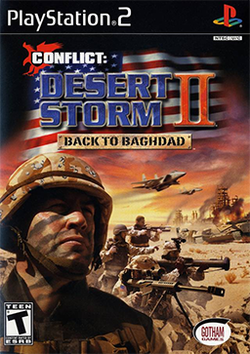

Conflict: Desert Storm II - Back to Baghdad arrives like a dusty, mid-2000s action movie that Ubisoft left in a hot car: earnest, a little stiff, but with flashes of competence. Pivotal Games doubled down on the squad-based tactical formula from the first Conflict title and shipped a game built around a four-man special forces team called Alpha One. On the PlayStation 2 this is a focused, sometimes fiddly tactical shooter where you switch between Foley the sniper, Jones the explosives whiz, Connor the heavy weapons specialist, and Bradley the by-the-book team lead and radioman. The plot follows their covert operations through the early days of the Gulf War - rescue, sabotage, capture, escape, and the small satisfaction of rendering enemy superguns useless before breakfast. This isn't a character drama in the Golden Age of narrative games sense. It does, however, give each team member a job, a role in the four-man choreography, and a tiny arc that the game nudges you through. If you're the sort of player who likes to imagine your AI teammates have complicated backstories (or like me, give them ridiculous accents and nicknames), Desert Storm II rewards that investment. It's not Citizen Kane, but it's also not just a list of pop-up objectives; the missions trace a sequence that subtly reshapes each soldier's moment in the sun. In this review I'll dig into those character beats and what they reveal about the design choices, then break down gameplay and visuals with the sort of snark that prevents nostalgia from curdling into delusion.
At its mechanical heart, Conflict: Desert Storm II is a switch-and-command tactical shooter. You control one soldier directly and give orders to the others: move here, cover that door, and for the love of all that is ballistic, plant the charge. The ability to switch control on the fly is core to the experience because each of the four has a specialty that changes how you approach engagements. Foley, the sniper, transforms long-range pancakes into quiet, satisfying headshots. When you're in Foley-mode the game feels like a different ambition: patient, precise, and slightly lonely. Foley's arc in the campaign mirrors that solitude; he begins as the team's distance problem solver and ends as the one who clears safe lines of sight, literally opening the world for the squad. Jones, the engineer and explosives expert, gets the close, greasy work: disarming, breaching, and being the man whose toolkit decides whether an objective ends in victory or a badly timed kaboom. Connor, the heavy weapons specialist, is essentially a walking small-arms rebuttal - when the map wants to give you tanks or armoured threats, Connor gets to be the team's thunder. Bradley, the radioman and leader, is the narrative hub; he calls in air strikes and barks orders, and his arc moves through competence and responsibility, culminating in that surrender-and-escape sequence where leadership is tested. The missions themselves range from stealthy infiltrations of radar and fuel dumps to full-on assaults against fortified positions, and the level design tends to reward either cautious stealth or head-on aggression. The game even tracks experience for each member, which results in promotions and medals; it's a tiny RPG smudge that nudges you into caring about individual performance. There's also a two-player co-op on PS2 where you and a friend each take two soldiers - this is where the game shows its best instincts. When your partner is sliding the silenced pistol while you hold an overwatch angle with Foley, Conflict feels like a weekend plan that worked out. Remote commands are sometimes clunky, which is honest: managing four soldiers with a PS2 pad is like juggling without thumbs. The A.I. for your teammates oscillates between reliable and comically literal; they'll obey 'follow me' with missionary zeal but occasionally ignore 'stay' as if they have a secret agenda. Licensed weapons like the M16A4 and a handful of vehicles such as the Bradley IFV give the game a tangible military wardrobe, and the presence of air support is more than spectacle - Bradley calling in an airstrike is an escalation button that feels earned by pacing. A major mission pivot in the story is Alpha One's capture. Gameplay pivots with it: what was a confident, go-team romp becomes an exercise in survival and timing as the squad endures interrogation and then uses chaos from air strikes to escape. These beats aren't just plot; they change the rhythm of combat and make you appreciate the individual roles you assigned to each soldier earlier in the campaign. The missions that cap the campaign - disarming SCUDs, stopping oil well arson, taking down the Superguns - stitch those roles together into a final cage match of utility, patience, and controlled violence. It's not a perfect system, but when the four-person choreography clicks, it sings.
Graphically, Conflict: Desert Storm II sits firmly in the era of PS2 realism: competent textures, chunky geometry, and environments that communicate place without photorealism. Kuwait's burned oil fields and the ruined architecture of Al-Hadar are convincingly middling: they tell you where you are without demanding you suspend disbelief for immersive detail. Explosions, gunfire, and the occasional Bradley IFV provide spectacle, but the real visual charm is in small touches - muzzle flashes, the silhouette of a rooftop SAM site, and the way a desert dust cloud can momentarily obscure a firefight. Character models are functional; faces don't do Shakespeare but they do grunt convincingly. Animations can be stiff, particularly when the squad is moving across open ground or interacting with mission objects. The prison sequence plays with lighting and particle effects to sell the chaos of an air strike, and those moments are where the engine tries its hardest. It's not pushing hardware, but it knows how to stage a scene: an emplaced radar being primed for demolition, a convoy of retreating troops, or the twin barrels of a Supergun in a harbor - all of these are framed to provide dramatic objectives, even if the textures read like they were painted in broad brush strokes. The PS2's limitations show up in pop-in and collision oddities. Enemy AI navigation sometimes encourages you to treat cover as blessed geometry rather than a living battlefield. Still, the variety of mission locales - cities, oil fields, radar bases, harbors - helps mask technical shortcuts. Sound design does much of the heavy lifting: gun reports, radio chatter, and the rumble of aircraft make the world feel populated and operational. On the whole, the game's visuals deliver what they promise: serviceable, occasionally stirring military tableaux that let the tactical gameplay be the star.
Conflict: Desert Storm II: Back to Baghdad is an odd little grandfather of modern squad shooters. It's not the most elegant title - the PS2's control scheme and the A.I. occasionally make the game feel like a cooperative exercise in improvisation rather than a polished tactical experience - but it's brimming with honest mission design and a four-man character framework that invites player projection. Each member of Alpha One has a readable role and a modest arc: Foley the patient marksman who opens doors from afar, Jones the hands-in-the-dirt demolitions expert, Connor the blunt instrument for heavy threats, and Bradley the responsible one who calls in the thunder and pays the emotional price when things go sideways. For players who prefer a methodical approach, the game rewards planning and careful role usage. For those who prefer to charge in with Connor chewing scenery, there's enough loud, crunchy fun to justify the approach. With mixed critical reception at the time - mostly average to decent scores - the game found its niche: a respectable tactical shooter with a knack for staging satisfying set pieces and a tiny but tangible human core. If you dig four-person dynamics, enjoy assigning personalities to your AI buddies, and can forgive the occasionally balky controls, Conflict: Desert Storm II is a PS2-era gem for weekend tactical bangs and nostalgic squad-based camaraderie.
 Tales of Aravorn: Seasons of the Wolf on Switch
 Laid-Back Camp -Virtual- Fumoto Campsite on PS4
 Bubsy: The Woolies Strike Back on PS4
 PixelJunk Shooter 2 on PS3
 Tom Clancy's Rainbow Six: Vegas on PS3
 Conflict: Global Terror on PS2
 PixelJunk Shooter on PS3
 Conflict: Vietnam on PS2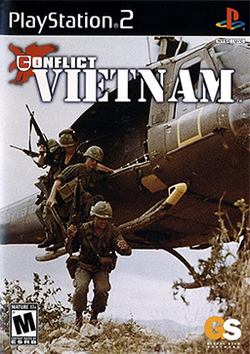












 Another SquareThought Site