

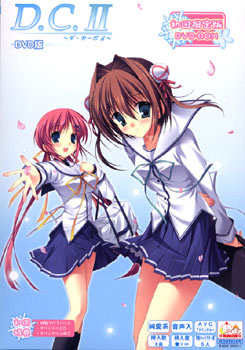

If you're the kind of player who likes narratives that unfurl more routes than a very indecisive subway map, Da Capo II: Plus Situation on PS2 is the sort of cozy rabbit hole you can lose entire weekends in. This is a visual novel born from an adult PC original, shepherded to a more family-friendly PS2 port with additional scenarios and promoted supporting characters. What that means for challenge-hungry players is simple: the gameplay challenge is almost entirely cerebral. There is no twitch reflex to flex, no combo system to master; your skill set will be reading speed, memory, planning, and an almost criminal dedication to 'save scumming.' The reward is emotional complexity, branching story design, and the slow burn satisfaction of unlocking every heroine's arc. Plus Situation pads the original with extra heroines and fresh content, which ups the completionist workload and gives you more endings to hunt down. If you like tests of patience that reward attention rather than agility, this PS2 port hands you a syllabus and a red pen.
Da Capo II's engine is the visual novel backbone Circus fans expect: long stretches of prose punctuated by decision points where you choose from two or three options. Those crossroads are deceptively simple on paper, but they form a branching lattice that demands strategy. The first and most obvious skill the game tests is patience. You will be reading a lot. If you skim, you will miss cues-subtle mentions of places, times, or relationships that determine which branch you fall into. Where most games punish you with instant death, Da Capo II punishes with rerouted routes and the slow, quiet death of having to replay hours to find the fork you botched. A close second is attention to detail. The PS2 port retains mechanics from the PC original like the alarm clock and location choices. The alarm clock is a small toy with outsized consequences: setting it wrong can change where Yoshiyuki is the next morning, which in turn toggles certain scenes and character encounters. Think of it like scheduling a date in a planner-except one wrong snooze and your love life gets canonically altered. The location choices are accompanied by heroine thumbnails, but those images are a convenience, not a cheat. Memorizing which choices lead to which characters speeds up subsequent playthroughs dramatically. It becomes a meta-game in which remembering that "go to the shrine" tends to trigger Minatsu's arc is just as valuable as writing down which flags you raised the previous run. Branch-management is another skill. The game offers six main plotlines plus the PS2-exclusive scenarios; unlocking them all requires both replaying and a disciplined approach to saves. Good visual novel etiquette here involves multiple save slots with descriptive notes: "End of Chapter 1 - chose Otome option" is your friend. The PS2's slower UI compared to modern PCs means save scumming feels more deliberate. You'll learn to love acronyms and slot numbers. If you dislike repetition, this is where the game will force you to grow a zen-like tolerance for reruns, because the only way to see every ending is to explore wrong turns and then circle back. Reading comprehension and empathy form the emotional muscles the game exercises. The stronger routes are praised for getting you to actually care about the heroines, and that rapport matters when making choices later on. Many decisions are not labeled "Good" or "Bad"; they are shaded in moral grey, and understanding the protagonist's voice helps you predict how characters will react. That anticipatory skill-predicting narrative consequences from dialogic cues-turns the game into a logic puzzle of feelings. It trains you to think two moves ahead in conversational chess: what happens if Yoshiyuki blurts X in front of Y? Will Otome withdraw, or will she reveal a secret that flips the entire arc? Time management enters the fray during the three major story arcs: the Christmas build-up, the winter holiday break, and the new-year return to school. The structure means certain events only occur in narrow windows; miss them and you may never see a scene until you replay the relevant span. The PS2 Plus Situation content increases the number of such windows. Strategic players will plan runs focused on a single heroine, mapping all the alarm and location permutations that trigger her scenes. That planning is the closest thing to 'mastery' the game offers: it's not about muscle memory but about a spreadsheet mindset-careful, patient, and slightly obsessive. On the mechanical side, the game rewards pattern recognition. Once you play a couple of routes, you begin to sense the author's rhythms: what sort of choices lead to confession scenes, which options ramp up tension, and which tangents are red herrings. Recognizing these patterns shrinks the grind. Moreover, the PS2 version adds a handful of new heroines and story beats, so your prior recognition from the PC release only gets you halfway there-expect to keep learning. The port also introduces content that flips supporting characters into full routes, which increases the complexity of the decision web. For completionists, that means additional playthroughs and a higher cognitive load; for casual players, it just means more story to enjoy. Finally, emotional endurance belongs on the skill list. Some routes deliberately intertwine characters' fates, meaning one character's happiness often comes at another's expense. The narrative uses this to create genuine tension-which may feel like punishment if you're attached to everyone. Wrestling with the game's bittersweet outcomes is a kind of soft difficulty: can you handle a narrative that makes you complicit in choosing who loses? If you can, you'll walk away with a sense of narrative accomplishment that few twitch-based games can match. If you were hoping for arcade-style difficulty, you won't find it; the challenge here is in mastering the game's systems of choice and consequence, building a mental map of branches, and accepting that skillful play means meticulous saving, careful reading, and methodical replaying. Those are niche skills, but when you develop them, unlocking every Plus Situation ending stops feeling like homework and starts feeling like detective work.
Visually, Da Capo II wears its pedigree on its sleeve. Character designs began with Natsuki Tanihara and were polished by a team of illustrators, giving each heroine a distinct silhouette and color palette. On the PS2, the sprites and backgrounds are clean and pleasantly anime-stylized-this is art made to be read against, not to be gawked at in 3D detail. The visual challenge is not about dodging pixels but parsing facial expressions and background clues. Because choices often hinge on small emotional beats, being able to notice a character's slight blush or a glance at a particular set piece is useful. The port's additional heroines received their own art direction, so the expanded cast never feels like cheap padding; they look like they belong. Technical limitations of the PS2 era mean you shouldn't expect high-resolution stills or cinematic pans, but the art does its job: it communicates tone, mood, and subtle characterization. Backgrounds of Hatsunejima and Kazami Academy provide a consistent sense of place, which helps when you are trying to remember where a particular scene took place during a later playthrough. Musically, the themes and insert songs-credited to artists such as Yozuca* and CooRie-amplify the emotional beats and help you time your responses; a swell of the right song often indicates that a decision will have weight. The graphics-and-sound package supports the core challenge loop of reading, noticing, and choosing.
D.C. II P.S.: Da Capo II Plus Situation on PS2 is a challenge wrapped in a cosy school-romance blanket. Its difficulty comes from demanding careful attention, solid planning, and lots of replays rather than from boss fights or precision platforming. If your idea of a difficult game includes reconstructing branching logic, timing alarm clocks to orchestrate encounters, and building a catalog of save files with military precision, this port is a clever, sometimes emotionally brutal, playground. The PS2 additions expand the workload for completionists, which is good news for anyone who enjoys the slow, methodical thrill of unlocking every secret. The game isn't for impatient players who expect instant gratification, but for readers who like their challenges to be puzzles of consequence, it delivers. Grind it like a hobby: take notes, manage your saves, and treat the alarm clock like a mini tactical device. In return you'll get well-crafted routes, solid art, and a story that rewards the cerebral over the physical. Score: 7.5/10 - not a flawless classic, but a satisfying endurance test for players who enjoy thinking their way to victory.
 Thoroughbred Breeder II Plus on PlayStation
 Constructor Plus on PS4
 MX vs. ATV All Out on Switch
 PlayStation All-Stars Battle Royale on PS3
 Tomoyo After: It's a Wonderful Life on PS3
 Cross Channel: To All People on PS2
 Looney Tunes Racing on PlayStation












 Another SquareThought Site