


 Aug 2025
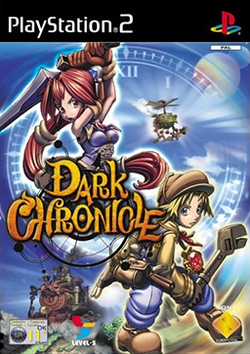

Dark Chronicle (released as Dark Cloud 2 in North America) is Level-5's ambitious follow-up to Dark Cloud, and it behaves like a PS2-era swiss army knife of gameplay systems - a toolset where each blade is lovingly polished but sometimes threatens to poke your thumb. From procedurally generated dungeons to a city-building "Georama" mode and an item synthesis economy that treats every piece of loot like it has a résumé, the game is a technical buffet. At its heart it's an action RPG played from a third-person perspective with real-time hack-and-slash combat, but Level-5's obsession with systems engineering - weapon XP tied to gear, synthesis points, spectrumization, evolving weapons, and cross-era world editing - is what makes Dark Chronicle meritorious and, for many players, compulsively fiddly. This review takes a magnifying glass to those systems. I'll examine how they're implemented, how they interlock, and where they strain the PlayStation 2 hardware or the player's patience. If you like the idea of a game that is simultaneously a dungeon crawler, a toybox editor, and a light inventory-based programming puzzle, this is a title built for you. If you prefer your RPGs streamlined, relax: there's still a gorgeous tonal rendering engine and a satisfying combat loop to be enjoyed here.
Dark Chronicle's gameplay is an exercise in systems design. The dungeon component uses procedurally-generated floors, which means each descent leans on algorithms to place rooms, enemies and Geostones rather than handcrafted layouts exclusively. Procedural generation on PS2-era hardware is not novel, but Level-5 uses it to enable a high degree of repeatability without burning disc space on bespoke content. The payoff is longevity and variance, but it comes with the expected trade-offs: layouts occasionally feel generic and the pacing becomes a loop of "generate, clear, extract." Level-5 counterbalances that with dense systems layered on top. Combat is real-time and hack-and-slash oriented. Max and Monica behave like archetypal action-RPG characters with distinct signatures: Max swings a wrench in melee and uses a gun for ranged attacks, and he has access to a pilotable Ridepod mech; Monica wields a sword and uses a magical bracelet and can shapeshift into monsters. These mechanical differences are more than cosmetic - the Ridepod introduces a vehicle-control regime and Monica's shapeshifts temporarily reconfigure her move set and hitboxes, giving the combat loop texture and tactical choice without breaking the game's core rhythm. The weapon progression system in Dark Chronicle is where the title gets clever and, frankly, nerdy. Weapons accrue "absorption points" (weapon-bound experience) rather than players accruing experience to level up a character. Once a weapon gains enough absorption points it automatically levels. Each weapon has a pool of "Synthesis Points" determining how many "SynthSpheres" (attachments) it can host. The spectrumization mechanic lets you break down most items into SynthSpheres which, when attached, provide stat bonuses. This is essentially an item-to-weapon transmutation economy: items are not only consumables or vendor trash, they're raw material for wind-up power gains. Synthesis Points are a capacity constraint that forces choices. Attach too many spheres and you'll hit the cap; keep grinding to level the weapon to unlock more capacity. Weapons can also be spectrumized - but the resulting SynthSphere is unstable unless the weapon was at least level five. This introduces an intriguing risk/reward loop: sacrifice an already-powerful weapon to obtain a potentially better attachment versus waiting for duplicates or farming. Weapons wear out over time and must be repaired, but unlike its predecessor, a broken weapon is preserved in inventory (it does not vanish). That design reduces the frustration ceiling while preserving equipment accountability. Weapon evolution adds another layer: under certain conditions - typically acquiring materials or killing specific enemy types - a weapon can morph into a new form. From a systems perspective this is a conditional state transition: weapon X + trigger -> weapon Y. It encourages players to think in terms of weapon archetypes and target reinforcement rather than simply hoarding the highest numerical stat item. Georama is the other major system and it fundamentally alters the game's macro-level design. Geostones harvested from dungeons are run through the Carpenterion database to render plans that become buildings, rivers, trees and entire landmarks. Georama mode is essentially a tile/placeable system that allows players to script future outcomes by reconstructing towns in the past or present. The castle-and-town editor isn't just cosmetic: placing the correct buildings and NPCs into the right configuration satisfies conditional checks that alter the future (Monica's era). It's a form of deterministic world editing where the player's construction choices become input parameters for timeline-state changes. This is a very sophisticated approach to player agency because it converts item collection into meaningful, world-shaping levers. NPC recruitment and party mechanics are handled differently from many RPGs. Recruited NPCs do not join the active battle roster; they act as passive system modifiers, enabling out-of-dungeon abilities, influencing item drops or providing crafting assistance. Think of them as modular, togglable passive perks. The game's menu-based interface exposes these toggles, which encourages meta-optimization: choose a character that boosts item drops when you're farming, then switch to efficiency boosters when building towns. Beyond the core, Dark Chronicle stuffs a lot of side-systems into the PS2 cartridge - err, disc. A fishing and fish breeding system feeds into competitions and races, the invention system lets you photograph items and combine them into recipes if you have components, and a spheda mini-game (golf-like) can be played on completed floors. These systems are not merely fluff; they provide alternative loops for resource acquisition and incremental progression that are integrated with the rest of the systems rather than being tacked on distractions. Where Dark Chronicle shines is the interlocking nature of its mechanics. Dungeon loot informs Georama construction, which in turn alters future dungeons and available resources; weapon synthesis ties into enemy farming; NPC abilities interface with crafting. From a technical design perspective, Level-5 executed an impressive cross-system dependency graph with meaningful feedback loops. The downside is complexity: the learning curve is steep and the game's episodic progression can feel repetitive for players who prefer a single, crisply directed RPG experience.
Level-5 made an important visual pivot from Dark Cloud to Dark Chronicle by adopting a cel-shaded look that they termed "tonal rendering." The studio's aim was to blend smooth-shaded foreground characters with highly detailed textures in the backgrounds, and the results are notably elegant for the PS2 era. The main character models were given a higher polygon budget - roughly 2,500 to 3,000 polygons - while supporting characters landed around 1,500 to 2,000 polygons. Those numbers are explicit and telling: Level-5 deliberately allocated polygons to focal actors to maintain expression and silhouette fidelity in both gameplay and cutscenes. Softimage 3D was the production tool of choice, and Level-5 pushed real-time rendering so that in-game models were reused for cutscenes. This decision has technical advantages: costume changes and player-driven equipment are faithfully represented in non-interactive sequences without costly prerendered cinematics. It also simplified pipeline complexity because the same assets were used across modes. The cel-shading is not a naive outline+flat-color approach - the team applied soft textures to reduce CG harshness and used texture mapping selectively to emulate lighting. The result is a hybrid visual identity: characters have smooth tonal gradients, while environments keep a textured, lit aesthetic. This duality helps characters pop during combat yet keeps the world grounded with believable materials and depth. Level-5 also optimized polygon budgets wisely, ensuring that focal geometry got the resources it needed while background geometry and textures carried the weight of scene detail. On the performance front, the documentation highlights real-time cutscene generation and asset reuse, which tend to be framerate-friendly strategies on constrained hardware. The PS2's limited RAM and streaming capabilities make it expensive to swap bespoke assets for cutscenes, so reusing gameplay models is both an artistic and engineering win. The emulated PS4 release in 2016 leverages this by offering 1080p resolution and modern conveniences like trophies and Remote Play, but the original PS2 build is where the clever resource budgeting and polygon allocation truly shine. From a technical-art standpoint, the tonal rendering and asset reuse are textbook examples of how to extract maximum aesthetic value from fixed-function-era hardware. The visual choices also serve gameplay clarity: attack telegraphs, enemy silhouettes, and environmental readability benefit from the stylistic consistency.
Dark Chronicle is a systems-forward game dressed in charming cel shading. Technically it's impressive: Level-5 balanced procedural dungeon generation, a dense item synthesis economy, weapon evolution mechanics, an editor-like Georama system, and real-time cutscene rendering - all within the constraints of PS2 hardware. The interlocking feedback loops are a designer's delight; the player who enjoys optimizing will feel like an engineer in a toyshop. And the tonal rendering plus smart polygon budgeting make the whole thing look better than the sum of its parts. The main criticisms are derived from the same strengths: the game can be overwhelming, repetitive in its episodic dungeon cadence, and occasionally bogged down by inventory and synthesis micromanagement. If you love deep mechanical toys and don't mind a bit of systems admin as gameplay, Dark Chronicle is a PS2 masterpiece. If you prefer a leaner narrative ride, this title will test your patience. Score: 9/10 - a wonderfully ambitious and technically polished action-RPG that rewards players who relish decoding and exploiting interconnected game systems, all while looking stylish enough to make your PS2 feel like a tiny, cartoonish supercomputer.
 Dark Souls II on PS3
 Dark Cloud on PS2
 Combat Elite: WWII Paratroopers on PS2
 Onimusha: Dawn of Dreams on PS2
 Action Man: Operation Extreme on PlayStation
 Project Sakura Wars on PS4
 Professor Layton and the Curious Village on DS
 Dragon Quest IX: Sentinels of the Starry Skies on DS
 Fantasy Life i: The Girl Who Steals Time on PS4
 Professor Layton and The New World of Steam on Switch 2
 Fantasy Life i: The Girl Who Steals Time – Nintendo Switch 2 Edition on Switch 2










 Another SquareThought Site