

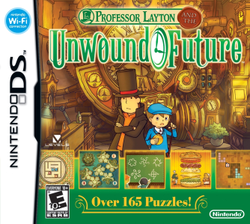

There are games that court your attention like a polite guest and games that simply move into your sitting room, arrange the cushions and never quite leave. Professor Layton and the Unwound Future belongs to the latter, though it wears a tweed jacket and insists on offering tea before it rearranges the drapes. Released as the third entry and the trilogy-closer in Level-5's original Professor Layton sequence, Unwound Future (branded Lost Future in Europe) is an exercise in calm craft: a point-and-tap adventure stitched together from precise puzzles, an understated narrative, and a presentation that makes the Dual Screen feel less like a novelty and more like a set of calling cards for good design. If you expected explosions and fistfights, this is not the cartridge for you; if you hoped for a mystery that respects your patience and your intellect, read on. From a 1990s reviewer's perch - an age when cartridges came with manuals thicker than some modern rulebooks - Unwound Future is pleasantly old-fashioned in its economy. It borrows the drawn, storybook charm of its predecessors while turning the screw on the emotional stakes. The premise is uncommonly theatrical for a portable puzzle game: a time-machine demonstration goes wrong, a future London appears to be both familiar and hostile, and a ten-years-older Luke arrives with a problem that is as personal as it is puzzling. The creators sidestep bombast in favour of atmosphere; the result is a game that feels like a serialized mystery from a bygone magazine, only with touchscreen heuristics.
Mechanically, Professor Layton and the Unwound Future does what it does with enviable clarity. The player navigates still-image locations, tapping suspects, storefronts and peculiar details on the touchscreen to trigger conversations and, crucially, puzzles. The fundamental loop is simple and reliable: explore, inspect, talk, puzzle. The puzzles themselves run a familiar and rewarding gamut - visual conundrums, logic grids, arithmetic teasers and spatial riddles - each presented cleanly on the DS's lower display while instructions and atmospheric illustration live above. There is no timer, no leaderboard stress, only a system that rewards careful thought and penalizes flippant guessing with a reduction in "Picarats," the currency awarded for correct solutions. Level-5 refined its hint economy in this instalment. Players hunt for hint coins hidden around scenes, and three-tier hint options can be purchased with these coins. A new addition, the "super hint," charges two coins and appears only after the three standard hints have been used; it comes perilously close to handing you the answer and is a welcome safety valve for the occasional brick wall. The presence of a graded hint system keeps the puzzles accessible without dulling their teeth: you can feel clever and still accept help when a particularly barbed brainteaser refuses to budge. Beyond the single-puzzle rewards, Unwound Future includes a pleasing array of side amusements, collected under the in-game repositories known as Layton's Trunk and Layton's Bag. These house three mini-games - a sticker-book placement game, a parrot-training rope puzzle and a toy-car tile-navigation challenge - that convert the main game's intellectual tone into something more tactile and whimsical. Successfully completing mini-games and collecting Picarats unlocks bonus puzzles, and when you clear the entire set you are granted a final, fiendish capstone. The DS's dual-screen setup is used judiciously; puzzles are interactive without feeling gimmicky, and the stylus handling remains precise throughout. The narrative propelling this mechanical scaffolding is not decorative window-dressing. Unwound Future delivers about 32 minutes of full-motion video stitched into the story, an unusual flourish that heightens the game's cinematic ambitions. The plot starts with a failed time-machine demonstration and segues into a faux-future London - a quasi-steampunk tableau - where an older Luke begs Layton to avert a dark destiny. The tale is a tidy three-act riddle filled with identity swaps, betrayals and a small constellation of characters whose motives are discoverable through both deduction and observation. Without spoiling the more moving beats, it is fair to say that Level-5 trades the series' comfortable eccentricity for a more melancholy register here. The relationship between Layton and Luke receives genuine attention; emotional payoffs are earned rather than manufactured. For collectors of additional content, a caveat: Unwound Future supported weekly downloadable puzzles via Nintendo Wi-Fi Connection for thirty weeks post-release, but that service was terminated in May 2014. Those puzzles are, therefore, effectively lost to newcomers unless they were downloaded in the game's lifetime. That loss is a shame but not a fatal flaw: the game ships with abundant content and unlockable bonuses that will keep a thoughtful player occupied for many hours.
Graphically the game is a polite argument in favour of good art direction over horsepower. The DS cannot compete with home consoles of the era in polygonal muscle, yet Unwound Future uses its still-image backdrops and character portraits to splendid effect. Environments are richly lettered and textured in a storybook aesthetic; London feels lived-in whether portrayed in the game's present day or its fabricated future. The designers lean on lighting, silhouette and careful framing to build atmosphere - Chinatown's lanterned alleys and the towering pagoda are small tableaux that reward investigation. The most conspicuous graphical flourish is the game's use of full-motion video for narrative highlights. Roughly half an hour of FMV is integrated with the static scenes, and while the DS's video fidelity is modest, the sequences deliver emotional punctuation where it matters. The pseudo-steampunk future is composed of layered set pieces: brass fittings, fog-choked streets and an air of theatrical engineering. Character sprites retain the series' trademark caricature - long noses, expressive eyes, and an almost theatrical stillness that lodges well against the voiced (and subtitled) drama. Composer Tomohito Nishiura's score complements the visuals with gentle themes that range from jaunty puzzle motifs to more somber passages accompanying the story's heavier moments. The original Japanese release features a vocal ending, "Time Travel," sung by Ann Sally; international releases use an instrumental version. On the DS, the soundtrack's clarity and melodic economy do the job well: it's unobtrusive where required and memorably plaintive when the story leans toward the tragic. If there is a graphical limitation to mention, it is not an oversight but an architectural decision: the game prefers presentation and character to lavish animation. For a player who demands high-frame spectacle, the still-image method will read as conservative. For anyone who prizes composition, pacing and a clear visual vocabulary, it reads as integrity.
Professor Layton and the Unwound Future is an exercise in disciplined charm and emotional restraint. It takes the formula that made the series a quiet success - impeccably designed puzzles, a cast of eccentric characters, and a tasteful visual sensibility - and tightens the screws until the emotional core begins to hum. Critics of the era were nearly unanimous in their praise: the aggregate reception skews highly (Metacritic around the mid-80s), and outlets from Nintendo Power to The Guardian awarded it strong marks and end-of-year recognition. Such approval is not merely bandwagon sentiment; Unwound Future delivers on the things it promises and, occasionally, on things the promise never mentioned: a genuinely affecting story arc and a set of puzzles that respect the player's time and intelligence. This is a game designed for the patient and the curious. It will not satisfy those who equate "fun" with explosions per minute, but it will reward anyone who prefers a slow-burning mystery, elegant problem design and small theatrical moments of revelation. Sales figures and awards attest to its broad appeal, but the real success is quieter: Level-5 created a portable game that behaves like a well-written paperback detective novel - one you can dip into on a commuter train and still feel as if you've been to the theatre. On a personal ledger, it earns a high recommendation. If you own a Nintendo DS and have not yet met Professor Layton's patient wit, Unwound Future is where the trilogy's momentum comes into focus. For a reviewer raised on a diet of cartridge labels and ink-stained press releases, this is the sort of portable game that restores one's faith in small-scale ambition. Keep your hint coins at the ready, but try to solve it under your own steam; that is where the pleasure lies.
 Crash Bandicoot: The Wrath of Cortex on PS2
 MLB The Show 22 on Switch
 Tintin: Destination Adventure on PlayStation
 One Piece Grand Adventure on PS2
 Professor Layton and the Last Specter on DS
 Puzzle by Nikoli 4: on PS4












 Another SquareThought Site